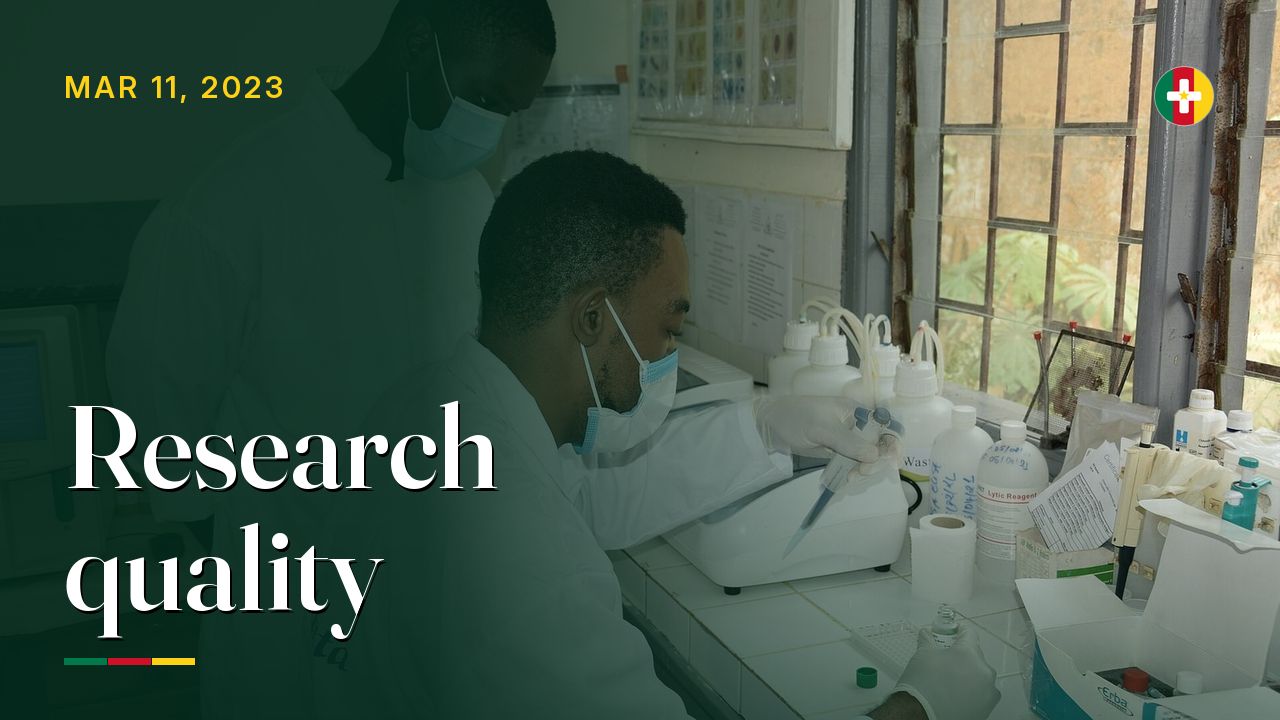
Raising the Quality of Medical Research in Cameroon
Overview
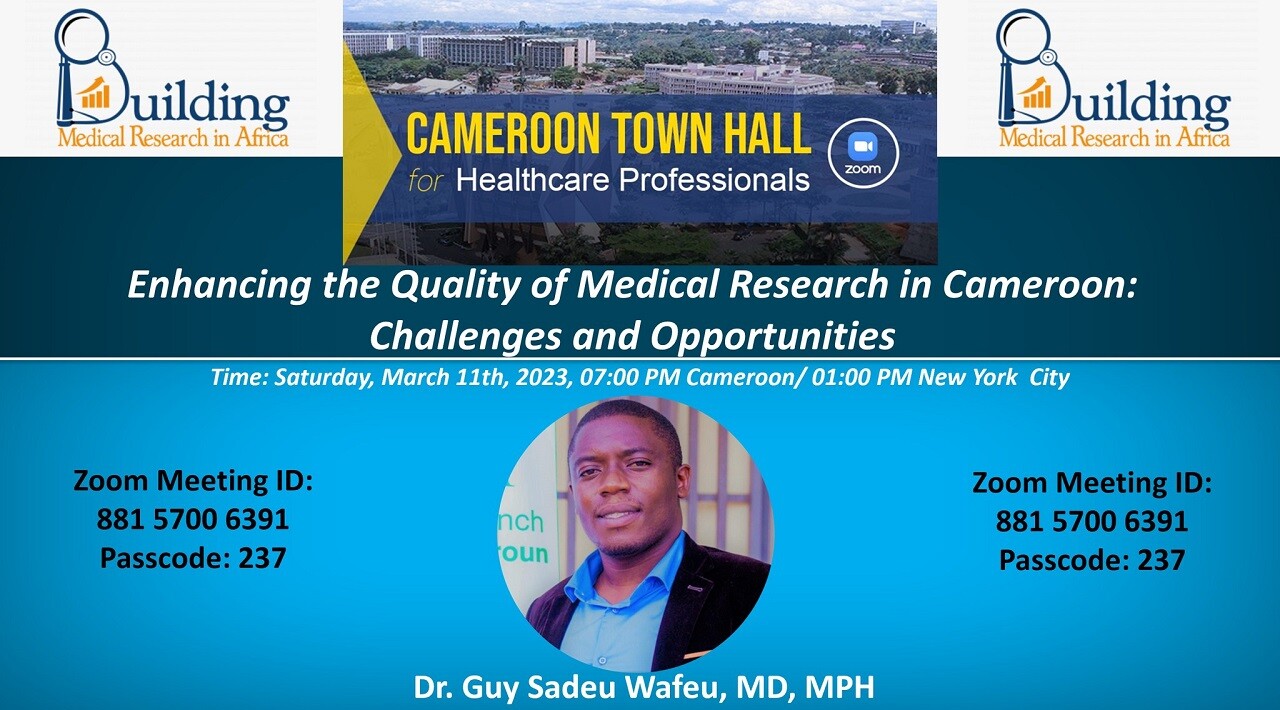
This policy briefing synthesizes key insights from the Cameroon Townhall for Healthcare Professionals meeting held on March 11, 2023, focusing on the theme "Enhancing the Quality of Medical Research in Cameroon: Challenges and Opportunities", presented by Dr. Guy Sadeu Wafeu, coordinator of Building Medical Research in Africa.
Context
Most medical research in Cameroon is produced through student theses, supervised by clinicians who are often not trained in research methods, and funded largely from abroad. Participants from Cameroon and the diaspora described low publication rates, weak biostatistics capacity, slow paper-based ethics review and institutions that discourage grants.
Key issues
- Weak research training and supervision. Students and some supervisors lack grounding in methods and biostatistics; theses are often unpublishable.
- Low publication and integrity concerns. Myths that a professor must co-author, misplaced authorship, and promotion systems that do not reward quality discourage good publishing.
- Funding and institutional barriers. Research relies on external funders whose priorities may differ, while university bureaucracy can block or divert grants.
- Research that does not inform practice. National guidelines can rest on small studies, and hospital-based findings are sometimes generalised to the population.
- Fragmented governance. Higher education and scientific research sit in separate ministries.
Discussion highlights
- The University of Buea's protocol panels, seminars and pre-defence were cited as a model for thesis quality.
- Bringing statisticians in at the design stage, not after data collection, was stressed.
- A rural district hospital study of neonatal sepsis showed how clinicians can use research skills locally.
- Digital ethics submission and a protocol review service with trial planning grants were announced for Cameroon.
Recommendations
- Reform thesis supervision. Medical and health faculties should adopt protocol review panels, seminars and a pre-defence for all theses, as in Buea, and teach research methods and biostatistics from the fourth year. A first step is a joint deans' meeting to agree common standards.
- Train supervisors and support publication. Faculties, with Cochrane Cameroon and diaspora partners, should run regular scientific writing and statistics courses for lecturers and students, with clear authorship rules based on contribution.
- Remove barriers to grants. University leadership should adopt transparent grant management rules that release funds as budgeted to investigators and recognise externally funded research in promotion.
- Fund national priorities. MINSANTE and the Ministry of Scientific Research should create a small competitive fund for community-based studies on priority problems such as maternal and neonatal mortality, and link it to guideline development.
- Digitise ethics review. The National Ethics Committee should complete online submission and review, building on the grant announced.
- Share opportunities. The town hall and diaspora associations such as CamDoc UK should maintain a shared list of funding, mentorship and exchange opportunities for Cameroonian researchers and make full use of existing university agreements.
Next steps
The next session (March 25, 2023) would continue the theme with implementation science. A dedicated session on the DAC protocol review service was planned after its launch in May, and the speaker and participants agreed to collaborate on a platform listing funding opportunities.
Conclusion
Cameroon has capable researchers at home and abroad, but weak institutions limit the quality and use of research. Stronger supervision, transparent grant management, early involvement of statisticians and shared opportunities could raise the quality of work and its value for policy.
Meeting minutes
Agenda
- Welcome and opening remarks by the lead moderator, Dr. Katte Jean-Claude, and the Chair
- Introduction of the speaker
- Presentation by Dr. Guy Sadeu Wafeu on "Enhancing the Quality of Medical Research in Cameroon: Challenges and Opportunities"
- Discussion and Q&A
- Closing remarks and parking lot
Opening remarks
- The lead moderator welcomed participants from the US, Europe, Africa and Cameroon to a session on improving medical research in Cameroon.
- Dr. Tegomoh said COVID-19 had shown how critical research is, and recalled the speaker as a mentor who helped many medical students with their theses and statistical analysis.
- The Chair said the speaker had been strongly recommended by his peers and that the session was bilingual, with participants free to speak in English or French. He recalled struggling as a final-year medical student to design and fund his own research.
Presentation
1. The speaker's work with students
Dr. Wafeu said he had left clinical practice to concentrate on research. Since 2016 he has coordinated Building Medical Research in Africa, which supports medical students with research design, protocols and statistical analysis, and he works on neglected tropical diseases, cardiovascular and neurological disease.
2. Challenges identified
As summarised by Dr. Tegomoh, the presentation identified weak research capacity and training, a serious lack of biostatistics skills, an inefficient ethics review environment, and funding that comes mostly from outside the country, with little ownership of research by government.
3. Quality of theses and publication
In discussion he said many teachers cannot themselves draft a paper or master research methods, so neither students nor supervisors fully understand methodology. Some MD theses are of such low quality that they cannot be published, and many students wrongly believe a paper must carry a professor's name.
4. Opportunities
He proposed a parallel route to change through free online training, including a planned online course in statistical analysis, since a biostatistics master's in Cameroon costs several million FCFA. His group planned a scientific writing workshop at the end of the year aiming for at least 80 percent of participants to publish. He also called for advocacy, often through informal conversations, by those with access to decision makers.
Discussion and Q&A
- Participants gave first impressions, including a consultant in Saint Lucia (MD, MPH) and a classmate of the speaker studying biostatistics and epidemiology at Oxford. The classmate said the challenges presented matched his own experience of research in Cameroon.
- Dr. Tegomoh asked how government and public institutions could be brought to take ownership of research and finance work on local needs. Dr. Wafeu said advocacy is the most important lever, especially by people with influence, since many in public service take decisions without considering research evidence.
- The Chair asked how training of young researchers in medicine, nursing and the sciences could be scaled up so that their work informs policy. Dr. Wafeu said change may need to come from a parallel system outside institutions, chiefly online training on free platforms specific to Cameroon's health sector, and that trained students can themselves change their teachers' practice.
- Elvis Ndansi commented on careers, ethics and funding. Elvis Ndansi said clinical research careers need stable employment beyond the first grant, and offered funding from his foundation for a student to study medication errors in Cameroon. Having served on an ethics committee, Elvis Ndansi said a Bill & Melinda Gates Foundation grant would help digitise ethics submission, which was still paper-based. Elvis Ndansi added that some universities repel grants through bureaucracy and by treating research funds as free money, which keeps them low in African rankings.
- A participant who had attended an exchange in Uganda asked why Cameroonian master's and PhD students graduate without publications when in Uganda publications are a condition of admission. Dr. Wafeu pointed to teachers' limited writing skills, the low quality of some studies and myths about publishing. Dr. Joshua Tambe, a radiologist and University of Buea lecturer, said many clinical professors published mainly case reports in local journals and had never corresponded with major journals, that promotion does not reward research quality, and that some leaders obstruct large grants. Dr. Katte noted that East Africa's research ecosystem rests on institutions built over decades.
- A former student said the speaker's corrections transformed his thesis protocol, and called for research basics to be taught to every clinician. The previous session's presenter asked how research on conditions in people who never reach hospital, such as early chronic kidney disease, is done without electronic records. Dr. Wafeu said community-based research depends on funding, such as the community trial on loiasis he worked on, while most hospital studies are student theses. The Chair said hospital-based findings should not be generalised: an early 11 percent HIV prevalence for Cameroon came from antenatal clinic data, while the true figure was much lower. Dr. Katte said all types of research are needed.
- Dr. Judwin Ndzo raised research integrity (a lecturer listed himself first on her thesis paper), asked how theses can be translated into practice, and asked about diaspora collaboration. Dr. Ndzo said Cameroon's neonatal sepsis guidelines rested on a small, low-powered 2013 study, and urged audits, guidelines and a focus on maternal and neonatal mortality. Dr. Katte listed exchange programmes (Fulbright, DAAD, programmes with Japan and India, the African Academy of Sciences) and said they are competitive. Dr. Wafeu proposed a platform listing funding and training opportunities. A participant noted that the minister had issued a memorandum on how the ministry will work with diaspora platforms.
- A medical school lecturer in anatomy, studying for a master's in Belgium, said separating the ministries of higher education and scientific research is a problem, and that research methods should be taught from the fourth year. The lecturer said more lecturers were taking MPH and epidemiology degrees to supervise students better. The speaker's Oxford classmate urged a research agenda aimed at impact, mentoring of young researchers, multidisciplinary teams and confidence to lead; A participant from the University of Calgary proposed requiring one publication before thesis work and offered to build a website listing grants for African researchers, which Dr. Wafeu welcomed.
- The director of a district hospital in the North West and a regional focal point of Building Medical Research in Africa, described applying research skills in a rural hospital. About 7 in 10 newborns in his hospital developed fever on day two or three. Staff attributed this to visitors carrying babies and posted notices, but with no evidence, so he designed a questionnaire study of mothers to find the real causes. He said empowering young clinicians with research skills improves care in rural areas.
- Dr. Tambe gave closing comments. Dr. Tambe said Cameroon has great researchers but weak institutions. At the University of Buea, students present protocols to a faculty panel, give seminars and pass a pre-defence before the final thesis defence. Dr. Tambe stressed bringing statisticians in from the start: a statistician brought in at the end performs an autopsy.
Calls to action and closing
- Elvis Ndansi announced a protocol review service and trial planning grants (Design, Analyze and Communicate) to be hosted in Cameroon at the Clinton Health Access Initiative and launched in May, with a dedicated town hall session to follow.
- The Chair thanked the speaker, urged members to try ChatGPT while noting its errors, and said research should aim to change policy, not only to be published.
- The next session, in two weeks, was announced.
- Participants moved to the parking lot.
Next meeting
In two weeks (March 25, 2023): Challenges and Opportunities in the Practice of Implementation Science in Cameroon, with Dr. Ferdinand C. Mukumbang.
Submitted by the Co-Moderators, Cameroon Town Hall for Healthcare Professionals.