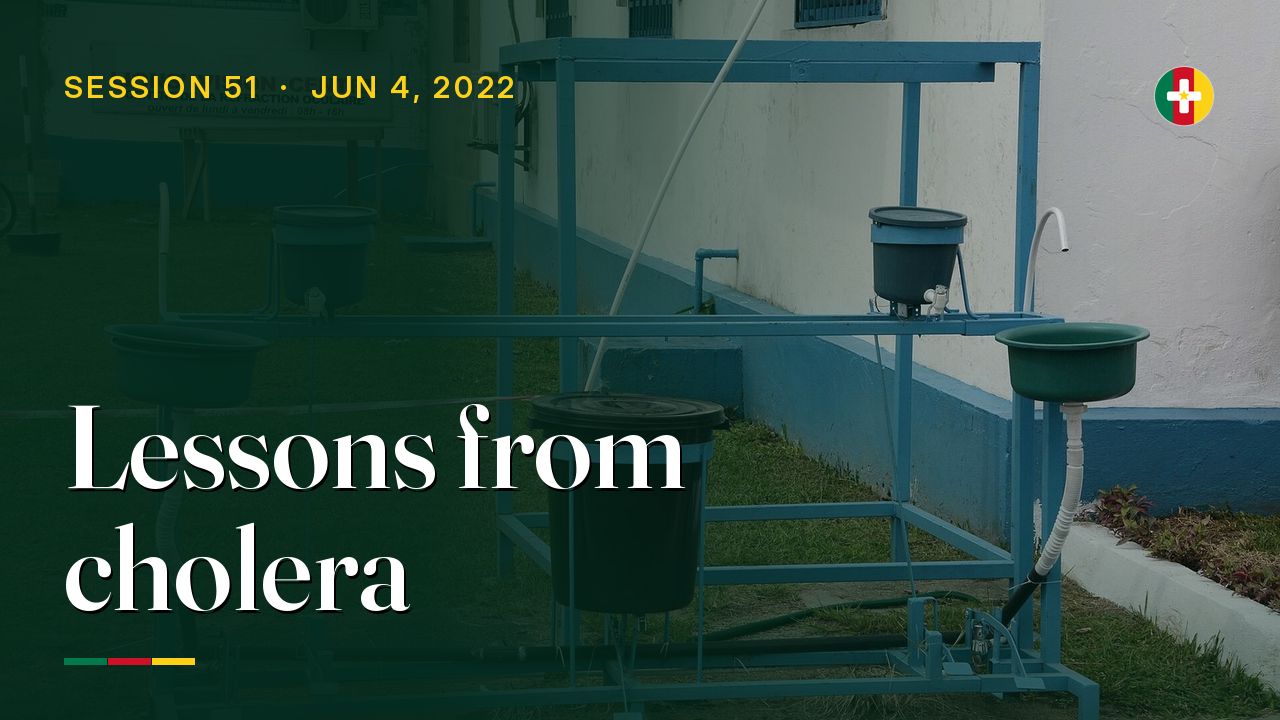
Ending Recurrent Cholera in Cameroon: Lessons from the 2021 to 2022 Outbreak
Overview
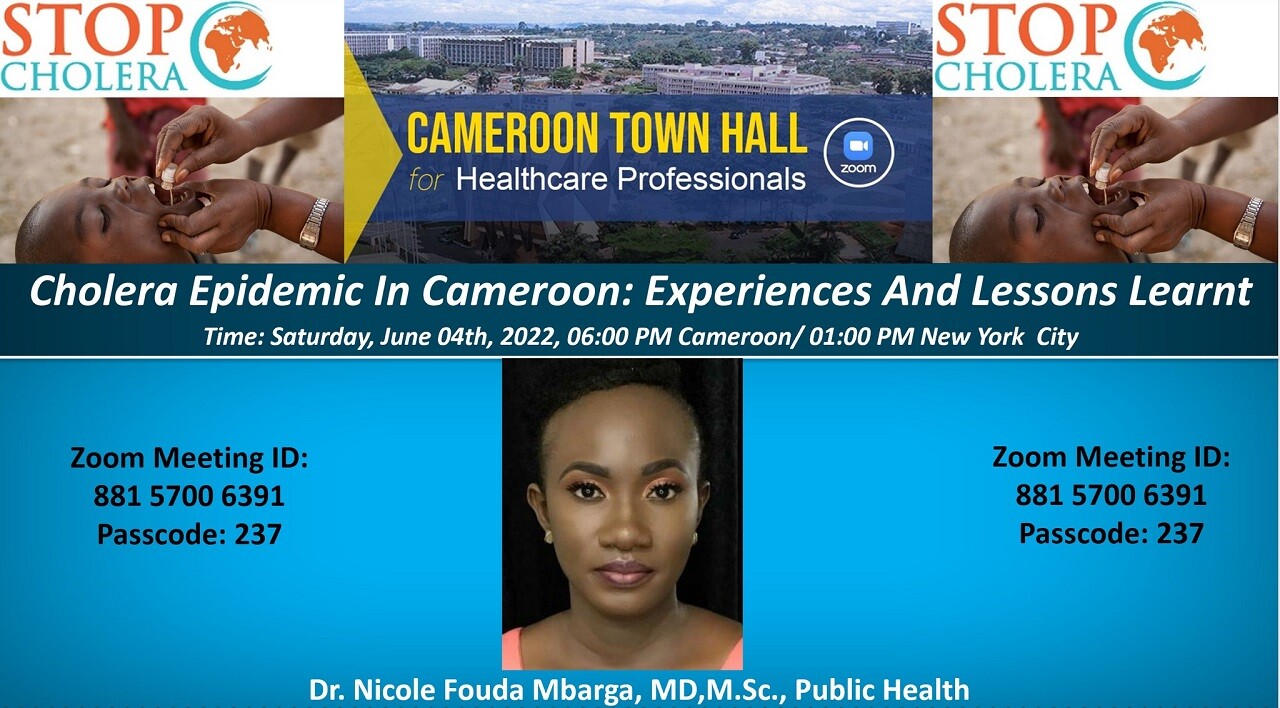
This policy briefing synthesizes key insights from the Cameroon Townhall for Healthcare Professionals meeting held on June 4, 2022 (51st edition), focusing on the theme "Cholera Epidemic in Cameroon: Experiences and Lessons Learnt", presented by Dr. Nicole Fouda Mbarga of WHO Cameroon, with contributions from the South West Regional Delegate of Public Health.
Context
Cholera has been endemic in Cameroon since 1971 and has recurred every year since 2018. The outbreak declared in October 2021 had reached 31 districts in seven regions, with 8,135 suspected cases and 151 deaths by the time of the session, more than 75 percent of cases in the South West. The response was led by the Ministry of Public Health with WHO, UNICEF and MSF, while the root causes, unsafe water and poor sanitation, sit with other sectors.
Key issues
- Root causes outside the health sector. Unsafe water, open defecation, septic tanks draining into streams and businesses without toilets drive transmission, but water, housing, commerce and councils were largely absent from the response.
- Hard-to-reach and cross-border areas. Island districts near Nigeria start outbreaks, lack laboratories and are costly to reach, and cross-border coordination with Nigeria has been limited.
- Laboratory confirmation. Only 5.9 percent of suspected cases were culture-confirmed, and the South West initially had no confirmation laboratory.
- Unsustained response funding. In Limbe, cases fell to zero under a well-run treatment centre, then rose again when funds ran out. Staff incentives promised had not been paid, and volunteers lacked basic equipment.
- Overstretched teams. The same staff were managing COVID-19, yellow fever, polio and the Africa Cup of Nations alongside cholera.
Discussion highlights
- Participants agreed that cholera is a marker of poverty and cannot be eliminated by the health ministry alone.
- Oral cholera vaccine coverage rose from under 60 percent in 2020 to about 89 percent after better communication.
- FETP-trained field epidemiologists were running much of the regional response.
- Hotspot mapping using the Global Task Force method had just been completed, a first step toward elimination by 2030.
- The town hall pledged 1,000,000 FCFA to recognise the Limbe treatment centre staff.
Recommendations
- Launch a multisectoral elimination plan. The Prime Minister's office, with MINSANTE as technical lead, should adopt the national cholera elimination plan with budgeted roles for the ministries of water and energy, housing and urban planning, commerce, education and transport and for councils. The planned high-level advocacy meeting is the first step.
- Invest first in mapped hotspots. Government and partners should direct water, sanitation and preventive vaccination to the priority hotspot districts year by year, starting with maritime districts of the South West and the Littoral.
- Enforce sanitation standards. Councils and line ministries should require working toilets and water in new buildings, markets, bars, schools, motor parks and travel agencies, ending administrative tolerance of non-compliance.
- Strengthen confirmation and early detection. MINSANTE should extend cholera culture to all ten regions, pre-position WHO-endorsed rapid tests at district level, and support the University of Buea laboratory as the South West reference.
- Formalise cross-border coordination with Nigeria. MINSANTE and regional delegations should hold regular cross-border meetings with Nigerian counterparts on surveillance data sharing and synchronised vaccination in border and maritime districts.
- Protect response staff and community workers. MINSANTE should pay promised incentives to treatment centre staff, and partners should equip community health workers (transport, boots, raincoats, megaphones). Diaspora groups can support this directly.
Next steps
The town hall committed to send 1,000,000 FCFA within two weeks to recognise the staff of the Limbe cholera treatment centre, and the Chair was to follow up with the regional delegate. The national high-level advocacy meeting on cholera elimination was expected the following month.
Conclusion
Cameroon's 2021 to 2022 outbreak showed that a determined health response can bring cases down, but not keep them down while water and sanitation remain inadequate. Elimination by 2030 depends on other sectors acting, on vaccination as a bridge and on steady support for frontline staff.
Meeting minutes
Agenda
- Welcome and opening remarks by the lead moderator, Elvis Ndansi
- COVID-19 and monkeypox update by the Chair, Dr. Munoh Kenne Foma
- Presentation by Dr. Nicole Fouda Mbarga on "Cholera Epidemic in Cameroon: Experiences and Lessons Learnt"
- Discussion and Q&A, including remarks by the South West Regional Delegate of Public Health
- Closing remarks and next meeting
Opening remarks
- The lead moderator opened the 51st edition, noting more than 1,245 registered members in more than 34 countries and that the town hall was nearing its third year.
- The Chair, joining from hospital duty, said he disliked seeing those in the diaspora belittle colleagues at home who work with very few resources.
- In his COVID-19 update he reported BA.2.12.1, BA.4 and BA.5 as dominant, falling deaths despite steady case numbers, and about 12 billion vaccine doses given worldwide. Cameroon had recorded about 200 new cases and three deaths in two weeks, with vaccination still low. He reviewed mRNA platforms now in trials for other diseases and cancers, and the treatments available for COVID-19.
- He noted that Cameroon sits at the junction of the West African and Central African monkeypox clades and has reported locally acquired cases. The lead moderator welcomed his use of images showing that monkeypox affects people of all skin colours.
Presentation
1. Cholera and the global goal
Dr. Fouda Mbarga described cholera as an acute diarrhoeal disease caused by Vibrio cholerae, spread through contaminated water and food, with a case fatality rate that should stay below 1 percent where treatment is good. WHO estimates 1 to 4 million cases and 21,000 to 143,000 deaths a year, mostly in Africa, reflecting poverty and low investment in water, sanitation and hygiene. The Global Task Force on Cholera Control's 2017 strategy targets 47 countries, including Cameroon, to reduce cholera deaths by 90 percent.
2. History in Cameroon
Cholera has been present in Cameroon since 1971 and is endemic, with recurring outbreaks shared with neighbouring countries. The worst outbreak, in 2011, caused more than 23,000 cases and more than 800 deaths. Outbreaks decreased between 2014 and 2017 but have recurred every year since 2018. The current outbreak was declared in late October 2021.
3. The current outbreak
Using the national situation report, she said 31 districts in seven regions (South West, Littoral, South, Centre, West, Far North and North) had been affected, with 18 districts in four regions still active. There were 8,135 suspected cases, 461 confirmed by culture (5.9 percent, against a WHO standard she gave as at least 8 percent) and 151 deaths, a case fatality rate of 1.9 percent, down from about 15 percent early on in Bakassi. The South West, the epicentre, reported 5,533 cases, more than 75 percent of the total. Cases peaked around epidemiological week 12 of 2022. The median age was 25, most cases were aged 21 to 30, and 32 percent were severe.
4. Risk factors
Drivers included limited access to safe water (people fetching water from streams where others defecate), inadequate sanitation, seasonal patterns, and humanitarian crises in the North West, South West and Far North and among refugees from the Central African Republic in the East. Cross-border spread from Nigeria, which had a severe outbreak the year before, was important: the index case in the South West was a Nigerian fisherman. She showed a water source in the Biyem-Assi district of Yaoundé next to a waste dump.
5. The public health response
National and regional incident management systems were activated, with regular partner meetings, a response plan and advocacy. Cholera kits were provided, treatment centres set up, rapid response teams deployed and active case finding strengthened. A first round of oral cholera vaccination covered 15 health districts in the South West, Littoral and South, and an affected prison received vaccination and mass chemoprophylaxis. Homes were disinfected, communities trained on hand washing and water treatment, some water sources improved, and water was trucked to Bakassi, which she said is costly and not sustainable.
6. Challenges
She listed insecurity in the English-speaking regions, an outbreak spread over seven regions, the same staff handling yellow fever, polio and COVID-19, new hotspots such as the West with little experience of cholera, and weak multisectoral collaboration, since the Ministry of Public Health was acting almost alone while the main causes lie with water and sanitation. Other gaps were low investment in water and sanitation, too few staff, weak community engagement, limited vaccine stocks and limited funding.
7. Plans for elimination
Cameroon was developing a national cholera plan with the goal of elimination by 2030. Planned steps included a high-level advocacy meeting led by the Prime Minister's office to bring other sectors on board, resource mobilisation, research including genomics, investment in water and sanitation, preventive vaccination (two doses protect for three to five years, buying time for infrastructure) and training of emergency medical and rapid response teams. In the Q&A she added that the country had just mapped and prioritised its cholera hotspots using the Global Task Force method, so that investment can start in priority districts.
Discussion and Q&A
- A nurse with an interest in infection prevention and WASH said public health had lost ground since the days when sanitary inspectors checked every compound for a toilet, that councils responsible for hygiene were not acting, and that the response started late, with messages in French that communities did not understand. Dr. Fouda Mbarga said the outbreak began while the country was preparing to host the Africa Cup of Nations, with the same teams managing several emergencies. It started in island districts such as Bakassi and Mundemba, where transport, telecommunications and data were difficult, boat trips could cost about 300,000 FCFA, and the South West had no laboratory able to confirm cholera, so samples went to the Littoral. She said the local response was not as late as it appeared from outside.
- A participant asked why people aged 21 to 30 were most affected. Dr. Fouda Mbarga offered hypotheses (a young population, working-age exposure, fishermen) and said research was needed. Dr. Tegomoh added that outbreak investigators report what they observe, and that analytical studies are needed to identify causes.
- Dr. Judwin Ndzo (paediatrician, UK) asked whether there is a long-term plan and budget for toilets and safe water, or whether the country waits for the next outbreak. Dr. Fouda Mbarga said the Ministry of Public Health can stop deaths but cannot build toilets and water systems alone; it was working with the Prime Minister's office on an advocacy process to make other sectors take responsibility. She added that mayors, councillors and governors also have a role. Elvis Ndansi said ministries of housing and urban planning, commerce, education and transport should require toilets and running water in new buildings, businesses, schools and travel agencies.
- A participant asked about case-area targeted interventions (CATI) used in Kribi and whether they could eliminate cholera. She explained that CATI delivers a package (health promotion, WASH, vaccination, risk communication and sometimes chemoprophylaxis) within about 150 to 250 metres of each case. It worked in Kribi as a complement to other measures and in the DRC and Nigeria, but Gavi's vaccine mechanism favours mass campaigns and limits doses for CATI, and it needs funding and staff. CATI works best at the start or end of an outbreak; she said it could contain the new outbreak in the West, while the Littoral, with more than seven districts affected, needs other strategies too.
- A participant from the Treatment Action Group in New York, a student, a public health physician with UNICEF Cameroon and a participant from Health Canada commented that the Ministry of Health cannot work in silos, asked what individuals can do, and said the response is reactive rather than proactive. Dr. Ivo Ditah said cholera is a marker of poverty: telling people to drink clean water when they have none is cosmetic, so mass vaccination is the realistic tool for now. The Chair said hygiene and sanitation, then vaccination and antibiotics, did most to raise human survival, and noted that a neighbourhood in central Bamenda had gone more than five years without piped water until residents drilled a borehole.
- The South West Regional Delegate of Public Health, Dr. Eko Eko Filbert, was invited to speak. He said the region's maritime districts, where 60 to 70 percent of residents are Nigerian and move across the border, usually start outbreaks, and that people there live in temporary structures without toilets. On the mainland, septic tanks empty into streams used for drinking. He estimated the health ministry can do at most 40 to 50 percent of what is needed, which is why the governor coordinates the response. For now he urged simple measures: hand hygiene, mass immunisation and treating water by boiling or Aquatabs. He also criticised the administrative tolerance that lets businesses operate without toilets.
- Dr. Eko described the Limbe response. Limbe, Tiko and Buea were the three epicentres. In Limbe the treatment centre was walled off from the public, with more than 230 patients and about 80 to 90 staff fed on site and all care free, while community health workers disinfected homes. Cases fell to zero, then rose again to more than 100 when funds ran out and the centre reopened to the public. WHO and UNICEF were the main partners. The minister had promised financial motivation for the staff, but it had not been paid two months after the names were sent. Elvis Ndansi pledged, with the Chair's agreement, that the town hall would raise 1,000,000 FCFA for those staff within two weeks.
- A participant working with the UN migration agency in the DRC raised vaccine hesitancy after COVID-19, cross-border coordination with Nigeria (including synchronised vaccination, as was done for Ebola in East Africa), OCHA's pilot of pre-agreed cholera anticipatory funding, persistence of Vibrio in brackish water, and the timing of CATI. Dr. Fouda Mbarga said oral cholera vaccine coverage was under 60 percent in 2020 but about 89 percent in the latest campaign, after more communication on the vaccine. Cross-border meetings with Nigeria had been only local, and she felt Central Africa receives less attention than West Africa. Dr. Eko said CATI had worked in districts where response was prompt, but that in Limbe and Buea the response slowed when MSF, which had led in the maritime districts, had administrative problems with the government.
- Dr. Tegomoh asked how field epidemiologists from Cameroon's FETP are used in outbreak response. Dr. Fouda Mbarga said FETP trainees and alumni are at the forefront of investigations and rapid response teams, though not enough. A field epidemiologist from the West region and a staff member of the South West delegation said their regional responses were largely run by FETP frontline alumni. He added that MSF had shut down operations in the region, that community health workers need transport, boots, raincoats and megaphones, and that unpaid volunteers were losing morale.
- A senior field epidemiologist from the South West called for operational research, and a nurse from Bamenda warned that uncollected waste and water shortages put Bamenda at risk of becoming the next hotspot. Dr. Fouda Mbarga said hotspot mapping had identified priority health districts in every region, including the North West because of the humanitarian situation, and would guide year-by-year investment.
- Elvis Ndansi asked how diagnosis could be improved for earlier detection. Dr. Kenji said culture remains the gold standard and should be available in all ten regions; WHO-endorsed rapid tests can be used for first-line screening, with culture confirmation before declaring an outbreak. Dr. Fouda Mbarga said about five laboratories confirm cholera, rapid tests are pre-positioned in regions and districts, and the University of Buea's emerging infectious diseases laboratory can now confirm cases. Dr. Fai reported that Epicentre's evaluation of three rapid tests found good performance but no gain from enrichment in alkaline peptone water; Dr. Kenji explained that enrichment helps culture but does not raise antigen levels for rapid tests.
Calls to action and closing
- Dr. Tegomoh thanked the speaker and the regional delegate and offered the town hall's expertise to the region.
- The Chair thanked the moderators and Dr. Fouda Mbarga, and praised Dr. Eko for speaking openly, saying more delegates like him would move health care forward.
- The lead moderator summarised that elimination requires inter-ministerial and intersectoral action on root causes, with immunisation as a bridge, and stressed that the town hall is apolitical.
- Next session announced for two weeks later.
Next meeting
In a fortnight (June 18, 2022 expected); topic not announced.
Submitted by the Co-Moderators, Cameroon Town Hall for Healthcare Professionals.