Ionizing Radiation Use in Medical Imaging in Cameroon
Overview
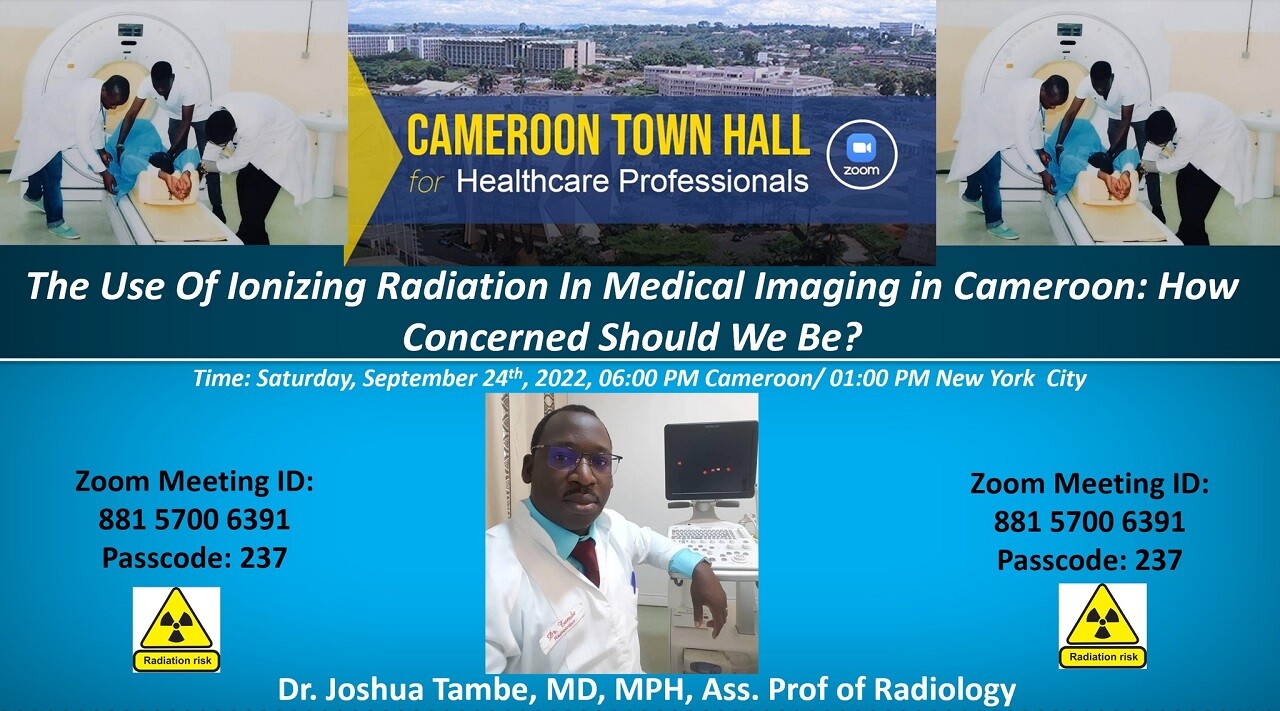
This policy briefing synthesizes key insights from the 59th edition of the Cameroon Town Hall for Healthcare Professionals, held on September 24, 2022, focusing on the theme 'Ionizing Radiation Use in Medical Imaging in Cameroon: How Concerned Should We Be?', presented by Dr. Joshua Tambe, radiologist and head of medical imaging at Regional Hospital Limbe.
Context
Access to CT and X-ray equipment is growing in Cameroon, often through second hand machines. Medical imaging now rivals natural sources as a source of radiation exposure, and radiation induced cancers have no safe threshold. Many facilities lack proper shielding, trained staff and dosimetry, requests are not vetted by radiologists, and the National Radiation Protection Agency has limited reach.
Key issues
- Unnecessary and inappropriate imaging. Requests are made without clinical justification, often for financial reasons, self referral or unfamiliarity with guidelines, and patients pay before radiologists see the request.
- Equipment and facility standards. Second hand equipment without quality control and rooms without proper shielding expose patients, staff and neighbours.
- Staff training and protection. Many radiographers are trained only on the job, and many staff work without personal dosimeters.
- Weak regulation. The National Radiation Protection Agency includes no radiologists, cannot sanction public facilities, and its fees and penalties discourage registration.
- Vulnerable groups. Pregnant women, women of reproductive age and children face higher risk from avoidable exposures.
Discussion highlights
- Radiologists should vet and, where needed, change requests before CT and special X-rays.
- Appropriateness guidelines exist (ACR, Royal College of Radiologists, iRefer) and can be adapted locally.
- Dosimetry exists in some facilities (Mbingo) but is unaffordable or unavailable in others (Limbe, Bamenda).
- Accreditation is desirable but hard to enforce where the only scanner is old.
- Disposal of radioactive sources and dead machines is an open question.
Recommendations
- Introduce radiologist vetting of high dose requests. MINSANTE and hospital managers should require radiologist approval of CT, fluoroscopy and special X-ray requests before payment, starting in regional and referral hospitals, and require clinical history on every request form.
- Adopt national imaging referral guidelines. The Cameroonian Society of Radiology and Radiation Oncology, with MINSANTE, should adapt international appropriateness criteria (ACR, iRefer) into national referral guidelines and teach them in medical and nursing schools.
- Make staff dosimetry affordable. The National Radiation Protection Agency should revise its contracts to remove punitive penalties, set affordable fees, and ensure every imaging worker has a dosimeter read regularly; radiologists should sit on the agency's technical bodies.
- Set and inspect facility standards. The agency and MINSANTE should register all imaging facilities, inspect shielding and equipment quality, and require quality control and maintenance plans for imported second hand equipment.
- Train imaging staff in radiation protection. Training schools and hospitals should provide formal radiation protection training for radiographers and require continuing professional development for imaging staff.
- Plan for radioactive waste. The agency should publish procedures for disposal of radiopharmaceuticals, radioactive sources and decommissioned equipment.
Next steps
The moderators planned a future session on radiopharmaceuticals and nuclear medicine. Participants agreed to continue the discussion on the agency's dosimetry contracts in the parking lot.
Conclusion
Imaging saves lives, and for most studies the risk is small, but it is never zero and it adds up across a population. Vetting requests, using guidelines, protecting staff and enforcing standards would let Cameroon gain the benefits of new imaging equipment while limiting avoidable harm.
Meeting minutes
Agenda
- Welcome by the moderators
- COVID-19 and monkeypox update by the Chair
- Introduction of the speaker by the lead moderator
- Presentation by Dr. Joshua Tambe on ionizing radiation in medical imaging
- Reflections and Q&A
- Closing remarks and vote of thanks by the Chair, and parking lot
Opening remarks
- The lead moderator opened the 59th edition and said radiation is a topic clinicians rarely think about, though radiologists worry about practices that have become normal.
- Bryan Tegomoh said the rapid acquisition of imaging equipment across Africa makes radiation protection an important public health topic.
- Dr. Munoh Kenne Foma's update: estimates suggest about 25 million excess COVID-19 deaths against 6.5 million reported; bivalent boosters were available in the US but not in most developing countries; monkeypox cases (65,415 worldwide) were falling; Cameroon's reported COVID-19 numbers had not changed in two weeks and vaccination remained low.
- Asked by Dr. Tegomoh when the pandemic could be called over, the Chair said COVID-19 is moving towards being endemic and may need yearly vaccines, and that saying it is over risks reducing public health attention.
Presentation
1. What ionizing radiation is
Dr. Tambe defined ionizing radiation as energy, as photons such as X-rays and gamma rays or as particles, strong enough to ionize matter, for example split water into free radicals. It has wide uses in medicine, industry and security, but it is an established carcinogen: leukaemia in radiologists was reported as early as 1943. He framed his talk as risk communication, meant both to alert and to reassure.
2. Sources of exposure
Exposure is natural (rocks, soil, radon, food, cosmic rays), medical and occupational. Natural sources make up about 50 percent of exposure and medical sources 48 to 50 percent, with CT accounting for half of medical exposure. He gave equivalents: a chest radiograph equals about three days of natural background radiation, a lumbar spine radiograph about 14 months, a plain abdominal film about nine months, and a head CT about 300 days, or 100 chest X-rays.
3. How radiation harms cells
DNA is the main target, damaged indirectly in about two thirds of cases through free radicals and directly in one third. Damage is usually repaired; when it is not, the cell dies or, if repair is imperfect, mutations or epigenetic changes follow. Effects depend on the type of radiation, the dose and the tissue.
4. Deterministic and stochastic effects
Deterministic effects, such as skin burns, hair loss, radiation syndromes and effects on fertility, occur above a dose threshold and worsen with dose. In pregnancy, the period from day 9 to week 9 is the most sensitive for malformations, and weeks 9 to 15 for brain development. Stochastic effects, mainly cancers, have no safe threshold, and their probability rises with dose; their probability is low below 100 millisieverts. Children are at higher risk because of smaller body volume, fragile growing tissues and longer lives.
5. Protecting patients and staff
He summarised radiation protection as justification (benefits must outweigh risks, enforced by the radiologist), optimisation (the protocol with the lowest dose that answers the clinical question) and dose limits for workers, who are withdrawn from exposure above 100 millisieverts in five years or 50 in one year.
6. Challenges in Cameroon
Problems include second hand equipment without quality control, rooms not built to shielding standards (including CT scanners in commercial buildings next to banks and offices), staff trained on the job without formal radiation protection training, prescribers unsure which test to request, no consultant vetting of requests, financial conflicts of interest, self referral, enthusiasm for new equipment, defensive medicine and industry marketing. His studies found 98 percent of pre-admission chest X-rays in university entrants were normal, and more inappropriate CT use among insured patients.
7. The National Radiation Protection Agency
The agency, created around 2011 to 2012 and based in Yaounde, controls all sources of ionizing radiation but includes no radiologists and cannot sanction public facilities. He described a machine from the 1960s that delivered a fixed dose for every examination, discovered only after a surprise inspection. He closed by asking clinicians to check whether each study is needed, talk to radiologists and explain risks honestly to patients.
Discussion and Q&A
- Dr. Denis Nsame Nforniwe, Director of Regional Hospital Bamenda, asked how to protect staff, noting his imaging staff had had no valid dosimeters for about seven years and that the agency's new contract carried heavy penalties. Dr. Tambe said in his own practice he has never had a personal dosimeter: his facility applied to the agency once and never heard back, and fees of several million FCFA are hard to justify. Staff rely on basic protection: leaving the room during exposures and wearing lead aprons.
- A physician in drug regulation in the UK asked how radiopharmaceuticals are sourced, regulated and disposed of in Cameroon. Dr. Tambe said this falls under radiation oncology and nuclear medicine, not his department, and offered to find out. The moderators said they would seek a speaker on the subject.
- Jacob Kwan, a nurse in infection prevention with the Cameroon Baptist Convention Health Services, asked whether any studies show how many imaging departments meet standards, given high costs for private facilities. No such data exist; a census and audit of every facility using ionizing radiation would be very hard. An audit of public facilities found many radiographers trained only on the job, without knowledge of radiation physics or effects.
- Dr. Katte Jean-Claude asked about accreditation or ISO certification of imaging units, and whether radiation could explain an unusual diabetes phenotype he sees. Dr. Tambe welcomed accreditation, perhaps with local standards, but said it would be hard to enforce in remote areas where an old scanner is the only one, and that maintenance costs strain hospital budgets. On diabetes, he knew only of radiation linked pancreatic tumours and offered to study the question.
- A participant working in nuclear medicine in Germany asked how exposure is tracked in Cameroon. Dr. Tambe repeated that he works without a dosimeter. The Chair added that unnecessary tests do not protect doctors from lawsuits, recalled a radiation accident in Brazil involving an abandoned radiotherapy source, and asked how dead machines are disposed of and whether radiologists vet requests.
- The Chair asked how to limit unnecessary studies. Dr. Tambe pointed to appropriateness guidelines (American College of Radiology Appropriateness Criteria, the Royal College of Radiologists' 'Making the best use of clinical radiology', and the European iRefer), discussion with radiologists and alternatives with less radiation, such as a transperineal ultrasound instead of an invertogram for a newborn. He said there is no consultant vetting in Cameroon because patients often pay before the radiology department sees the request.
- A radiologist with the Cameroon Baptist Convention at Mbingo described practice there. Staff are registered with the agency and dosimeters are sent for reading every month, though readings are sometimes inconsistent (a secretary reading higher than technicians). Radiologists review requests and pricing with patients to adjust examinations.
- The head of radiology at Regional Hospital Bamenda described the challenges. He said radiologists must validate special X-rays and CT scans, and gave an example of a 12 month old sent for a barium meal whose neck X-ray revealed a coin stuck in the throat. He described the agency's contract as built on penalties and urged radiologists to petition the minister. Dr. Tambe encouraged patience and collaboration.
- A surgeon and lecturer at the University of Buea asked whether a regulatory radiological society exists. Dr. Tambe said the Cameroonian Society of Radiology and Radiation Oncology is a scientific body without regulatory powers, and there is no continuing professional development requirement. He stressed that radiology is a clinical discipline that needs clinical history on every request.
Calls to action and closing
- The Chair said radiologists and pathologists are his most important partners in oncology and stressed 'garbage in, garbage out' for imaging requests.
- The lead moderator closed the 59th edition and announced an off-the-record parking lot of about 30 minutes.
Next meeting
In two weeks.
Submitted by the Co-Moderators, Cameroon Town Hall for Healthcare Professionals.