Affordable, Evidence Based Systemic Treatment for Breast Cancer in Cameroon
Overview
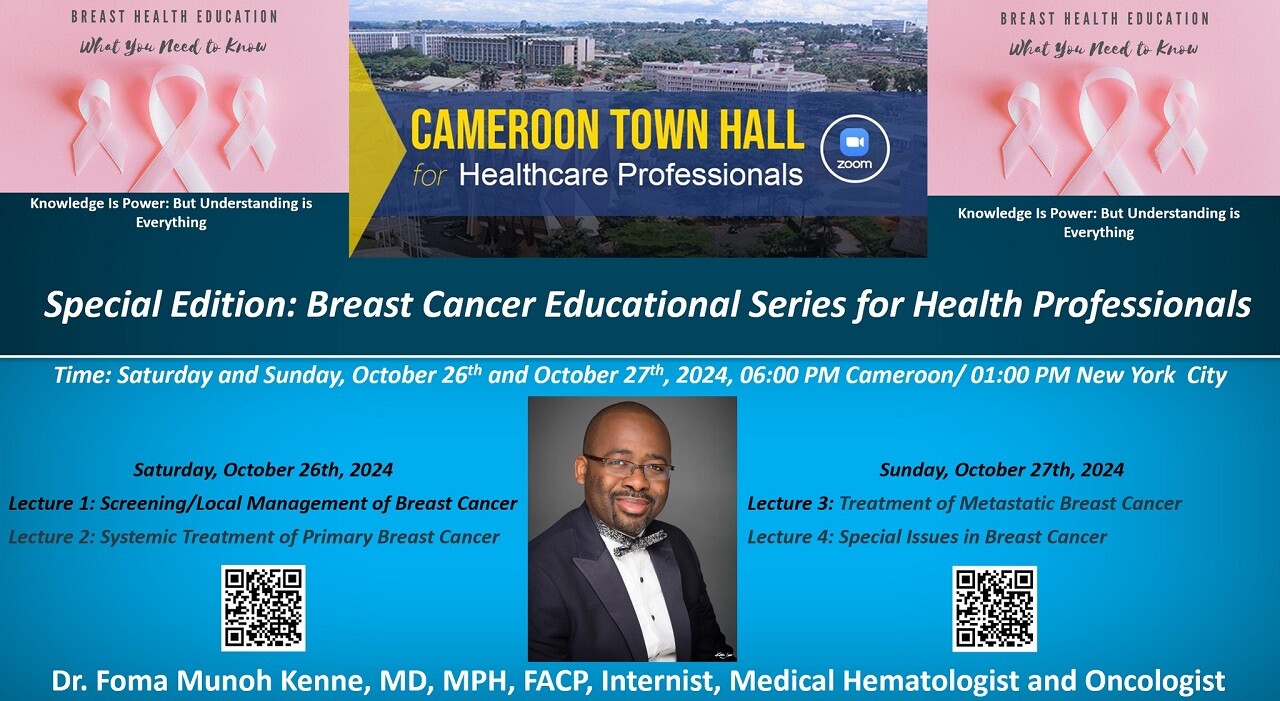
This policy brief synthesises key insights from the special edition of the Cameroon Town Hall for Healthcare Professionals held on October 27, 2024, the second part of a breast cancer educational series for health professionals, in which medical oncologist Dr. Munoh Kenne Foma reviewed systemic treatment and how to adapt it to Cameroon.
Context
Most effective breast cancer drugs for the commonest subtype (hormone receptor positive) are already available and affordable in Cameroon, yet many women receive chemotherapy without receptor testing. Key drugs for HER2 positive and triple negative disease, such as trastuzumab and immunotherapy, are either too costly or unavailable.
Key issues
- Treatment without receptor results. Chemotherapy is often given before ER, PR and HER2 status is known, exposing women to unnecessary toxicity and cost.
- Underuse of endocrine therapy. Tamoxifen and aromatase inhibitors are available but underused in favour of chemotherapy.
- Cost of HER2 therapy. Generic trastuzumab costs about 200,000 francs CFA per dose and is not on the essential medicines list.
- No immunotherapy or advanced testing. Pembrolizumab, trastuzumab deruxtecan, genomic assays and germline BRCA testing are not routinely available.
- Fragmented imaging and team care. Missing baseline and prior scans prevent proper response assessment; surgeons often manage patients without oncologists.
Discussion highlights
- A patient in Bamenda achieved remission on tamoxifen plus palbociclib for under 60,000 francs CFA a month.
- Mbingo Baptist Hospital was cited as able to deliver dose dense chemotherapy and HER2 therapy.
- Radiologists called for standard requests and access to prior images so RECIST can be used.
- Participants proposed a national directory of oncology skills and molecular testing capacity.
Recommendations
- Add key breast cancer drugs to the essential medicines list. MINSANTE should add generic trastuzumab and palbociclib to the national essential medicines list and negotiate prices with generic suppliers. First step: a request from the national cancer programme and the Cameroon Society of Oncology, supported by partners such as the Clinton Health Access Initiative (CHAI).
- Issue a national systemic treatment protocol. The national cancer programme should publish a short protocol stating that receptor testing precedes systemic treatment, endocrine therapy is first line for hormone positive disease, and chemotherapy is reserved for defined indications. Diaspora oncologists can help draft it and teach it through CME.
- Strengthen referral to oncologists. Hospitals and regional delegations should require referral of every breast cancer patient to an oncology service (for example Mbingo, Douala and Yaoundé centres) before surgery for HER2 positive and triple negative disease.
- Standardise oncology imaging. Radiology departments should adopt RECIST based reporting, and hospitals should give patients their baseline images and reports to carry, as a first step toward shared image archives.
- Assess molecular testing capacity. The University of Buea and other research centres, with the town hall, should map existing sequencing and PCR capacity and assess whether BRCA and other tests can be offered locally at low cost.
- Invest in palliative care. MINSANTE and training schools should train palliative care nurses and doctors and improve access to opioids for patients with advanced cancer.
Next steps
The series is to be repeated each October, with CME lectures on prostate and cervical cancer planned. Participants proposed a needs and resource assessment of oncology services and molecular testing in Cameroon.
Conclusion
For most Cameroonian women with breast cancer, effective and affordable treatment already exists: receptor testing followed by endocrine therapy. Making HER2 therapy and CDK4/6 inhibitors affordable, and ensuring patients reach oncology teams, would close much of the remaining gap.
Meeting minutes
Agenda
- Welcome and recap of Part 1 by Dr. Munoh Kenne Foma
- Clinical vignettes
- Systemic treatment in the non metastatic setting: triple negative, HER2 positive, hormone receptor positive
- Discussion break
- Treatment of metastatic breast cancer
- Bone health and conclusions
- Open discussion and Q&A
Opening remarks
- Dr. Foma welcomed participants to Part 2, noting that Part 1 had drawn about 40 to 50 participants, and said this session would be more technical and aimed especially at nurses, physicians and medical students who treat breast cancer.
- He again presented the case of his 32 year old friend in Douala, treated without receptor testing or staging, whose ER 100% and PR 90% result arrived after her death, to show why every patient needs testing and team based care.
- He recapped Part 1: risk assessment, prevention with tamoxifen and aromatase inhibitors, the screening age debate, core biopsy, staging for stage 3 disease, and surgery adapted to limited radiotherapy.
Presentation
1. Receptor status decides treatment
Dr. Foma said hormone receptor positive, HER2 negative disease makes up 60 to 70% of breast cancers, HER2 positive about 15 to 20%, and triple negative about 20 to 30% in African populations. Because treatment differs completely between these groups, he called it 'criminal' to treat without ER, PR and HER2 results, which can be obtained for about 80,000 francs CFA through Mbingo or via Centre Pasteur. Invasive lobular carcinoma is almost always ER positive, so an ER negative result should be re-checked.
2. Hormone receptor positive disease: endocrine therapy first
The main treatment is endocrine therapy, not chemotherapy: tamoxifen for premenopausal women (with ovarian suppression, such as leuprolide, for high risk), and anastrozole, letrozole or exemestane for postmenopausal women, for 5 to 10 years. He said many women in Cameroon receive chemotherapy they do not need; genomic tests such as Oncotype DX show most node negative and many postmenopausal node positive patients gain nothing from it, and where these tests are unavailable Ki-67 based risk tools can guide decisions. All these hormonal drugs are available and affordable in Cameroon.
3. CDK4/6 inhibitors are reachable
Adding a CDK4/6 inhibitor (palbociclib, ribociclib or abemaciclib) to endocrine therapy improves outcomes in metastatic disease. He described a patient in Bamenda in complete remission after one year on tamoxifen plus palbociclib obtained through Noble Pharmacy, at under 60,000 francs CFA a month, without seeing an oncologist. He urged advocacy to make palbociclib generic and available.
4. HER2 positive disease: the cost barrier
HER2 positive tumours from stage 1B onward should receive chemotherapy with trastuzumab before surgery, followed by trastuzumab to complete a year, with T-DM1 for residual disease. Trastuzumab is available but costs about 200,000 francs CFA per dose despite being generic, and pertuzumab adds cost for small benefit, so he advised docetaxel with trastuzumab when pertuzumab is unaffordable. He called for trastuzumab to be added to Cameroon's essential medicines list. Trastuzumab deruxtecan has changed care for HER2 low disease but is not available in Cameroon.
5. Triple negative disease
Standard care for stage 2 to 3 is anthracycline and taxane chemotherapy (with or without carboplatin) before surgery plus pembrolizumab (KEYNOTE-522), and capecitabine for residual disease. Mbingo can give dose dense regimens, but immunotherapy is not available in Cameroon, and he urged advocacy similar to that used for HIV drugs. BRCA testing matters because PARP inhibitors (olaparib, talazoparib) help BRCA positive patients, and he asked University of Buea researchers whether they could offer germline testing.
6. Metastatic disease and team care
Metastatic breast cancer is incurable but patients live longer each decade. For hormone positive metastatic disease, surgery on the breast and radiation do not improve survival except for palliation; endocrine therapy with or without a CDK4/6 inhibitor is first line, and chemotherapy is reserved for visceral crisis (he noted that bone metastases are not visceral disease). Bone protecting agents (alendronic or zoledronic acid, denosumab) with dental review should be given. He stressed the need for radiation oncology, surgical oncology, pharmacists, nutritionists, palliative care and pain specialists, and referral to oncologists such as Dr. Francine Kouya at Mbingo rather than surgeons managing alone.
Discussion and Q&A
- A participant whose aunt received trastuzumab through a foundation asked whether fewer doses could be used in Cameroon to cut cost. Dr. Foma said de-escalation trials, including Japanese data, suggest six months may be close to one year in some patients, but Cameroon needs its own trials. He said trastuzumab is generic and should not be so expensive, and that he would raise it with Dr. Yauba Saidu of the Clinton Health Access Initiative. He argued that helping one patient at a time is unsustainable and advocacy should target policy and essential medicines.
- Dr. Joshua Tambe asked how response (complete, partial, stable, progressive) is assessed in practice, and noted that oncology imaging had been left out of the team slide. Dr. Foma agreed this was an omission and said radiologists and pathologists are central to tumour boards. Response is judged by imaging using RECIST criteria, and in the USA he also uses circulating tumour DNA. Prof. Tambe said RECIST is rarely applied in Cameroon because baseline and previous scans are often missing or done at different centres. Dr. Foma said radiologists should always compare with prior imaging and described PACS systems used in the USA.
- A surgical oncologist in the USA asked whether Buea or Cameroon has capacity for molecular profiling, noting differences in tumour biology in African populations (for example high rates of MSI high colon cancer and triple negative breast cancer). Dr. Foma said next generation sequencing and PCR machines installed for COVID-19 and tropical disease research exist in Buea and elsewhere, but capacity for cancer testing is unknown. He proposed first a needs and resource assessment and a directory of who can do what in Cameroon (for example who can safely perform bronchoscopy, EBUS or image guided biopsy), working with researchers such as Prof. Tambe.
Calls to action and closing
- Dr. Foma said the series would be repeated during breast cancer week each year, and that CME lectures on prostate cancer, cervical cancer and other common cancers were planned.
- He encouraged diaspora researchers with NIH and other grants to collaborate with universities in Buea and Yaoundé.
- He closed with 'difficult roads can lead to beautiful destinations' and wished participants a good Sunday.
Next meeting
Regular town hall to resume on the usual fortnightly Saturday schedule; breast cancer series to be repeated in October 2025.
Submitted by the Co-Moderators, Cameroon Town Hall for Healthcare Professionals.