Prostate Cancer in Cameroon: Earlier Diagnosis, Team Based Care and Clear Referral Pathways
Overview
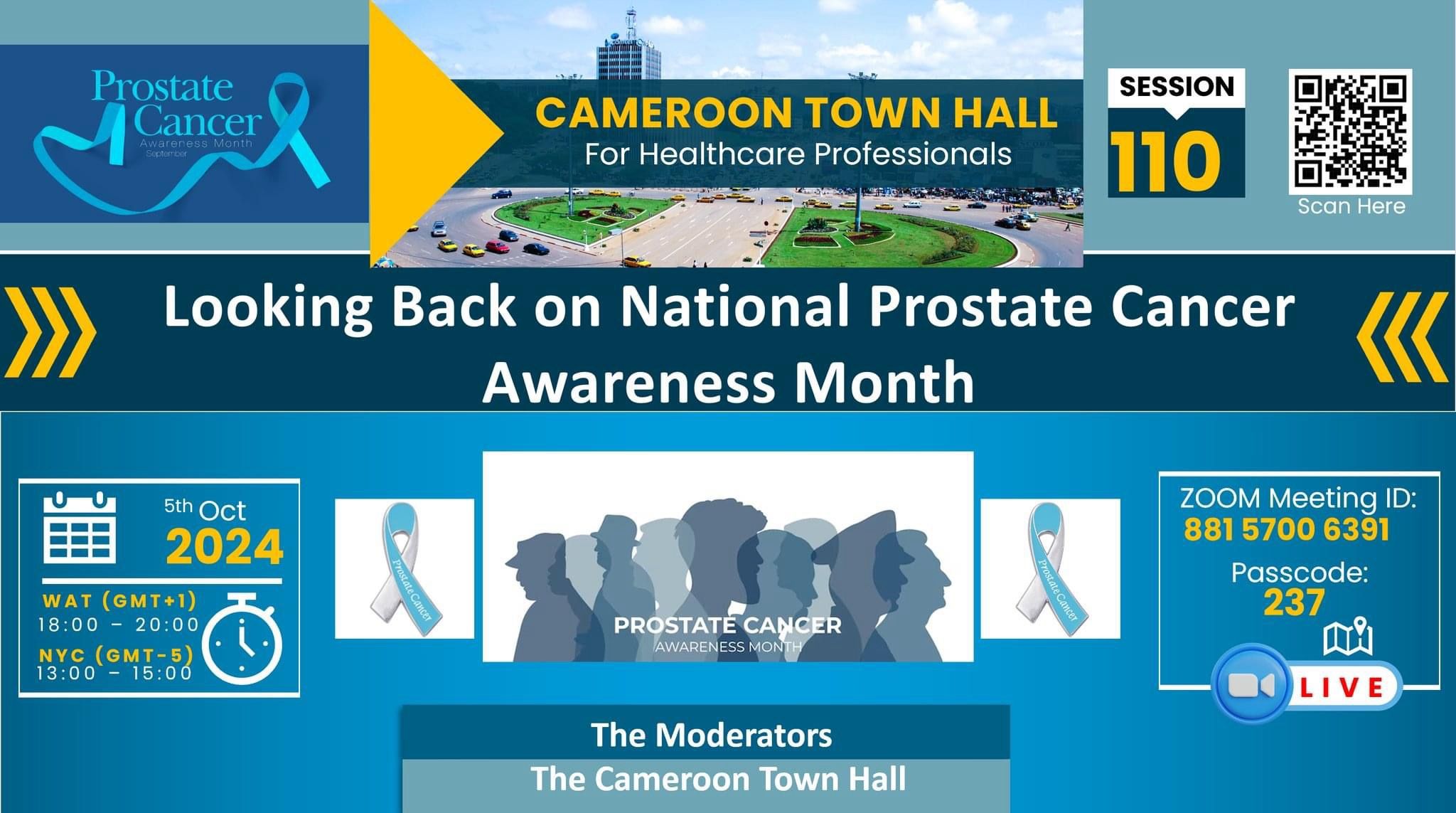
This policy brief synthesises key insights from the Cameroon Town Hall for Healthcare Professionals meeting held on October 5, 2024 (110th session), focusing on prostate cancer in Cameroon following National Prostate Cancer Awareness Month, with a presentation by medical oncologist Dr. Munoh Kenne Foma.
Context
Prostate cancer is the most common cancer in Cameroonian men, about 25% of male cancers by the speaker's figures, and is underdiagnosed. The speaker estimated that almost 70% of cases are found at the metastatic stage. Effective drugs and procedures already exist in the country, but gaps in screening, pathology, imaging, radiotherapy and referral mean many men are diagnosed late or treated inappropriately.
Key issues
- Late diagnosis. Men seldom seek care until they have bone pain, anaemia or other signs of advanced disease, and PSA testing is rarely ordered in primary care, especially in rural areas.
- Incomplete pathology and imaging. Most pathology reports lack Gleason grading needed to stratify risk. MRI is unevenly distributed and PSMA PET is unavailable.
- Inappropriate treatment. Patients with metastatic disease are sometimes offered prostatectomy, which does not help them, while orchiectomy and androgen deprivation therapy, both available, are underused. Patients with very low risk disease may be overtreated.
- Shortage of specialists and support roles. There are few radiation oncologists, uro-oncologists, medical physicists, oncology nurses and genetic counsellors, and no national school for medical physicists.
- Weak referral and navigation. Even doctors with personal networks struggle to know where and how to refer cancer patients. Referral hospitals do not publicise their services or contacts to district facilities.
Discussion highlights
- Point of care PSA tests are affordable and could be used in all district hospitals and health centres.
- ADT, generic abiraterone, docetaxel, bone protecting agents and orchiectomy are available in Cameroon; the gap is knowledge and referral.
- Mbingo Baptist Hospital and the Cameroon Oncology Center in Douala were cited as centres able to deliver guideline based care.
- Family members already act as patient navigators by default and could be trained for the role.
- Participants called for local research on why men of African descent have more frequent and more aggressive prostate cancer.
Recommendations
- Adopt PSA screening for men over 45. MINSANTE and regional delegations should issue guidance for PSA testing of men aged 45 and above, yearly or every two years, using point of care tests in district hospitals and health centres, with PSA above 10 triggering urology referral. First step: include PSA in routine adult check ups at district level and train general practitioners and nurses to interpret results.
- Strengthen pathology reporting. Hospitals and the national pathology network should adopt a standard prostate biopsy report that includes Gleason score, grade group and number of positive cores. Diaspora pathologists and partners can support training and second opinions.
- Publish clear cancer referral pathways. MINSANTE, with referral hospitals such as those in Douala and Yaoundé, Mbingo Baptist Hospital and the Cameroon Oncology Center, should publish a directory of oncology services, contact numbers and referral criteria for district hospitals and primary care. A town hall session on referral and counter referral was proposed as a first step.
- Disseminate a national treatment protocol. The national cancer programme and professional societies should circulate a short protocol on staging before surgery, orchiectomy and ADT for metastatic disease, active surveillance for very low risk disease, and bone health. Diaspora oncologists can help draft and teach it through CME sessions.
- Expand radiotherapy and the oncology workforce. Government, with private and diaspora partners, should plan radiotherapy capacity across all 10 regions and upgrade ageing machines. Training schools should create programmes for medical physicists and oncology nurses, and urologists should be supported to sub specialise in uro-oncology.
- Train patient navigators. Hospitals and community health programmes should train community health workers and family members as navigators, and target men through trusted relatives and frontline clinicians (GPs, cardiologists, rheumatologists) who see them first.
Next steps
The next session, in two weeks, focuses on Breast Cancer Awareness Month. A two part breast cancer education series for health professionals was scheduled for the week of October 26, 2024. A future session on referral and counter referral systems in Cameroon was proposed.
Conclusion
The session showed that most of the tools needed to diagnose and treat prostate cancer already exist in Cameroon. Earlier screening, complete pathology, a multidisciplinary team approach and clear referral pathways would allow more men to be diagnosed early and receive the right treatment.
Meeting minutes
Agenda
- Welcome and opening remarks by Dr. Bryan Tegomoh and Dr. Marthe-Sandrine Mpollo
- Presentation by Dr. Munoh Kenne Foma: prostate cancer in Cameroon, a multidisciplinary disease
- Discussion and Q&A
- Testimonies from participants on referral and navigation in Cameroon
- Closing remarks, announcements and next meeting
- Parking lot discussion (not broadcast)
Opening remarks
- Dr. Bryan Tegomoh explained that the topic was chosen because September had been Prostate Cancer Awareness Month and prostate cancer was rising in incidence among men in sub-Saharan Africa, while past sessions had focused more on lung, colorectal and breast cancer.
- He framed the session around the scale of the problem, its changing epidemiology, and the gaps in diagnosis, screening, management and research data in Cameroon.
- Dr. Marthe-Sandrine Mpollo welcomed participants to the 110th session of the Cameroon Town Hall and moderated.
- Dr. Munoh Kenne Foma noted that the session had been organised at short notice at Dr. Tegomoh's suggestion and invited oncologists, urologists, radiation oncologists and radiologists in Cameroon to take part.
Presentation
1. Burden of prostate cancer in Cameroon
Dr. Foma reported that prostate cancer accounts for about 25% of all cancers in Cameroonian men and remains underdiagnosed, with about one in eight men who live to 75 developing it. For both sexes combined, breast, cervical and prostate cancer rank first to third in Cameroon, mirroring African data. He estimated that almost 70% of prostate cancers in Cameroon are diagnosed at the metastatic stage, often in men presenting with back or joint pain, and noted that 'if you don't look for it you will not find it.'
2. Illustrative cases from Cameroon
He presented a 73 year old man with severe anaemia, leg swelling and weight loss whose PSA was above 46,000 after a young internist thought to order it; the bone marrow was full of cancer. He said he had personally received more than four such cases from Cameroon. A second case, a 55 year old professor with a Gleason score of 9 and bone metastases diagnosed in Yaoundé, should have received androgen deprivation therapy with abiraterone and docetaxel, all of which he said are available in Cameroon.
3. A multidisciplinary team is required
Prostate cancer care needs urologists, radiologists, pathologists, radiation oncologists, medical oncologists, oncology pharmacists, nurse navigators, nutritionists, social workers, genetic counsellors and palliative care. He said Cameroon is short of radiation oncologists and uro-oncologists, and that most pathology reports he receives from Cameroon lack the Gleason grading needed to decide treatment. He noted that MRI is rare outside major cities (he understood the Northwest region had none) and that PSMA PET scanning is not available.
4. Risk factors and screening
Being male, age and African ancestry are the main risk factors, alongside family history, BRCA2 and other genetic changes, Lynch syndrome, obesity, smoking and repeated prostate inflammation, including tuberculosis of the prostate and sexually transmitted infections. He noted that reduced screening in the USA had been followed by more metastatic cases and rising mortality. He recommended that every man above 45 in Cameroon have a PSA test once a year, or once every two years, with PSA above 10 prompting referral to a urologist for biopsy.
5. Risk stratification and avoiding overtreatment
Men with very low risk disease (for example Gleason 3+3, PSA under 10, few positive cores) may never need treatment, and he cited one patient monitored for 31 years. Surgery, radiation and monitoring give similar mortality in very low risk disease, so active surveillance is reasonable. He warned against prostatectomy in men with suspected metastatic disease and said staging work up must come first, for example in a man with a PSA of 65.
6. Treatments available in Cameroon
He listed options he said are available in Cameroon: orchiectomy (still a WHO standard for newly diagnosed metastatic disease and more affordable), leuprolide (Lupron, injection every 3 or 6 months, available at Noble Pharmacy in the Northwest and at Mbingo), generic abiraterone, enzalutamide and apalutamide (expensive), bicalutamide, docetaxel, carboplatin, and bone protecting drugs such as alendronic and zoledronic acid with calcium and vitamin D. He cited Mbingo Baptist Hospital as already using ADT with abiraterone and docetaxel as protocol, and the Cameroon Oncology Center in Douala for good quality linear accelerator radiotherapy. Prostatectomy is currently the most affordable local therapy, while older cobalt radiotherapy machines carry more side effects.
7. Investment priorities
He called for investment in pathology, sub specialty training for urologists in uro-oncology, training of medical oncologists alongside radiation oncology, genetic counselling and BRCA testing, PSMA imaging and radiotherapy in all 10 regions. He said government should lead on radiotherapy because of its cost, with the private sector and diaspora also contributing, and observed that Cameroon was opening many medical schools but had no school for medical physicists or properly trained oncology nurses.
Discussion and Q&A
- A participant asked whether frequent sex reduces prostate cancer risk, what a man in a village with few resources can do to lower his risk, and which genes make Black men more vulnerable than Asian men. Dr. Foma said a 2016 study in a European urology journal suggested more frequent ejaculation might lower risk, but it had not been replicated and the evidence was weak (level C). Primary prevention is limited because the main risk factors (sex, age, genes) cannot be changed, though avoiding STIs, prostate TB, smoking and heavy alcohol help a little; the main tool is PSA screening above 45. On genetics, BRCA2, ATM, CHEK2 and other mutations appear frequent in people of African descent, but little testing has been done in Africa and possible protective genes in Asian populations are a hypothesis needing research. He added that most Black Americans studied have West and Central African ancestry.
- Dr. Tegomoh asked whether PSA screening is affordable and accessible in rural and peripheral facilities. Dr. Foma, drawing on his time as a district medical officer and clinical pathologist, said qualitative and semi quantitative point of care PSA tests are affordable and can be done in all district hospitals and even health centres.
- A participant asked about orchiectomy and other treatment options for metastatic disease in Cameroon. Dr. Foma said orchiectomy is valid and remains standard of care for newly diagnosed metastatic disease, but many men are instead given a more expensive and useless prostatectomy because no one has the courage to discuss castration. He described first line treatment for fit patients with bone metastases as six cycles of docetaxel, generic abiraterone and Lupron every six months, and said his anaemic patient from the opening case was now doing well after one Lupron injection.
- Dr. Mpollo relayed a chat question on how to tell benign prostatic hypertrophy from cancer, the risks of overtreatment, and whether specific biomarkers exist. PSA between 6 and 10 should be referred to a urologist for examination and ultrasound; BPH usually causes urinary symptoms and responds to tamsulosin, while PSA above 10 calls for biopsy. There are no genetic markers that separate the two, but very low risk criteria (T1c, Gleason 3+3, PSA under 10, few positive cores, PSA density under 0.15) identify patients, about 20% of cases, who do not need treatment.
- Dr. Mpollo asked how other professionals contribute in practice and how Cameroon could use family members and community health workers as navigators. Dr. Foma walked through a US case involving nurse navigators, oncology pharmacists, nutritionists, palliative care and social workers. A physician working at a district hospital in Cameroon described the reality there: families lack money, patients refuse referral to the regional hospital in Bamenda because they know no one there, and he had to telephone the regional director personally. His team relies on family support and cooperation with a sister hospital, St John's.
Calls to action and closing
- A surgeon in private practice in Douala said teaching should include how to navigate the system, that he asks older men to come with a family member, and that referral hospitals such as the Douala oncology services should advertise their services and contact numbers to district hospitals and primary care doctors, not only to patients.
- A Cameroonian cardiologist in the USA said that even with classmates in the system he could not find where to send a relative of a friend with suspected metastatic lung cancer in Buea, and only found a route through a medical physicist contact before sending the patient to the Cameroon Oncology Center in Douala.
- An internist in the USA recounted a relative with metastatic prostate cancer who was advised to have a prostatectomy at a major hospital; through Dr. Foma he was referred to Mbingo, where his PSA became undetectable on leuprolide and other therapy.
- Dr. Foma proposed a future town hall on referral and counter referral systems in Cameroon.
- He reflected that lung cancer in Cameroon is reported as almost zero because few biopsies and little pathology are done.
- Announcements: a two part breast cancer lecture series for oncologists, physicians, nurse practitioners and nurses during the week of October 26 (outside the town hall, with CME credits being sought); the next session in two weeks would celebrate Cameroonians working on cancer, with Sidney Tazeh, MSc, DABR (medical physicist and founder of CLEAR Radiology, Buea) expected to speak on breast cancer. Groups mentioned included the Angel Foundation (a walk in Atlanta that day) and CLEAR Radiology, which was offering free prostate screening in Buea.
- The chair invited participants to propose topics, moderators and vetted speakers, and the meeting moved to the parking lot.
Next meeting
In two weeks (Saturday, October 19, 2024): Breast Cancer Awareness Month.
Submitted by the Co-Moderators, Cameroon Town Hall for Healthcare Professionals.