Bridging Cancer Care Disparities in Cameroon
Overview
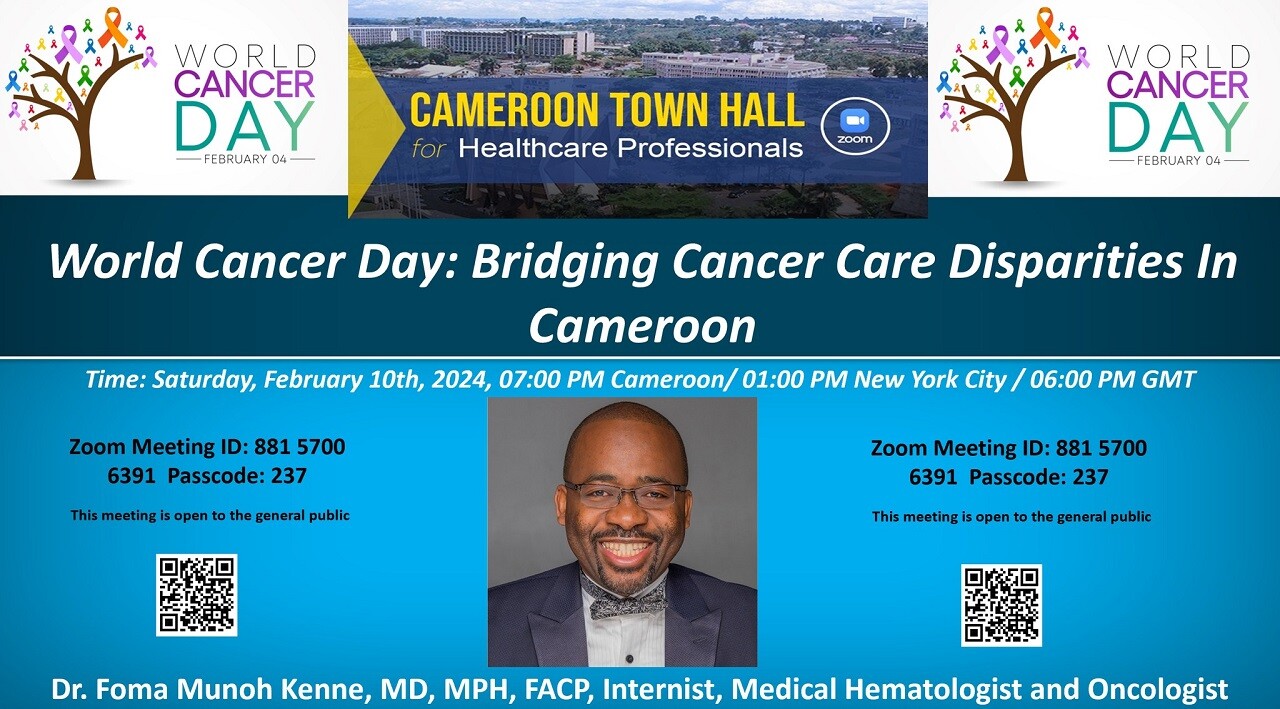
This policy briefing synthesizes key insights from the Cameroon Townhall for Healthcare Professionals meeting held in the weeks after World Cancer Day 2024, focusing on the theme "Bridging Cancer Care Disparities in Cameroon," presented by the Chair, Dr. Munoh Kenne Foma, a hematologist and medical oncologist practising in the United States.
Context
Cancer is becoming a leading health problem in Cameroon as the population ages, but most national figures are estimates. Diagnosis depends on pathology and imaging that are scarce outside a few centres, treatment is costly, and the National Strategic Plan for Prevention and Control of Cancer (2020 to 2024) reached its final year with much of it unimplemented.
Key issues
- No national screening policy. There is no national policy for breast, cervical or colorectal cancer screening; screening depends on individual clinicians and centres.
- Weak diagnostic base. Only one laboratory was said to perform immunohistochemistry, some cancer centres lack working MRI, and staging is often skipped before surgery.
- Limited treatment. Three to four radiotherapy centres with one working constantly, no immunotherapy or most targeted drugs, and few interventional radiologists.
- Missing cadres. Shortages of oncology nurses, medical physicists, dosimetrists, palliative care staff, haematologists and gynaecologic oncologists, while medical schools multiply.
- No cancer registry. Centres do not share data, so cancer cannot compete for political priority.
- Low HPV vaccine uptake. Gardasil 9 is free but rumours of infertility keep uptake low.
Discussion highlights
- Prevention and early detection were agreed as the priority over high cost treatment.
- Breast, cervical and prostate cancer were proposed as the first targets for national screening.
- Linked hospital and community cancer registries were proposed as the way to put cancer on the political agenda.
- Clinical trials were described as a route to new drugs, training and resources.
- Community awareness, including on HPV vaccine safety and firewood smoke, was seen as the cheapest intervention.
Recommendations
- Adopt national screening guidelines. MINSANTE should adopt national screening guidelines for breast, cervical, prostate and colorectal cancer, based on an existing international guideline adapted to Cameroon, with target ages and intervals. First step: a working group of Cameroonian and diaspora oncologists, gynaecologists, gastroenterologists and urologists to draft them.
- Strengthen pathology and imaging in every region. MINSANTE and regional delegations should make immunohistochemistry (at least hormone receptor and HER2 testing for breast cancer) available beyond one laboratory, and ensure working mammography, ultrasound and MRI in designated cancer centres before placing equipment elsewhere. First step: an inventory of pathology and imaging equipment and its working status in each cancer centre.
- Set up a national cancer registry. MINSANTE, with the cancer centres (Mbingo, Banso, Douala General, Yaoundé General and others), should link hospital based registries and start community registries so that real data replace estimates. First step: a data sharing agreement among the main centres.
- Train the full cancer team. Training schools and university hospitals should open programmes for oncology nurses, medical physicists, dosimetrists, palliative care nurses and interventional radiologists, and teach staging guidelines (ESMO, ASCO) to general practitioners and surgeons. Diaspora professionals can support curricula and tumour boards.
- Raise HPV vaccine uptake. MINSANTE, the Expanded Programme on Immunization and regional delegations should evaluate past HPV campaigns, counter infertility rumours with communication experts, and work with schools, antenatal clinics, traditional and religious leaders. First step: confirm that districts holding vaccine are using it.
- Prepare Cameroon for cancer clinical trials. MINSANTE, universities and partners should build trial capacity (ethics review, trained staff, data systems) and join regional advocacy for inclusion of African patients in trials, alongside continued work with the Clinton Health Access Initiative on access to cancer medicines.
Next steps
The town hall announced that a policy briefing would be produced for each session from 2024 and posted on its website. Participants were invited to include cancer education in their Giveback Project activities. The next session, two weeks later, was to address the malaria vaccine.
Conclusion
Participants agreed that Cameroon cannot yet treat most cancers to international standards but can prevent and detect many of them early. Screening policy, pathology, registries and the wider cancer workforce were seen as the foundations on which treatment can later be built.
Meeting minutes
Agenda
- Welcome and opening remarks by the moderators, Dr. Katte Jean-Claude, Elvis Ndansi and Dr. Bryan Tegomoh
- Presentation by the Chair, Dr. Munoh Kenne Foma, on bridging cancer care disparities in Cameroon
- Summary of key issues by Dr. Katte Jean-Claude
- Discussion and Q&A moderated by Dr. Bryan Tegomoh
- Closing remarks by Elvis Ndansi and Dr. Katte Jean-Claude, and next meeting
Opening remarks
- Dr. Katte Jean-Claude welcomed participants to the session, held in the wake of World Cancer Day, and introduced the Chair, Dr. Munoh Kenne Foma, as the speaker.
- Elvis Ndansi said cancer kills nearly 10 million people a year worldwide, and that in sub-Saharan Africa the number of cancer treatment centres is far below need, with economic and infrastructure constraints on top. He said several friends had recently lost relatives to cancer.
- Dr. Bryan Tegomoh recalled that World Cancer Day had been marked in early February and noted it was only established in the early 2000s. He said Cameroon is going through a shift from infectious to non-communicable disease, with a shortage of health workers, weak diagnostics, limited access to treatment and costs most families cannot meet.
Presentation
1. The pillars of cancer care
Dr. Foma, who said he sees about 100 cancer patients a week in his US practice, described the services a cancer programme needs: surgery with sub-specialty skills, radiation oncology, safe chemotherapy, precision medicine, immunotherapy, pathology and radiology. He said Cameroon has about three to four radiotherapy centres, of which only one, in the private sector, works constantly, and that radiation units need physicists and dosimetrists as well as physicians. Only one laboratory in the country was said to perform immunohistochemistry. 'No tissue, no issue': pathology is the cornerstone of oncology.
2. Cases that show the gap
He presented anonymised cases referred to him by families: a 40 year old woman who had a hysterectomy for cervical cancer without staging and was later found in the US to have liver metastases; a 70 year old woman from Cameroon with haematuria who was found to have bladder cancer, lung cancer with brain metastases and a lymphoma; a 73 year old man with renal failure from undiagnosed prostate cancer (PSA in the thousands); a 63 year old man with four years of headaches who had glioblastoma; and a 24 year old woman in Cameroon with squamous cell lung cancer who needed thoracic surgery. He said wealthier patients seek care in India, Europe or the US, while poorer patients often never get a diagnosis.
3. Cancer burden and data gaps
Using Globocan (Cancer Today) estimates, he said the most common cancers in Cameroon are breast, cervical and prostate cancer, non-Hodgkin lymphoma and Kaposi sarcoma, cancers that can be seen or easily tested, while colorectal and bladder cancers are under-diagnosed because colonoscopy and cystoscopy are rarely done. He noted that reported cancer prevalence follows the location of cancer centres, which is why the North West, with Mbingo and Banso Baptist hospitals, reports the most cases. Most national figures are modelled estimates. He linked lung cancer in women to smoke from firewood kitchens.
4. Uneven cancer centres
He described Mbingo and Banso Baptist hospitals as following guidelines more closely than many larger hospitals, with Mbingo building a radiation oncology unit, and Douala General Hospital as well equipped and well managed. He said the Yaoundé General Hospital, a cancer centre, had no working MRI while new MRIs were placed in non-cancer facilities, that the Yaoundé Central Hospital cannot do radiotherapy, and that Laquintinie Hospital in Douala cannot perform immunohistochemistry. He cited a private oncology centre as an example of good work.
5. No national screening policy
Citing WHO data for 2022 to 2023, he said Cameroon has no national screening policy for breast, cervical or colorectal cancer, although individual clinicians screen. He proposed colonoscopy, mammography, Pap smear and HPV testing in all 10 regions, PSA screening, and adoption of an existing guideline (European, ASCO or US Preventive Services Task Force) with set ages and intervals. He said HPV vaccine (Gardasil 9) is available free in Cameroon but uptake is low, and that it also prevents penile, anal and head and neck cancers.
6. Staging, testing and appropriate treatment
He urged primary care doctors and surgeons never to treat a cancer without staging, pointing to the ESMO and ASCO guidelines, and described mastectomies and prostatectomies done on patients who already had metastatic disease. He said about 80% of breast cancers are hormone receptor positive and may not need chemotherapy, so every breast cancer needs immunohistochemistry. He described next generation sequencing and targeted pills used in the US, noted that immunotherapy is now part of most protocols but is not available in Cameroon, and called for a policy on cancer drugs similar to the HIV response of the early 2000s. He acknowledged the work of the Clinton Health Access Initiative on access to cancer drugs.
7. Workforce and the national cancer plan
He reviewed Cameroon's National Strategic Plan for Prevention and Control of Cancer (2020 to 2024) and asked how much of it had been achieved. He questioned the plan's counts of trained palliative care nurses and gynaecologic oncologists, said many radiologists leave for France or the US, and listed missing cadres: oncology nurses, medical physicists, dosimetrists, specialised radiology technicians, palliative care staff, haematologists and paediatric oncologists. He said Cameroon should stop proliferating medical schools and train the staff who work alongside doctors. Interventional radiology was described as rudimentary.
8. Prevention first
He closed by saying that hygiene and sanitation, preventive medicine and vaccination, antibiotics and smoking cessation have done more for health than most clinical care. His proposed way forward: work with the government and the private sector on prevention, use the diaspora to reinforce knowledge, support training of auxiliary staff in medical schools, and make cancer a national priority.
Discussion and Q&A
- Dr. Ferdinand Mukumbang: South Africa vaccinates girls against HPV in primary schools. Is anything similar planned or under way in Cameroon? Dr. Foma said Cameroon has a vaccination policy and gives Gardasil 9 free, from age nine for girls and boys, and had run a campaign with prominent women about two years earlier. The main barrier is rumours that the vaccine causes infertility. He credited Cameroonian gynaecologists who pioneered cervical screening, but said there is still no national screening policy.
- Dr. Tegomoh: with limited resources, what should be the top priorities for cancer screening over the next five to ten years? Breast cancer first: a mammogram and breast ultrasound in all 10 regions and sub-regions, with radiologists and technicians trained to read mammograms and do stereotactic biopsies, under a national policy. Second, cervical cancer: understand vaccine refusal, vaccinate, and screen women aged 20 to 65 under a national policy, with trained pathologists. Third, prostate cancer: PSA screening, biopsy, proper staging and available drugs. He added colon cancer, pathology, oncology nursing schools, palliative care and pain management, and said expensive machines that break down in two months do not improve care.
- A participant: could rapid point of care tests based on cancer markers such as BRCA1 and BRCA2 help early diagnosis? Dr. Foma said tumour markers such as PSA, CEA, CA 19-9 and CA 125 can help in a low resource setting but do not make a diagnosis on their own and need training to use. Next generation sequencing is the future, and cancers will increasingly be classified by their driver mutation, but Cameroon must first fix the basics, starting with hormone receptor testing. Dr. Tegomoh agreed that screening within current reach should come first while building capacity for genetic profiling.
- Dr. Samuel Ndinjiakat (comment): what is the experience on the ground? He described the Swedish based digital African network for cervical cancer elimination working in East Africa (awareness, prevention, screening, diagnosis, treatment and palliative care). In Ndop the HPV vaccine was at the district hospital but not being used; after education, women at his centre (more than 300 a month) began accepting it, though many feared it would make their daughters infertile. On a mission, 37 professional women in Yaoundé were screened by visual inspection with acetic acid and 10 had lesions. He proposed awareness as the first thing to fund. Dr. Foma linked this to the diaspora Giveback Project.
- A participant: what can a poor woman cooking with firewood do to prevent cancer? Does more sex prevent prostate cancer? Is it true that chemotherapy kills patients in Cameroon? Do lemon water or antioxidants help? Dr. Foma said the answers come back to education and prevention, and that engineers and researchers should provide kitchens that vent smoke outside rather than tell women to stop cooking. Data on sexual activity and prostate cancer go both ways. On chemotherapy, he said deaths are to be expected where growth factors, regular free blood counts, management of nausea and diarrhoea, palliative care and trained oncology nurses are lacking; the belief needs to be studied, but the training gap is real.
- A nephrologist in Cameroon: what message should the community retain, and how available are these new drugs? He said most cancers cannot be prevented by individuals, so the community message should be 'screen for cancers and treat early', repeated on radio. He said drug access in high income countries comes through insurance but above all through clinical trials, and urged the town hall to build teams to bring trials to Cameroon, which bring resources, staff and training. Dr. Foma agreed, said about 80% of NIH trials are in oncology, recalled a trial of more than $10 million during COVID-19 that Cameroon could not take up, and said his US patients get new drugs the day after approval.
- Sidney Tazeh (comment): what practical message can help patients now? He said breast cancer found early has about 98% five year survival, and that the most useful messages are short: the HPV vaccine for cervical cancer, mammography for breast cancer, smoking cessation for lung cancer. Women above 35 should be screened, and clinicians should ask about family history of cancer to identify people at higher risk.
- Dr. Tegomoh: how can African participation in cancer clinical trials be expanded? Dr. Foma said pharmaceutical companies place trials where they can sell drugs, and that black patients make up less than 5% of participants in major US and European prostate cancer and myeloma trials. He called for African countries to advocate together as they did for HIV, for regulators and journals to require minority participation, and for local production of essential drugs. He noted that hydroxyurea trials for sickle cell disease were done in the US in 1988 and in Africa only around 2018.
- A participant focused on health policy: how can Cameroon build a national cancer registry? He said solutions have been over-medicalised and that cancer care is a political and policy question: the government must be shown real data to make cancer a priority over malaria, HIV and maternal health. Centres do not share data, and those who travel to India for care are the wealthy. He also asked that diaspora and local scientists be put forward together for opportunities such as a US cancer immunotherapy society fellowship. Dr. Foma agreed, said he and Dr. Tegomoh spent a week struggling to find Cameroonian cancer data, and called for linked hospital based and community cancer registries.
- A participant with a background in HIV programmes: what communication strategy exists for cancer, especially cervical cancer, and can lessons from HIV be applied? The participant proposed using antenatal care, schools and workplaces, and involving traditional and religious leaders. Dr. Foma said Cameroon's HIV communication model was once taught across Africa, that knowledge alone does not change behaviour, that community gatekeepers must be involved, and that communication experts should evaluate past HPV campaigns. He described the US tumour board model, with nurse navigators, social workers and psychosocial support, as what holistic management means.
Calls to action and closing
- Dr. Tegomoh announced that, from this year, a policy briefing would be produced from each session and posted as a PDF on the Cameroon Town Hall website, then under development. A question posted in the chat was held for the parking lot session.
- Elvis Ndansi said the session should be seen as an eye opener rather than a reason for discouragement, cited CLEAR Radiology in the South West as a diaspora effort, and invited participants to make cancer education in their own communities part of their Giveback Project.
- Dr. Katte Jean-Claude closed by describing prevention as holistic, running from policy (primordial prevention) through primary, secondary and tertiary prevention.
Next meeting
In two weeks. Dr. Foma said the malaria vaccine would be discussed at the next town hall.
Submitted by the Co-Moderators, Cameroon Town Hall for Healthcare Professionals.