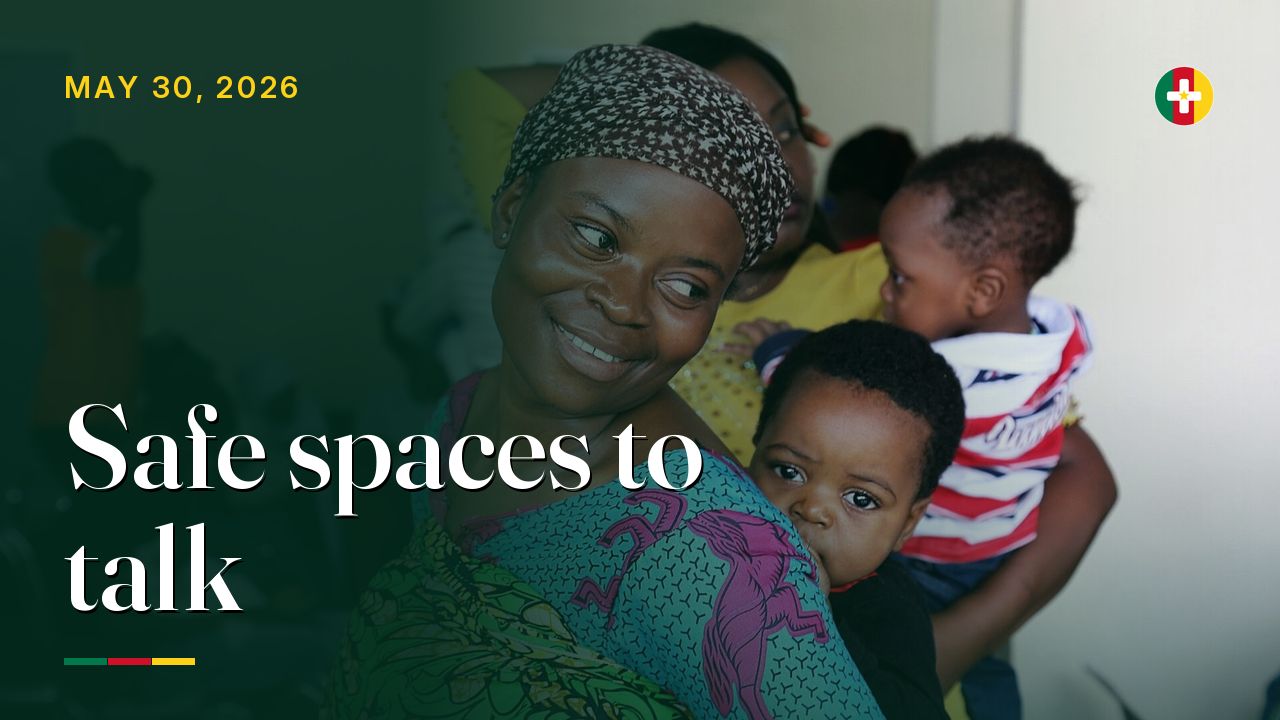
Mental Health in Cameroon: From Silence to Safe Spaces and Services
Overview
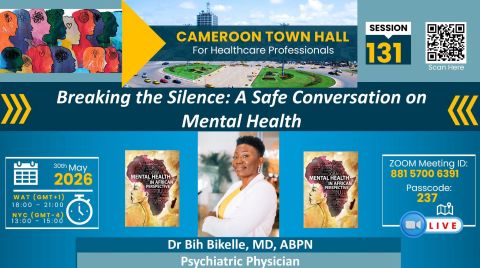
This brief draws on a session of the Cameroon Town Hall for Healthcare Professionals held on May 30, 2026, during Mental Health Awareness Month. Dr. Bih Bikelle, a Cameroonian-trained psychiatrist practising in the United States, spoke on stigma and safe conversations, and participants in Cameroon and the diaspora discussed suicide among health workers, the crisis-affected regions and gaps in services.
Context
Mental illness is common in Cameroon, but it is widely attributed to spiritual causes, hidden by families and addressed only in crisis. Participants described the Jamot service in Yaoundé as the main public psychiatric resource, a few psychiatrists in private practice, almost no trained counsellors and little mental health content in medical curricula. Two medical student suicides and the recent suicide of a colleague at a referral hospital were reported. Displaced families in the North West and South West live with trauma, and psychosocial programmes there lack funding.
Key issues
- Stigma and silence. Families hide mental illness for fear of shame and seek spiritual help first, delaying treatment.
- Too few professionals. There are very few psychiatrists, psychiatric nurses, psychologists or counsellors, and few doctors choose psychiatry.
- Health worker suicide. Medical students and doctors are at high risk and have no structured support.
- Hidden trauma. Child sexual abuse, domestic violence, harsh discipline and conflict-related trauma go unaddressed.
- Substance use. Alcohol misuse is normalised and other drugs are widely available to young people.
Discussion highlights
- Dr. Bikelle: mental illness is treatable, and recovery happens every day.
- Dr. Bikelle: listen without judgement, validate, and support practically.
- Dr. Bikelle: you cannot give from an empty cup; health workers need self-care.
- A UK-based doctor: ask every patient how life is going.
- Dr. Foma: train psychiatric nurses and medical psychologists, not just more doctors.
Recommendations
- Integrate mental health into primary care. MINSANTE and regional delegations should add brief mental health screening to routine consultations and train general practitioners and nurses in supportive care and referral, using the WHO mhGAP approach. First step: pilot screening and referral in district hospitals of one region.
- Train a mental health workforce. MINSANTE, the Ministry of Higher Education and training schools should create psychiatric nursing, clinical psychology and counsellor training programmes and strengthen psychiatry in medical curricula. Diaspora psychiatrists can support training virtually.
- Protect health workers and students. Faculties of medicine, hospitals and the Cameroon Medical Council should set up confidential counselling, peer support and postvention teams after a suicide, and include mental health in continuing professional development. First step: establish a support service at faculties and hospitals that have recently lost students or staff.
- Fund psychosocial support in crisis-affected regions. MINSANTE, the Ministry of Social Affairs and humanitarian partners should fund psychological first aid and psychosocial support for displaced children and families in the North West, South West and Far North, training teachers, health and social workers.
- Work with faith leaders and communities. Regional delegations should train pastors, traditional and community leaders in warning signs and referral, and run campaigns in local languages that present mental illness as treatable.
- Collect baseline data. The town hall, with partners, should conduct a survey of mental health needs and services to inform the Ministry.
Next steps
The town hall will work with Dr. Bikelle on a baseline survey, hold a second, more informal session on mental health, and raise mental health training and services with the Ministry of Public Health.
Conclusion
Mental illness is common and treatable, but silence keeps Cameroonians from care. Safe conversations at home, trained professionals and services that work alongside faith and community can turn crises into recovery.
Meeting minutes
Agenda
- Welcome by the moderator, Dr. Bryan Tegomoh
- Remarks by the Chair, Dr. Munoh Kenne Foma
- Presentation by Dr. Bih Bikelle
- Reflections by the Chair
- Questions and contributions
- Remarks by Prof. Alan Tita
- Closing remarks
Opening remarks
- Dr. Tegomoh recalled that the town hall began during COVID-19 as a trusted space for health professionals. He noted that WHO had that week declared the Bundibugyo variant of Ebola a public health emergency of international concern, following a hantavirus outbreak in prior weeks with no demonstrated human-to-human transmission, but said the session would focus on mental health.
- The Chair, Dr. Foma, said mental health remains taboo in Cameroonian families, that families hide relatives with schizophrenia and other conditions, that young people in the diaspora face new stresses, and that drugs are widely available to youth in Cameroon. Training of psychiatric specialists in Cameroon is lacking. He also questioned why Africa does not fund its own outbreak response rather than blaming others for underfunding Africa CDC.
Presentation
1. Two stories
Dr. Bikelle described her older brother, who returned from Belgium unwell in the early 2000s, became withdrawn and aggressive and heard voices; the family first sought a traditional healer and a pastor before he was taken to the Jamot psychiatric service in Yaoundé, treated with a long-acting medication, and recovered; he is now married with two children. Her mother told almost no one. She also told of a Ghanaian nurse in Virginia whose daughter died by suicide after writing letters about struggles no one knew of. Both stories show that people struggle unseen because we cannot recognise mental illness or will not talk about it.
2. How common it is
She said one in eight people worldwide lives with a mental disorder and about 700,000 people die by suicide each year. She cited a higher suicide rate in Africa than elsewhere (about 11 against 9 per 100,000), with Lesotho, Zimbabwe, Mozambique, the Central African Republic and Botswana among the highest, while cautioning that African data are incomplete.
3. Mental health and mental illness
Mental health is the ability to cope with daily life, maintain relationships, work and manage stress. A mental disorder is present when persistent changes in mood, behaviour or thinking impair these functions. Warning signs build over time rather than overnight.
4. Silence in our communities
Erratic behaviour is often explained as a curse or possession, emotional suffering is treated as normal, and stigma and fear of shame (including for marriage prospects) keep families silent until a crisis. Depression, schizophrenia, trauma and PTSD, anxiety and substance use are common; alcohol misuse is normalised while other drug use is condemned. Child sexual abuse within families, domestic violence, neglect and physical abuse are hidden, and statements such as 'just pray about it' or 'snap out of it' can push a person in crisis further.
5. Recognising warning signs
Withdrawal, irritability or aggression, persistent sadness or tension, falling grades and talk of hopelessness are signs to act on. Lack of knowledge, denial and stigma keep people from acting. Diaspora migrants face particular stressors: separation from family, immigration status, obligations at home, isolation and burnout; she described her own loneliness after moving to Reno in 2007.
6. Becoming a safe space
She asked participants when they last called someone simply to ask how they were really coping. A safe space means checking in genuinely, listening without judgement, validating the person's experience and supporting them practically, including by pointing to a doctor, counsellor or other resource.
7. Conversations at home
She described regular check-ins with her three children during meals, drives and errands, including planned mental health days for a son stressed by school and a school group that helped another son with peer conflict. Families should normalise an emotional vocabulary, not ban topics such as self-harm, and treat seeking help as strength.
8. Closing the gap in Cameroon
Cameroon trains few psychiatrists, has almost no mental health counsellors, and medical curricula give little attention to mental health. She called for mental health training in medical schools, trained counsellors, community advocates, partnership with churches (faith and treatment working together), and public education campaigns, and offered to partner on mental health education in Cameroon.
Discussion and Q&A
- The Chair's reflections. Dr. Foma said many families have undiagnosed relatives and that he was not taught enough in medical school to recognise schizophrenia or bipolar disorder in people living on the streets. He spoke of deaths from alcohol and withdrawal, of child abuse in homes where children live with relatives or step-parents, and of physician colleagues in the US who died by suicide.
- Dr. Tegomoh: what explains the apparent rise in mental health crises? Dr. Bikelle said country rankings reflect incomplete data and isolated reported events. Reduced stigma means more people seek help, and since COVID-19 she sees far more anxiety, depression and ADHD, with immigration and world events adding stress.
- A nurse who directs programmes at the Geneva Learning Foundation asked about psychosocial support for children affected by the crisis in the North West and South West, training parents, and self-care for health workers. She noted that a psychological first aid project for children affected by the war in Ukraine was funded by the EU while no comparable funding exists for Cameroon. Dr. Bikelle said displaced families live with constant fight or flight stress; she suggested parenting education and small consultation points in towns, since the Jamot service is out of reach for most. Health workers must balance work and self-care: 'you cannot give from an empty cup.'
- Chat: should psychosocial interventions be weighted above medicine, and how can a family with few resources help a relative? It depends on severity: mild to moderate cases may respond to therapy alone, while severe illness needs both. In the US, resources can be found through a primary care doctor, a pastor or directories such as Psychology Today; in Cameroon she named the Jamot service as the main public resource, alongside a few psychiatrists in private practice in Douala and Yaoundé.
- A doctor and internal medicine resident at Mbingo described two medical student suicides the previous year and a colleague's suicide the week before, and asked about policies for health professionals. Dr. Bikelle offered condolences and said depression is a leading cause of disability and is more common among health workers, who tie their identity to their role and hide distress. About half of suicides occur without a diagnosed mental illness, after an overwhelming stressor. Policies cannot prevent every case, but check-ins, assessment at hiring, trained counsellors and a trauma response team for colleagues after a suicide can help.
- A participant asked about the provider shortage, whether asking 'how are you?' helps when one cannot solve the problem, interlinked stress across work and family, and stigma faced by men who are abused. Dr. Bikelle said shortages exist everywhere but Cameroon lacks the counsellors and nurses that fill the gap elsewhere. Checking in is support, not a promise to solve problems, and one call can save a life. Men are the majority of those who die by suicide, and men who experience domestic abuse deserve the same attention as women and children.
- A doctor practising in the UK described asking every patient about their life and marriage, and proposed a survey for the Ministry and continuing education through the Cameroon Medical Council. Dr. Bikelle agreed that primary care should screen for mental health as part of every assessment, and that doctors in Cameroon should be trained to offer supportive listening until referral pathways exist.
- Chat questions on harsh discipline, culturally adapted care and use of social media. She said physical discipline that injures a child has crossed into abuse; parenting education through churches and premarital counselling, and legal consequences for serious harm, are needed. Care in Cameroon should keep positive cultural support systems while ending harmful practices such as widowhood rites. To reach mothers and grandparents in villages, door-to-door and campaign-style outreach in local languages will reach more people than social media. Fewer than ten doctors enter psychiatry residency each year (as stated), and talking about the specialty can attract more.
- Dr. Franklin Maloba: how do we cope when stressors such as unemployment and harassment are constant, and how can churches and existing structures be used? Dr. Bikelle agreed that churches and other first responders should be strengthened and trained, but said new resources are also needed, such as counsellors trained in about a year. Lifestyle (diet, activity, sleep, social contact and avoiding alcohol and drugs) is part of mental health.
- A participant on language, basic needs and stories. She suggested speaking of well-being in plain terms, linking mental health to basic needs, training lay people in listening and warning signs, and using stories of recovery. Dr. Bikelle agreed and welcomed a suggestion for a monthly virtual programme on mental health.
- Prof. Alan Tita. He described a secondary school classmate who did well in the US, suffered a severe mental illness after stressful events, and was sent back to Cameroon, where she has lacked care for some 20 to 25 years. He thanked the speaker and asked that the recording be shared widely.
Calls to action and closing
- Dr. Foma summarised the hidden traumas discussed: sexual abuse, domestic violence, child trauma and emotional neglect, and untreated psychiatric illness. He said the town hall would work with Dr. Bikelle on a baseline survey, use its access to the Minister of Public Health for advocacy, and press for mental health in the training of nurses, doctors and allied professionals, including specialised psychiatric nursing and medical psychology programmes rather than more medical schools alone.
- Dr. Bikelle and the Chair agreed on a second, more informal session where participants could raise personal questions.
Next meeting
In about four weeks (date not announced in the session).
Submitted by the Co-Moderators, Cameroon Town Hall for Healthcare Professionals.