The Delta Variant: Risks for Cameroon and the Case for Vaccination
Overview
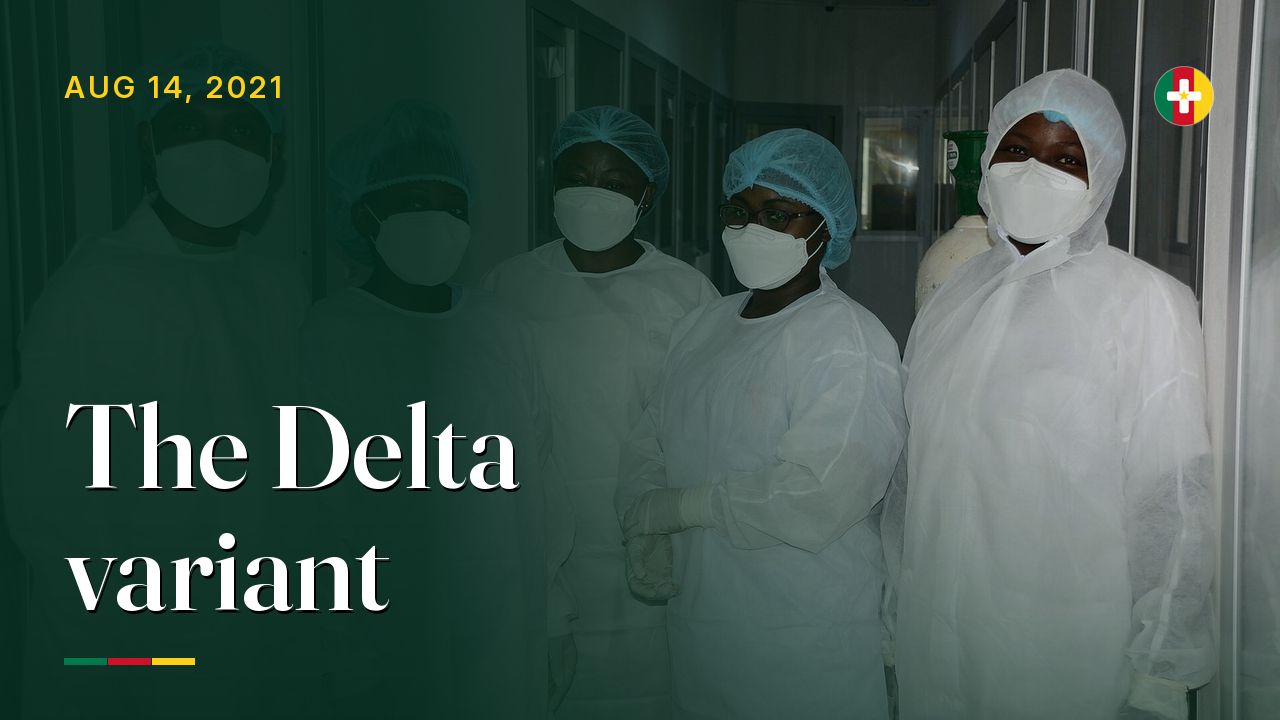
This policy briefing synthesises key insights from the Cameroon Townhall for Healthcare Professionals meeting held on August 14, 2021, focusing on the theme "How Dangerous Is the COVID-19 Delta Variant?", presented by Dr. Obadia Mfuh Kenji.
Context
By August 2021 Delta had become the dominant variant in many countries and had been detected in Cameroon, where vaccine coverage was very low and hesitancy was common, including among health workers and scientists.
Key issues
- Faster spread. Delta is 40 to 60 percent more transmissible than Alpha, with much higher viral loads early in infection.
- Possible higher severity. Early data suggested higher risks of hospitalisation, ICU admission and death.
- Breakthrough transmission. Vaccinated people can be infected and transmit Delta, though they clear the virus faster and rarely become severely ill.
- Low vaccine uptake and misinformation. Rumours (microchips, placebo for ministers, blocked natural immunity) spread faster than scientific messages.
- Limited testing. Low testing and genomic surveillance in Cameroon hide the true number of infections.
Discussion highlights
- Vaccines remain highly effective against severe disease and death from Delta.
- Vaccine-related clotting is rare, and COVID-19 carries a far higher clot risk.
- Allergy to sulfa drugs is not known to be a contraindication.
- Cameroon's young population may explain lower mortality, but Africa is not protected.
- Scientists need clearer, more emotionally resonant communication.
Recommendations
- Accelerate vaccination. MINSANTE and the EPI should expand access to all available vaccines, prioritising health workers, older adults and people with diabetes or hypertension, and stress completing two doses where required.
- Keep barrier measures. MINSANTE and regional delegations should maintain mask use in crowded indoor settings, hand washing and isolation of cases, including for vaccinated people.
- Strengthen testing and sequencing. The national public health laboratory network and partners should expand PCR testing and genomic surveillance to track Delta and new variants.
- Answer health workers' concerns. Regional delegations and professional orders should run sessions where specialists answer health workers' questions on clotting, allergies and boosters.
- Counter misinformation. MINSANTE, the media and diaspora professionals should use clear, emotionally resonant messages and personal testimonies, in English and French, to answer common rumours.
Next steps
Recordings of past sessions were being posted on the Town Hall's YouTube channel, website and Facebook page.
Conclusion
Delta is more dangerous than earlier variants, but vaccines still prevent most severe disease and death. For Cameroon the priorities are more vaccination, continued barrier measures, better testing and better communication.
Meeting minutes
Agenda
- Welcome and opening remarks by Elvis Ndansi
- Remarks on how vaccines protect individuals and populations
- Presentation by Dr. Obadia Mfuh Kenji on the Delta variant
- Discussion and Q&A, with the Chair answering clinical questions
- Summary, closing remarks and next meeting
Opening remarks
- Elvis Ndansi said the Town Hall had held more than 30 editions and recalled the previous session on cardiac surgery in sub-Saharan Africa. Dr. Bryan Tegomoh, due to co-present, could not join because of an emergency, and another co-moderator was absent.
- The Chair asked to go straight to the variant topic instead of the usual COVID-19 update.
- Elvis Ndansi explained the difference between a vaccine's direct effect on the person vaccinated and its indirect effect on the population through reduced transmission. He noted that a vaccine that prevents severe disease but not infection could increase asymptomatic spread, and that the first goal of COVID-19 vaccines, preventing severe disease and death, had largely been met.
Presentation
1. How viruses infect and how the body responds
Dr. Kenji used a lock and key image to explain that a virus must bind a specific receptor to enter a cell, and that mutations let animal viruses such as bat coronaviruses spill over to humans. The body responds with antibodies that neutralise the spike protein and with killer T cells that destroy infected cells.
2. Why variants appear
The more the virus circulates, the more mutations arise. Mutations in the spike protein can increase spread, reduce the effect of monoclonal antibodies, increase severity, escape some diagnostic tests and reduce immunity from infection or vaccination. This is why vaccination is needed to stop chains of transmission.
3. Delta spreads faster
Delta is estimated to be 40 to 60 percent more transmissible than Alpha. One study found viral loads about 1,000 times higher than with the original strain, and contacts tested positive sooner. The P681R mutation makes cleavage of the spike more efficient, so about 70 percent of Delta virions are primed for entry compared with about 10 percent of the original strain.
4. Delta may cause more severe disease
A Canadian study he presented found adjusted increases in risk with Delta of 108 percent for hospitalisation, 234 percent for ICU admission and 132 percent for death compared with non-variant strains, and odds ratios of about 1.4, 1.8 and 1.5 versus Alpha. He cautioned that it was one study with probable rather than confirmed Delta cases.
5. Vaccines still work
Laboratory studies showed reduced neutralisation of Delta by sera from Pfizer and AstraZeneca recipients, but antibodies are only one arm of immunity. In the NEJM real-world study, two doses gave about 88 percent effectiveness against Delta (93 percent against Alpha) for Pfizer, with lower figures for AstraZeneca; a single dose gave much less protection.
6. Breakthrough infections and transmission
Vaccinated people infected with Delta started with viral loads similar to unvaccinated people, so they can transmit, but their viral load fell faster. In one cohort, pneumonia occurred in 53 percent of unvaccinated versus 21 percent of vaccinated patients, oxygen in 20 versus 2.8 percent, ICU admission in 5.4 percent versus none, and deaths in 1.5 percent versus none.
7. Third doses
A trial in transplant recipients showed a third mRNA dose raised antibody responses, from about 40 to about 70 percent with antibodies. Dr. Kenji said boosters for the general population would depend on new variants and further data.
8. Conclusion
Higher transmission, possible higher severity and partial immune escape make Delta especially dangerous, but vaccines remain highly effective against symptomatic and severe disease, so people should get vaccinated, wear masks and follow public health measures.
Discussion and Q&A
- Can mutations be blamed on any cause? (Elvis Ndansi) Dr. Kenji said mutation is natural during replication, with selective pressure on the spike protein. SARS-CoV-2 mutates more slowly than influenza; what matters is where mutations occur and what they do.
- Will we need a fourth or fifth dose? (Dr. Christelle Jouego Tagne) Dr. Kenji said a third dose was recommended for immunocompromised people; for others it would depend on future variants, and high vaccination coverage could prevent new variants.
- What causes vaccine-related clotting, is immunity waning, and what are neutralising antibodies? (a participant) The Chair said vaccine-induced thrombosis with thrombocytopenia is rare, resembles heparin-induced thrombocytopenia with antibodies against platelet factor 4, is seen mainly with adenovirus vaccines, and is treated with non-heparin anticoagulants such as argatroban. COVID-19 itself carries a much higher clot risk, and oral contraceptives also carry a higher risk than the vaccines. Dr. Kenji said neutralisation falls for new variants, which may justify boosters, and that laboratory studies use pseudovirus assays with whole serum.
- Comment from a critical care physician in the USA She described two young unvaccinated COVID-19 patients with a heart attack and a massive pulmonary embolism, and an 82-year-old vaccinated woman with severe heart failure who was extubated within 24 hours and went home within five days.
- Do vaccines cause mutations, and do breakthrough rates differ by vaccine? (an anaesthesia provider in Buffalo) Dr. Kenji said vaccines do not drive mutation; it comes from replication errors, as seen in unvaccinated people and bats. Breakthroughs are more frequent with adenovirus-vector vaccines than mRNA vaccines, but all reduce severe disease.
- What is the role of T cells? (a virologist from Belgium) Dr. Kenji said T cells matter: some infected people with no antibodies showed strong interferon gamma responses. The Chair shared a study of T cell responses to mRNA doses.
- Why has Cameroon seen fewer deaths than the West? Dr. Kenji cited Cameroon's young population, limited testing, and possible cross-reactivity with seasonal coronaviruses found in pre-pandemic Cameroonian samples from 2005. The Chair added population movement, flight connections and mask use, and warned that Africa is not special and could become the next India.
- Do vaccine antibodies block natural immunity? (a doctor based in Japan) Dr. Kenji said vaccine responses are polyclonal, not monoclonal, which is why vaccines still work against variants. Both speakers said scientists must communicate better; Dr. Kenji recalled that after a four-hour talk to scientists in Cameroon only one said they would get vaccinated.
- Should elective surgery be delayed after vaccination? (an anaesthesia provider) The Chair said the American Society of Hematology has no such recommendation; patients should be assessed for their own clotting risk, and he had not seen such cases in a large New York haematology practice.
- Is a sulfonamide allergy a contraindication? (a nurse anaesthetist in Bamenda) The Chair said he knew of no sulfonamide-derived component in the vaccines and that Johnson & Johnson was a good single-dose choice. A participant with multiple allergies, including to sulfa drugs, said she had received two AstraZeneca doses without problems.
- Delta-specific vaccines, Novavax and mixing vaccines (a participant, via Dr. Christelle Jouego Tagne) Dr. Kenji preferred vaccines that induce broadly neutralising antibodies over variant-specific ones. The Chair said Novavax was promising but delayed by production problems, and that UK data suggested AstraZeneca followed by an mRNA vaccine gives a strong response.
Calls to action and closing
- Elvis Ndansi summarised the main findings and urged members to keep wearing masks, washing hands and encouraging relatives in Cameroon to get vaccinated.
- He said about 40 participants attended and that past sessions were being posted on the Town Hall's YouTube channel, website and Facebook page.
- The next session was announced for two weeks later.
Next meeting
In two weeks (August 28, 2021, inferred).
Submitted by the Co-Moderators, Cameroon Town Hall for Healthcare Professionals.