Beyond Malaria: Diagnosing Fever in Cameroon
Overview
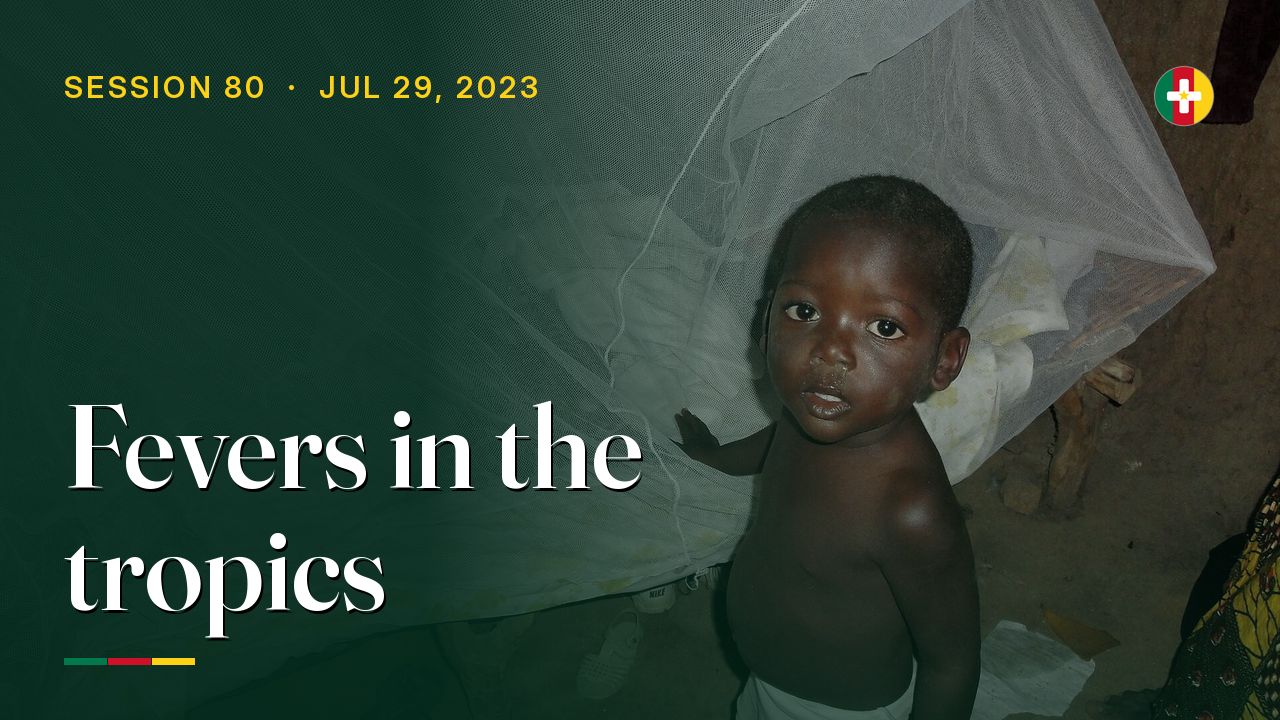
This policy briefing synthesizes key insights from the Cameroon Townhall for Healthcare Professionals meeting held on July 29, 2023 (80th edition), focusing on the theme "Diagnostic Dilemmas: Fevers in the Tropics," presented by Dr. Obadia Mfuh Kenji, laboratory director.
Context
Most febrile patients in Cameroon are still treated for malaria whether or not they test positive. In a study in four cities, 92% of febrile participants were clinically diagnosed with malaria, while PCR found it in 54%, and 38% of those treated had fever from other causes, mainly respiratory infections and typhoid.
Key issues
- Presumptive malaria treatment. Negative tests are often ignored. In Bamenda, about 5% had malaria by PCR but 77% received antimalarials.
- Missed bacterial infections. Malaria negative febrile patients have higher mortality, often from sepsis and pneumonia, and cultures are rarely requested in adults.
- Antibiotic misuse. Antimalarials and broad spectrum antibiotics are given together by default, eroding drugs such as ciprofloxacin and ceftriaxone.
- Weak laboratory capacity. Laboratories receive little investment, tests are run one at a time, and RDTs on the market are not always evaluated.
- Cost and protocols. Patients' limited means and the lack of adapted clinical protocols push clinicians toward empirical treatment.
Discussion highlights
- Withholding antimalarials from RDT negative febrile children is safe, provided other causes are sought.
- Syndromic multiplex panels reduce turnaround and antibiotic use; COVID-19 era thermocyclers can be repurposed.
- HRP2/3 deletions require RDTs with additional targets where prevalence exceeds 5%.
- Paediatric practice in Cameroon shows the model of cultures and inflammatory markers that adult medicine should follow.
- Training, clinician and laboratory collaboration, and public awareness are needed alongside new tools.
Recommendations
- Enforce test, then treat. MINSANTE and the National Malaria Control Programme should reinforce guidance that a negative RDT means no antimalarials and a search for other causes, through supervision and prescription audits in regional and district hospitals. First step: a short national circular and job aid for outpatient and paediatric units.
- Adopt a national fever and sepsis algorithm. MINSANTE, with university hospitals and diaspora specialists, should issue a fever algorithm adapted to Cameroon's epidemiology: RDT first, then sepsis criteria, blood culture before antibiotics where available, and referral where it is not.
- Repurpose COVID-19 laboratory capacity. MINSANTE and laboratory partners should use thermocyclers and staff trained during COVID-19 for respiratory and febrile illness panels. First step: an inventory of existing PCR platforms and a pilot respiratory panel in two regional hospitals.
- Regulate rapid tests and monitor HRP2/3 deletions. The national regulatory authority and reference laboratories should evaluate RDTs before market entry and map HRP2/3 deletion prevalence by region, switching to multi-target RDTs where it exceeds 5%.
- Strengthen antimicrobial stewardship and training. Medical, nursing and laboratory schools should teach non-malaria fever, cultures and stewardship, and hospitals should track culture requests and antibiotic resistance, starting with typhoid and Gram negative bacteria.
- Support point of care innovation. Researchers in Cameroon and the diaspora, with partners, should develop and validate affordable multi-pathogen point of care tests (for example malaria with procalcitonin) and a clinical decision app built on local data.
Next steps
Laboratory scientists in Cameroon and the diaspora proposed a subgroup on repurposing COVID-19 equipment. Dr. Kenji offered to collaborate on point of care tests and to share his article on laboratory capacity and supply chains in Africa. The Chair proposed a follow up session on sepsis and antimicrobial stewardship.
Conclusion
Fever in Cameroon is no longer mostly malaria, especially outside highly endemic areas and in young children. Participants agreed that trusting negative malaria tests, investing in laboratories and syndromic testing, and adopting adapted protocols would save lives and protect antibiotics.
Meeting minutes
Agenda
- Welcome and introduction of the guest speaker by the moderators
- Remarks by the Chair, Dr. Munoh Kenne Foma, and the co-moderators
- Announcements: Dr. Katte Jean-Claude's PhD and the creation of the MINSANTE diaspora working group
- Presentation by Dr. Obadia Mfuh Kenji on fevers in the tropics
- Discussion and Q&A, moderated by Dr. Bryan Tegomoh
- Closing remarks by the Chair and adjournment
Opening remarks
- The moderators welcomed participants to the 80th edition and introduced Dr. Kenji, a regular member of the town hall, described as a board certified laboratory director who has worked with Stanford Medicine, Illumina and WHO.
- Dr. Tegomoh said fever is one of the most difficult diagnostic problems for clinicians in Cameroon and sub-Saharan Africa, since it can signal malaria, viral infection, typhoid and many other causes, often without the tests to tell them apart. He recalled how quickly Dr. Kenji's Stanford team built SARS-CoV-2 tests early in the pandemic.
- Elvis Ndansi congratulated Dr. Katte Jean-Claude on defending his PhD.
- Elvis Ndansi announced that the Minister of Public Health had kept his promise to the town hall: a decision signed by the Minister created a working group on the diaspora, with four diaspora members alongside ministry representatives, to address visas, delays and other barriers faced by diaspora health professionals. The group held its first meeting on July 27, and a special session on it was planned.
Presentation
1. From 'the fever' to many causes
Dr. Kenji contrasted a Loa loa worm in the eye, a diagnosis made on sight, with a girl in Maroua who had had bouts of fever for 10 days. Using David Livingstone's records (1841 to 1871), he showed that fever was once seen as a single disease caused by bad air ('mal aria'), and that it is now understood as a symptom of many infections. After independence, syndromic management spread with primary care, and WHO's 2006 guidance on clinical diagnosis led to the assumption that fever equals malaria. The girl in Maroua, treated for malaria for about 10 days, tested positive for typhoid and improved on antibiotics.
2. What happens when the malaria test is negative
He described four responses by a health worker: not trusting the result and giving an ACT, trusting it but giving an ACT to please the patient, sending the patient away (who then buys antimalarials at a pharmacy), or trusting the result and looking for other causes, the only option that leaves the patient both satisfied and well. Around 2010 to 2011, WHO moved to recommend confirmed diagnosis before malaria treatment.
3. Performance of malaria tests in Cameroon
In a study around 2015 with 551 febrile participants in Yaoundé, Bamenda, Maroua and Kousseri, malaria prevalence was 31% by microscopy, 45% by RDT and 54% by PCR, while 92% were clinically diagnosed with malaria. In Bamenda, prevalence was about 4% by microscopy and 5% by PCR, yet 77% received antimalarials. Against PCR, clinical diagnosis had 100% sensitivity but 17% specificity; RDT 78% sensitivity and 94% specificity; microscopy 57% and 99%. Overall accuracy was 62% for clinical diagnosis, 85% for RDT and 73% for microscopy, and 38% of those clinically diagnosed with malaria had fever from other pathogens. He noted that RDTs can stay positive for about 21 days after parasite clearance and that WHO reserves PCR for research.
4. Withholding antimalarials from test negative children is safe
He presented a study of 1,000 febrile children: 97% of malaria negative children who received no antimalarials were cured by day seven, but two of them died of sepsis and pneumonia, not malaria. Studies in Tanzania (about 14,000 children) and Ghana (4,474 admissions) found higher case fatality in malaria negative than in malaria positive patients (11% against 6%, and 12% against 7%). His conclusion: not giving antimalarials to RDT negative febrile children is safe even in highly endemic areas, but the other causes must be found.
5. Non-malaria causes of fever
A Tanzanian study of more than 1,000 febrile children found acute respiratory infections in 62% and malaria in about 10%, with 22% having more than one diagnosis. In the Cameroon study, which tested for malaria, typhoid, leptospirosis, dengue, West Nile, enteric and respiratory pathogens, a cause was found in about 67% of participants. Malaria dominated in Maroua and Kousseri during the malaria season, while respiratory infections led in Bamenda, where malaria prevalence was about 6% by PCR. In children under five, respiratory infections led, with RSV the main pathogen, followed by influenza. Malaria and typhoid co-infection was the most common combination, and a few chikungunya, dengue and West Nile cases were found. In a small exploratory model, asthenia, headache and vomiting were associated with malaria, and abdominal pain and vomiting with typhoid.
6. Syndromic and multiplex testing
He argued for moving from one test at a time to syndromic panels by body system (respiratory, enteric, meningitis, bloodstream, joint). He said a combined COVID-19, influenza and RSV test costs about $25 in the US against about $20 for each separately, and cited reports of a 13% reduction in antibiotic duration, a 30% reduction in prescriptions, a turnaround about 30 hours shorter, three fewer ICU days, a 10% increase in survival and savings of about $9 per test. He mentioned GeneXpert in Cameroon, a battery powered point of care PCR, BioFire panels (a meningitis panel with 14 targets and a GI panel with 22), and a multiplex serology assay for viral haemorrhagic fevers (Ebola, Marburg, Lassa) developed with the Biotechnology Centre of the University of Yaoundé I.
7. Future plans and acknowledgements
He described plans for a 'fever app' using AI on clinical signs to estimate the probability of each cause, a book on the aetiology of febrile illness in the tropics, and point of care tests for several pathogens at once. He thanked hospital directors and staff in Maroua, Bamenda and Kousseri, the Biotechnology Centre in Yaoundé, and funders including Cameroon's national medical research institute (for the Maroua work), NIH and the US Department of Defense. He noted that the Minister of Public Health and the national malaria control programme had invited him to present the findings to hospital directors.
Discussion and Q&A
- Dr. Samuel Ndinjiakat: if hospitals adopt multiplex testing, how accessible will reagents be? Dr. Kenji said COVID-19 showed multiplex PCR is no longer out of reach in Africa; he had trained 23 African countries in next generation sequencing in Ghana. He said reagents can be lyophilised to avoid cold storage, called on governments and WHO to plan supply chains and local production, and said the long term answer is point of care tests that need no added reagents.
- Dr. Tegomoh: which African countries have done best at bringing such diagnostics to peripheral levels? He said every African country has the scientists to implement these tools, but needs political will and funding. He had seen large automated respiratory panel platforms in Kenya and Tanzania, but warned that maintenance contracts can cost more than reagents, so user friendly tools suited to low resource settings are preferable.
- Franklin Maloba: how should fever be managed during an epidemic when attention narrows to one disease, and what about asymptomatic and sub-microscopic malaria? Dr. Kenji clarified that both groups in the cited studies had fever. During a pandemic, rapid tests for that disease are needed, but other causes do not go away, and patients should be referred where blood culture is available. He said very low parasite levels may not cause disease, though they matter for transmission, that no test is perfect, and that countries should evaluate and regulate the RDTs on their markets.
- Dr. Tegomoh: how do HRP2 and HRP3 gene deletions affect rapid tests in Cameroon? He said WHO advises switching tests where HRP2/3 deletion prevalence exceeds 5%, and that RDTs that also detect P. falciparum specific LDH still perform well. He did not know the prevalence in Cameroon and said it may vary by region.
- The Chair: how can laboratories be empowered and clinicians convinced to use cultures and de-escalate antibiotics, including at district level? The Chair said adults in Cameroon routinely receive antimalarials and antibiotics together, that ciprofloxacin and ceftriaxone have been undermined by widespread use, that RDTs selected per WHO guidance are more than 98% specific, and that a sepsis algorithm with cultures is needed. He noted that Cameroon has few infectious disease specialists in internal medicine and questioned the typhoid test in common use. Dr. Kenji called for training from medical school onward, better collaboration between clinicians and laboratory staff, and wider use of simple markers such as CRP, lactate and procalcitonin.
- Dr. Katte Jean-Claude: could a point of care test combine malaria and procalcitonin to guide antibiotic use? Dr. Katte said that among patients who test negative for malaria, the share who leave with antibiotics and antimalarials is about double (30 to 35% against 17%). Dr. Kenji said he is working on such a multi-target test, called for a functioning referral system for blood culture, and gave the example of CD4 testing, whose cost fell through advocacy. He said COVID-19 era thermocyclers in Africa could be repurposed for respiratory and other panels.
- Dr. Tegomoh, relaying a chat comment: how can quality care be balanced with patients' limited means? Dr. Kenji said that when a patient cannot pay, clinicians must rely on their judgement, but this differs from not looking beyond malaria; the long term answer is affordable tests. He added that health spending is often a matter of priorities and patient education.
- A nurse: is overprescribing driven by cost or by bias, and where are the protocols? She said many patients arrive with only 1,500 FCFA, which leads to broad spectrum antibiotics, and that Cameroon needs clinical protocols, such as drawing blood cultures before antibiotics when sepsis criteria are met. The Chair said protocols must be adapted to local epidemiology, with an RDT first, and recalled a 34 year old patient in New York who died of falciparum malaria after a sepsis protocol missed it.
- A clinician working in public health in The Gambia: comment on medical training She said clinicians practise as they are trained and asked the town hall to bring the challenges of medical training in Cameroon to light for advocacy.
Calls to action and closing
- Dr. Christelle Jouego Tagne said the session had been invigorating and that fever is something all clinicians in Cameroon deal with.
- The Chair said Cameroonian paediatricians are good at ruling out other infections, ordering CRP, ESR and cultures, and guiding antibiotic use, and that this practice should spread to internal medicine and surgery. He noted that patients with diabetes and sickle cell disease are dying of sepsis that is not caught early, and that general practitioners and nurses should work with laboratories that can already do cultures.
- The Chair said Dr. Samuel Ndinjiakat, the working group's rapporteur, would report on its work within the next month.
Next meeting
Not stated; the next session (August 12, 2023) covered the MINSANTE diaspora working group.
Submitted by the Co-Moderators, Cameroon Town Hall for Healthcare Professionals.