Breast Cancer in Cameroon: Challenges and Solutions
Overview
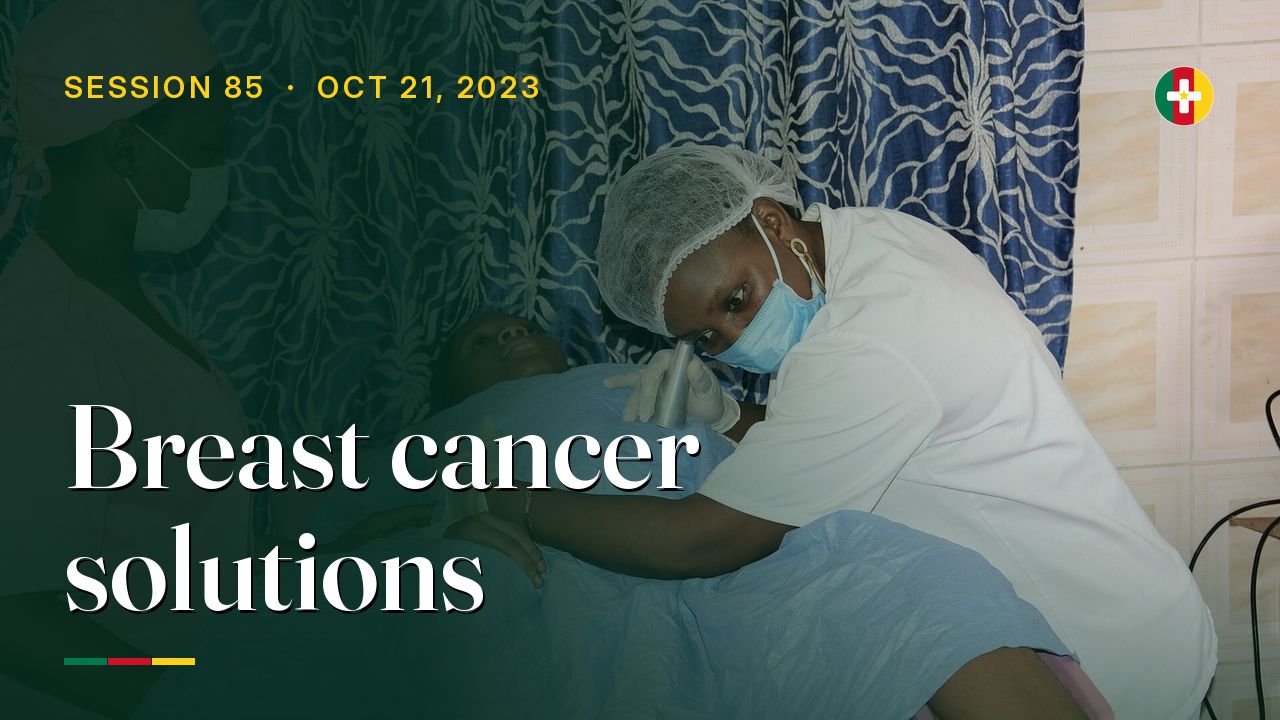
This policy briefing synthesizes key insights from the Cameroon Townhall for Healthcare Professionals meeting held on October 21, 2023 (85th edition), at which Dr. Munoh Kenne Foma, medical oncologist, examined why breast cancer is diagnosed late and poorly treated in Cameroon and what can be done.
Context
Breast cancer is the most common cancer in Cameroon. There is no national cancer registry, no screening guideline and no integrated public cancer centre, and most women present with advanced disease.
Key issues
- No screening policy. Fewer than 1% of women get regular mammograms, mostly employees with insurance; most units are private.
- Pathology gaps. Receptor testing is done in-country only at Centre Pasteur (about 100,000 FCFA) and is often skipped, so chemotherapy costing 500,000 to 1,000,000 FCFA is given to women who may not need it.
- Inappropriate surgery. Mastectomies are done without staging on women with metastatic disease, and radical mastectomy persists.
- Missing workforce. There are too few internists and family doctors, and no training for oncology nurses, radiation therapists or medical physicists; deaths from neutropenic fever are common.
- No data. There is no registry, no outcome data and no hereditary cancer data for Cameroon.
Discussion highlights
- Participants agreed prevention and screening offer more than treatment in a fragile system.
- Self breast examination was supported in Cameroon because most cancers are found by women themselves.
- Hospital cohort studies of standard of care and outcomes were proposed as a low-cost first step.
- Genetic testing by cheek swab was offered through a partner in Côte d'Ivoire and Atlanta.
- The South West Regional Delegate asked diaspora experts to train local teams through pre-congress workshops.
- A Cameroon Tribune article during Pink October was proposed with CHAI.
Recommendations
- Adopt a national breast cancer screening guideline. MINSANTE should adopt WHO guidance (mammography from 50 every two years, earlier for high-risk women) and make mammography in regional hospitals affordable or free. First step: a circular to regional delegations on use of the mammography units already delivered.
- Make receptor testing routine. MINSANTE and regional hospitals should fund immunohistochemistry in at least one public laboratory per region and require ER, PR and HER2 on every breast cancer report before treatment. First step: a costed plan with Centre Pasteur and partners.
- Stage before surgery. Hospitals and surgical and gynecology societies should require staging CT for suspected stage III disease and stop radical mastectomy. First step: a joint practice statement from surgical and gynecology societies, with diaspora input.
- Train the cancer workforce. MINSANTE and the Ministry of Higher Education should train more internists and family doctors in prevention, and open courses for oncology nurses, radiation therapists and medical physicists. First step: add oncology nursing at the specialist nursing school in Yaoundé.
- Build data. MINSANTE should create a national cancer registry, and hospitals should work with researchers in the town hall on outcome cohorts and hereditary cancer studies.
- Use diaspora expertise in-country. Diaspora professionals and the town hall should run pre-congress workshops (for example with the gynecology society) on biopsy and breast cancer management, and support regional tumour boards.
Next steps
Dr. Foma and Dr. Yauba Saidu agreed to prepare a paper and a Cameroon Tribune article. Dr. Foma planned a lecture series on breast cancer for physicians and students. Participants were invited to contact Dr. Okou on genetic testing. The next session was set for two weeks later.
Conclusion
Breast cancer in Cameroon is mostly diagnosed late and treated without the basic information needed to treat it well. Participants agreed that screening, receptor testing, staging before surgery and a trained workforce would save more lives than costly treatment of advanced disease.
Meeting minutes
Agenda
- Welcome and opening remarks by the moderators, Dr. Bryan Tegomoh and Dr. Katte Jean-Claude
- Comments from invited participants
- Presentation by Dr. Munoh Kenne Foma on breast cancer in Cameroon
- Discussion and Q&A
- Closing remarks by the moderators and the Chair
- Parking lot discussion
Opening remarks
- Dr. Tegomoh, joining from the annual meeting of the American Society of Tropical Medicine and Hygiene, welcomed participants and said breast cancer receives little attention in Cameroon despite the country's epidemiological transition.
- Dr. Katte said most participants had been touched by breast cancer through someone close to them and hoped the session would produce solutions that could be followed up in Cameroon.
- Invited participants spoke briefly. One said families often hear of cases only when patients are flown abroad at stage four and return 'in their coffin'. Dr. Ivo Che Ditah said screening is for people without symptoms and that, as people live longer, resources must move toward preventive health and breast cancer screening.
- Dr. Tegomoh introduced Dr. Foma as founder of the town hall, which began early in the COVID-19 pandemic and has since taken on other public health issues.
Presentation
1. Cancer care as a test of the health system
Dr. Foma said he would be more critical than usual, arguing that a health system's handling of cancer shows how developed it is. He noted that a newly released list of specialist trainees showed Cameroon training more cardiologists than internists (about 20 against 10, as he put it), when internists, family doctors and well-trained general practitioners should be the guardians of the system and lead screening and prevention.
2. Burden and missing data
Breast cancer is now the leading cancer in Cameroon, ahead of cervical cancer, in a country of more than 27 million people. Cameroon has no national cancer registry, so available figures come from case reports and a few centres, and most deaths are not recorded. He said no government hospital has an integrated cancer centre: the radiotherapy unit at Yaoundé General Hospital had not worked for about 15 years, and the integrated centres that exist are run by the Baptist mission (Banso, Mbingo, Mutengene and others) and the Chantal Biya Foundation for children.
3. Weak pathology and missing receptor testing
He called pathology the biggest weakness of cancer care. Of more than 30 Cameroonian breast pathology reports he had reviewed, none met reporting standards, and ER, PR and HER2 were rarely reported. Immunohistochemistry is done in-country only at Centre Pasteur, and private labs send samples abroad. He described a young woman who had a mastectomy without staging, was then found to have metastases, and died on chemotherapy before her tumour was shown to be 100% estrogen and progesterone positive, a cancer that could have been treated with cheap hormonal therapy for years.
4. Risk factors and prevention
Being a woman and getting older are the main risk factors. BRCA1 and BRCA2 raise risk about tenfold but account for 5% of cases or fewer, and he had seen several Cameroonian patients in the US with Li-Fraumeni syndrome. Earlier menarche, later first births, alcohol and obesity raise risk, while breastfeeding, earlier pregnancy and exercise lower it. High-risk women can be identified with tools such as the Gail model and given preventive tamoxifen, raloxifene, exemestane or anastrozole, which he said are available and affordable in Cameroon.
5. No national screening policy
There are no official screening guidelines for breast cancer or any other cancer in Cameroon, and fewer than 1% of women, mainly employees of large companies and international organisations with insurance, have regular mammograms. Most mammography units are private; Bamenda Regional Hospital had received one about two months earlier. He recommended WHO guidance (mammography from age 50 every two years), assessing family history from age 30, ultrasound for younger high-risk women, and continued self breast examination in Cameroon, where most cancers are found by women themselves.
6. Late diagnosis and inappropriate surgery
He said a palpable mass often means metastatic disease, so any suspected cancer above stage two should have CT of the chest, abdomen and pelvis (about 50,000 FCFA in the North West, he said) before surgery. He urged surgeons not to do mastectomies on metastatic patients or radical (Halsted) mastectomies at all, said breast surgery should be a surgical sub-specialty rather than handled by gynecologists, and argued that without access to radiotherapy, mastectomy is the safer choice than breast conserving surgery.
7. Treatment needs a trained workforce
About 80% of breast cancers are hormone receptor positive and may not need chemotherapy, about 20% are HER2 positive and need trastuzumab (almost a million FCFA for a course in Cameroon, he said), and immunotherapy for triple negative disease is not available. He said many patients die of neutropenic fever because nurses are not trained to give chemotherapy, and that Cameroon creates medical schools but not schools for oncology nurses, radiation therapists or medical physicists.
8. Way forward
He concluded that the problem is systemic: MINSANTE should prioritise breast cancer screening and buy mammograms rather than MRIs, general practitioners need training in preventive medicine, every regional hospital needs a pathology department able to do immunohistochemistry, oncology must work through multidisciplinary teams, and the public needs health education. He said fragile health systems cannot afford to treat advanced cancer, so prevention and early detection come first.
Discussion and Q&A
- A medical graduate of the Yaoundé faculty: is there evidence for self breast examination in low-resource settings, and is there political will, given falling maternal mortality? Dr. Foma said there is no trial evidence that self-examination lowers mortality where women have yearly mammograms, but in Cameroon most cancers are found because a woman noticed a change, so it should be encouraged. On maternal health, he said Cameroon's gains followed targeted investment, but it is still worse than in 1980, partly because it stopped training midwives for years. Prevention and screening are more cost effective than treating cancer.
- A clinical researcher: how can Cameroon do better within a weak system? He said Cameroon produces professors through case reports and case series that lead nowhere, and proposed that gynecologists, surgeons and oncologists work with researchers to describe the standard of care in each hospital and follow cohorts for 5 and 10 year mortality, treatment costs, drug procurement and follow-up. Dr. Foma agreed that data is the best way to influence care.
- Dr. Tegomoh: have other low-resource countries implemented evidence-based cancer strategies? Dr. Foma pointed to Rwanda, Kenya and other East African countries, which trained family doctors and advanced nurse practitioners as gatekeepers, placed mammograms in regional and divisional hospitals, built pathology capacity for biopsy and immunohistochemistry, trained surgeons, opened radiotherapy centres or chose mastectomy where they could not.
- Dr. Ivo Che Ditah: how does the town hall get this to the authorities, for example through the Minister's committee on cooperation with the diaspora? Dr. Foma said mammograms had recently been provided to several regional hospitals after the issue was raised with the Minister, and that he would push the committee on prevention for all major cancers, affordable or free mammography, cervical cancer screening and vaccination, and prevention-focused training (noting that training falls under the Ministry of Higher Education). Elvis Ndansi said the town hall tracks policy news, noted that a hospital had just acquired its first pacemaker after an earlier session, and reported that the Minister wished to return with an update.
- Dr. Katte Jean-Claude: at what age should Cameroon start screening, given that women are diagnosed young? Dr. Foma explained the US range of recommendations (American Cancer Society from 40 yearly; US Preventive Services Task Force from 50 every two years to 75) and said that, without local data, Cameroon should follow WHO and start at 50 every two years. He noted that black women in the US have more triple negative disease and dense breasts, and that BRCA and other mutations in Africa are largely untested.
- Dr. David Téa Okou (clinical molecular geneticist): what is known about hereditary breast cancer in Cameroon, given Africa's genetic diversity? Dr. Foma said there was no such data. Dr. Okou reported that in Côte d'Ivoire the national cancer programme sent him 78 women with breast cancer and family history, mean age 28; he found many BRCA1 and BRCA2 variants, many of uncertain significance. He offers an 84-gene multi-cancer panel run on cheek swabs that travel at room temperature, and offered to collaborate with Cameroon. Elvis Ndansi invited participants to contact him.
- Dr. Eko Eko Filbert, South West Regional Delegate of Public Health: the problems are real, but what will diaspora experts do with us? He said he had stopped four or five breast surgeries until immunohistochemistry was done; the test costs about 100,000 FCFA at the subsidised Centre Pasteur and about 250,000 FCFA in private labs that send samples abroad. He noted low pay for doctors, that the gynecology society had no standard of care yet, and invited diaspora experts to run pre-congress workshops on biopsy and cancer management. Dr. Foma accepted the need for solutions and described his partnership with the North West region's tumour boards.
- An immunologist in Atlanta: could long-term HIV infection contribute to breast cancer risk? Dr. Foma said there is no data showing HIV raises breast cancer risk, but that Atlanta's large black HIV population could support such a study. He repeated that immunohistochemistry is cheaper than chemotherapy and that trastuzumab is available in Cameroon but very expensive.
- Dr. Yauba Saidu, CHAI Cameroon: proposals He said his team has published on barriers to cancer care in Cameroon, and proposed turning the session into a paper and an article in Cameroon Tribune (English and French) during Pink October, planning a larger effort for the next October, and pushing for a global movement on breast cancer like the WHO strategy on cervical cancer. Dr. Foma agreed to write it up with him.
Calls to action and closing
- Dr. Tegomoh said the town hall should learn how policy is made in Cameroon and what evidence feeds it, so that the session's lessons lead to practical steps.
- Elvis Ndansi cited 18.1 million new cancer cases globally (as he stated it) with 5.8% from Africa, noted that hepatitis C treatment had just been made free in Cameroon after earlier price cuts, and said many of the changes discussed are within the Minister's powers.
- Dr. Foma said the session was deliberately provocative. The way forward is advocacy for proven prevention strategies (cervical cancer vaccination and screening, mammography, education of women), health worker pay and retention, and not treatment of advanced disease. He promised a series of lectures for physicians and students on breast cancer management.
- The moderators announced a parking lot discussion after the session; it was not recorded.
Next meeting
In two weeks (the 86th edition, on decolonizing global health, was announced for November 4, 2023).
Submitted by the Co-Moderators, Cameroon Town Hall for Healthcare Professionals.