Glaucoma in Cameroon: Earlier Detection Through Primary Care
Overview
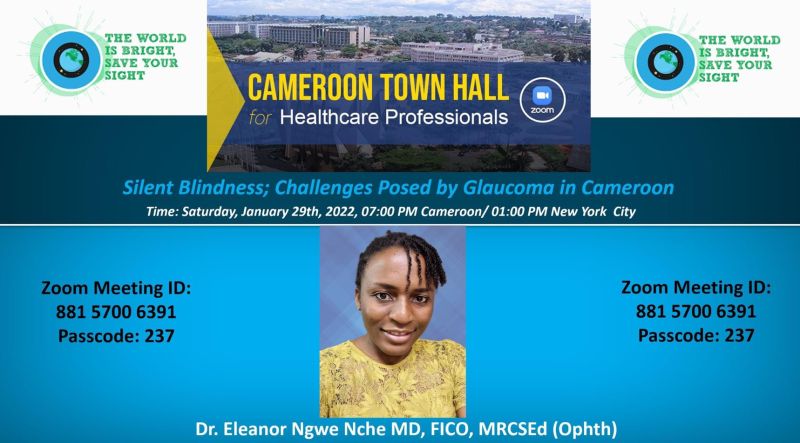
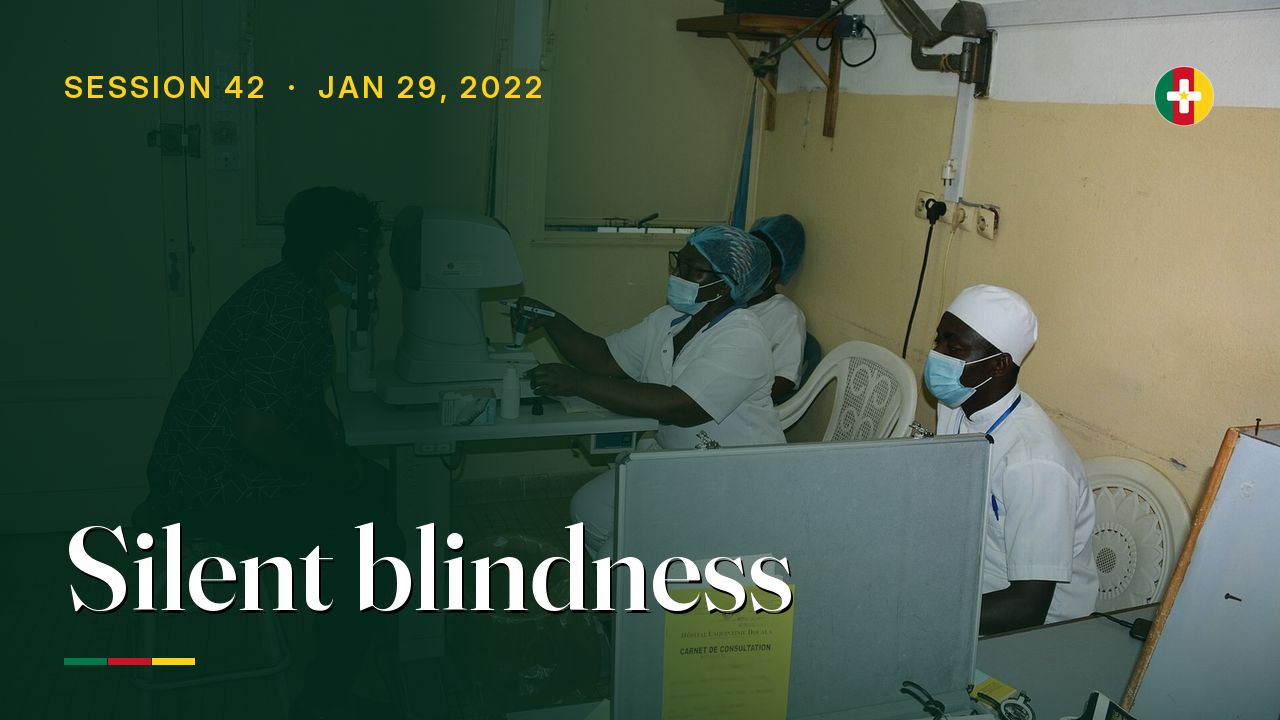
This policy briefing synthesises key insights from the Cameroon Town Hall for Healthcare Professionals meeting held on 29 January 2022, the 42nd edition, focusing on the theme "Silent Blindness: Challenges Posed by Glaucoma in Cameroon," presented by Dr. Eleanor Ngwe Nche, ophthalmologist and cornea surgeon trained at Hadassah, Jerusalem.
Context
Glaucoma is the leading cause of irreversible blindness worldwide, and people of black African descent develop it earlier and more aggressively. Cameroon had about three ophthalmologists per million people in 2016, mostly in large cities, so most patients reach care only after vision is lost. The session coincided with glaucoma awareness month.
Key issues
- Late diagnosis. Glaucoma has no symptoms until late, and many believe loss of sight is normal with age. Hospital data showed 4.5 to 8.2 percent of eye patients had glaucoma, and a quarter of young patients already had total cupping.
- Too few eye specialists. Three ophthalmologists per million people, only a quarter with surgical skills, one training programme producing few graduates, and no optometry school.
- Cost and availability of treatment. Drops cost 10,000 to 15,000 FCFA a bottle and must be used for life; lasers and surgery are limited to a few centres.
- Weak diagnostic capacity. Few centres have OCT and visual field machines, leading to conflicting diagnoses, as reported by an endocrinologist at Yaounde Central Hospital.
- Missed screening points. Primary care rarely checks visual acuity, school entry has no vision screening, and fitness-to-drive certificates are often signed without a vision test.
Discussion highlights
- Participants agreed that general practitioners and nurses in the periphery must act as the first line of eye care.
- Smartphone fundus photography and telemedicine with diaspora experts were seen as practical first steps.
- Vision screening at school entry and for driving licences was proposed as a cross-sector measure.
- Myths about cannabis and alcohol as glaucoma treatment should be addressed in public messaging.
Recommendations
- Integrate eye checks into primary care. MINSANTE and regional delegations should require visual acuity charts and direct ophthalmoscopes in district hospitals and integrated health centres, and train staff to measure pressure with portable tonometers. First step: a short training for health centre chiefs led by the regional ophthalmologist in one region.
- Screen high-risk groups. Hospitals should screen diabetics, hypertensives, long-term steroid users and relatives of glaucoma patients, and use the 'glaucoma suspect' label until confirmation.
- Expand the eye care workforce. MINSANTE and training schools should increase ophthalmology training places, create optometry and ophthalmic officer training, and strengthen ophthalmology teaching in medical and nursing schools.
- Make glaucoma drops affordable. MINSANTE should consider adding basic glaucoma drops to essential medicines lists and special health funds so patients can stay on lifelong treatment.
- Vision screening for schools and drivers. MINSANTE, the education ministries and the transport ministry should introduce vision checks at school entry and a real vision test for driving licence certificates.
- Pilot teleophthalmology. Diaspora professionals and partners should pilot smartphone fundus imaging in district hospitals, with images reviewed remotely by ophthalmologists.
Next steps
Follow-up session in two weeks (about 12 February 2022), with details to be confirmed. A later session on AI in health was announced for 26 February 2022.
Conclusion
Glaucoma steals sight silently, and in Cameroon it is found too late. Training and equipping primary care staff, screening high-risk groups, expanding the eye workforce and making treatment affordable would preserve vision for many patients.
Meeting minutes
Agenda
- Welcome by the lead moderator and the co-moderators
- Opening remarks and COVID-19 update by the Chair, Dr. Munoh Kenne Foma
- Introduction of the guest speaker
- Presentation by Dr. Eleanor Ngwe Nche on "Silent Blindness: Challenges Posed by Glaucoma in Cameroon"
- Participant reflections, discussion and Q&A
- Closing remarks by the moderators and vote of thanks by the Chair
- Parking lot discussions (celebration of the AFCON win)
Opening remarks
- The lead moderator welcomed participants to the 42nd edition of the town hall and noted that Cameroon had just beaten The Gambia at the Africa Cup of Nations hosted in Cameroon.
- The Chair said the town hall belongs to all health workers and sympathisers, and invited members to propose people doing good work in Cameroon and problems that need to be discussed. He noted this was the first session on ophthalmology.
- COVID-19 update by the Chair: he said vaccines remained effective during the Omicron wave, that unvaccinated patients filled ICU beds in his hospital, and that data from Israel, the UK and the US showed booster doses reduced deaths and hospitalisation. He called 2022 'the year for therapeutics', citing Paxlovid and molnupiravir, and said fluvoxamine was a lower-cost option with data suggesting it reduced severity.
- He criticised the travel restrictions placed on South Africa after it identified Omicron, raised cold chain gaps for donated vaccines in Africa, and urged continued masking and vaccination.
Presentation
1. Three true stories
Dr. Nche opened with three cases: a child with large eyes who avoided sunlight and was seen as a poor student, a young engineer who discovered he could not see in one eye, and an elderly woman, blind for years from glaucoma and confused by her many eye drops, who died after falling into a pit near her toilet at night. She said all three were real and that many people with glaucoma move around undiagnosed because the disease has no symptoms.
2. What glaucoma is
Glaucoma was defined as a chronic progressive optic neuropathy that damages the optic nerve and retinal nerve fibre layer. High intraocular pressure is the main risk factor but is not part of the definition, so patients can have glaucoma with a 'normal' pressure. She noted that mean intraocular pressure in Africans (about 15.5) is higher than in Caucasians, and that the damage is irreversible.
3. Who is at risk
Risk factors listed were age over 60 (40 for primary open angle glaucoma), black African descent, family history (highest when a sibling is affected), steroid use including inhaled steroids in asthmatics, diabetes, high myopia (above six dioptres), hypertension, a thin central cornea (under 500 microns), eye injury and sleep apnoea. In black Africans the disease starts earlier and runs a more aggressive course, and primary open angle glaucoma is the form that is a public health problem.
4. Signs and diagnosis
In children the warning triad is tearing, excessive blinking and fear of light, with enlarged or cloudy corneas and falling school performance. In adults symptoms include halos around lights, blurred vision, headaches and loss of peripheral vision, often noticed only at the stage of tunnel vision. A cup to disc ratio above 0.7 carries about a 95 percent chance of glaucoma. Confirmation uses tonometry, pachymetry, gonioscopy, visual fields and optical coherence tomography of the nerve fibre layer.
5. Treatment
Treatment aims to keep pressure at a target level for life to slow loss of vision, and should be chosen for low side effects, minimal disruption of daily life and affordable cost. Options include eye drops (prostaglandin analogues, beta blockers, carbonic anhydrase inhibitors, alpha agonists), acetazolamide (Diamox), lasers and surgery such as trabeculectomy and tubes. She warned that beta blocker drops can cause bronchospasm and bradycardia, alpha agonists are contraindicated in infants, and most glaucoma drops except brimonidine are pregnancy category C. She said cannabis is not recommended by any major ophthalmic body: THC lowers pressure for only three to four hours and CBD may raise it.
6. The burden in Cameroon
She cited a hospital prevalence of 4.5 to 8.2 percent among patients seen at eye services, against an African figure of 4.16 percent. A 2011 hospital study found primary open angle glaucoma the second cause of blindness, with 19.7 percent of 927 patients bilaterally blind from glaucoma. About 15 percent of diabetics referred to Douala General Hospital had glaucoma, and among patients aged 10 to 35 with glaucoma, 88.3 percent had a family history and 25 percent already had total cupping.
7. Access to care
Most drops are available only in large cities and cost about 10,000 to 15,000 FCFA a bottle, with some patients needing three bottles a month. Lasers and surgery exist in few centres. According to the International Council of Ophthalmology, Cameroon had three ophthalmologists per million people in 2016, only 25 percent with surgical skills, mostly in big cities. She named public referral hospitals, the Magrabi ICO Cameroon Eye Institute, and Baptist and Presbyterian eye networks as main providers.
8. What can be done
Individuals of African descent should get screened, ask about family history and stay on treatment. Health professionals should check visual acuity, practise with the direct ophthalmoscope and refer early, since general practitioners in the periphery are 'the ophthalmologists' for their patients. Nationally she called for population screening, awareness programmes, equipping facilities with acuity charts and ophthalmoscopes, training non-ophthalmic staff to measure pressure with portable tonometers, and using tele-glaucoma, smartphone fundus imaging and AI.
Discussion and Q&A
- Participants asked whether marijuana and alcohol help glaucoma. Dr. Nche said the pressure-lowering effect of THC lasts three to four hours and of alcohol about one hour, so a patient would need to be intoxicated all day to benefit, while CBD may raise pressure. Twice-daily eye drops work better with far fewer side effects.
- A senior colleague, whose son is followed for glaucoma, asked what is being done to bring more doctors into ophthalmology given three ophthalmologists per million people. She said ophthalmology is poorly taught and seen as an easy specialty, that only one programme trains ophthalmologists (about four a year when she checked), and that Cameroon has no optometry school. She called for ministry programmes that treat eye health as a priority and said she personally mentors trainees, but one person cannot reach 25 million people.
- Can both open angle and angle closure glaucoma cause headache? Yes, any raised pressure can. Angle closure tends to present acutely with severe pain, while open angle develops slowly. A young person with chronic headache should see both a neurologist and an ophthalmologist.
- Is a vision test required for a driving licence in Cameroon? She described her study of commercial drivers in motor parks in Buea and Limbe, where about 10 percent did not have adequate vision in their better eye and most had not seen an eye doctor in years. She asked how many doctors had signed fitness-to-drive certificates without testing vision.
- Dr. Anne Ongmeb Boli, endocrinologist at Yaounde Central Hospital, asked why diabetic patients are diagnosed with glaucoma by one ophthalmologist and told they do not have it by another. Dr. Nche said diagnosis depends on the clinician's competence and on equipment such as OCT, which few centres have. She suggested labelling uncertain cases 'glaucoma suspects' until confirmed, and offered to review difficult cases with referring doctors.
- A physician working in digital health in the United States asked whether telemedicine infrastructure exists in Cameroon, proposing that diaspora experts could review images sent by phone. She knew of no functioning teleophthalmology programme in Cameroon, cited India's model of trained technicians taking images in districts, and said WhatsApp-based advice was already possible. The lead moderator added that town hall members had collaborated with clinicians in the North West during the COVID-19 peak.
- The Chair asked how ophthalmology can be better integrated into medical and nursing education, noting he never referred patients to an ophthalmologist as a general practitioner in Bamenda. She cited Moses Chirambo in Malawi, who trained ophthalmic officers to perform cataract surgery, and proposed that regional ophthalmologists train nurses and health centre chiefs around them, noting a phone torch is enough to spot a cataract.
- Dr. Bryan Tegomoh asked about the prevalence of normal tension glaucoma, mentioning his father's eye lost to glaucoma that went undiagnosed because his pressure was normal, and how to improve screening. She said African data on normal tension glaucoma are scarce. A nurse with a smartphone could dilate patients and send fundus photos for review, and suspicious cases could start treatment before referral given the cost of travel.
- Elvis Ndansi asked whether the ministries of basic and secondary education could require vision screening before school entry, citing his son who could not see the board. She agreed, describing screening at birth and at school entry elsewhere, and raised retinopathy of prematurity and amblyopia, noting that a child who does not see well before about age eight may not recover vision even with glasses.
Calls to action and closing
- The moderators thanked the speaker; Dr. Tegomoh said it was the simplest ophthalmology lecture he had attended.
- Elvis Ndansi said the town hall should keep talking about this public health problem and find resources to act.
- The Chair thanked Dr. Nche, proposed training auxiliary staff and nurses to close the gap, thanked the moderators, and reminded members that the platform belongs to all of them.
- Participants asked for the speaker's contact details so they could refer patients.
- The lead moderator officially closed the 42nd edition and invited members to the parking lot to celebrate the AFCON win.
Next meeting
In two weeks (about 12 February 2022). Details to be confirmed.
Submitted by the Co-Moderators, Cameroon Town Hall for Healthcare Professionals.