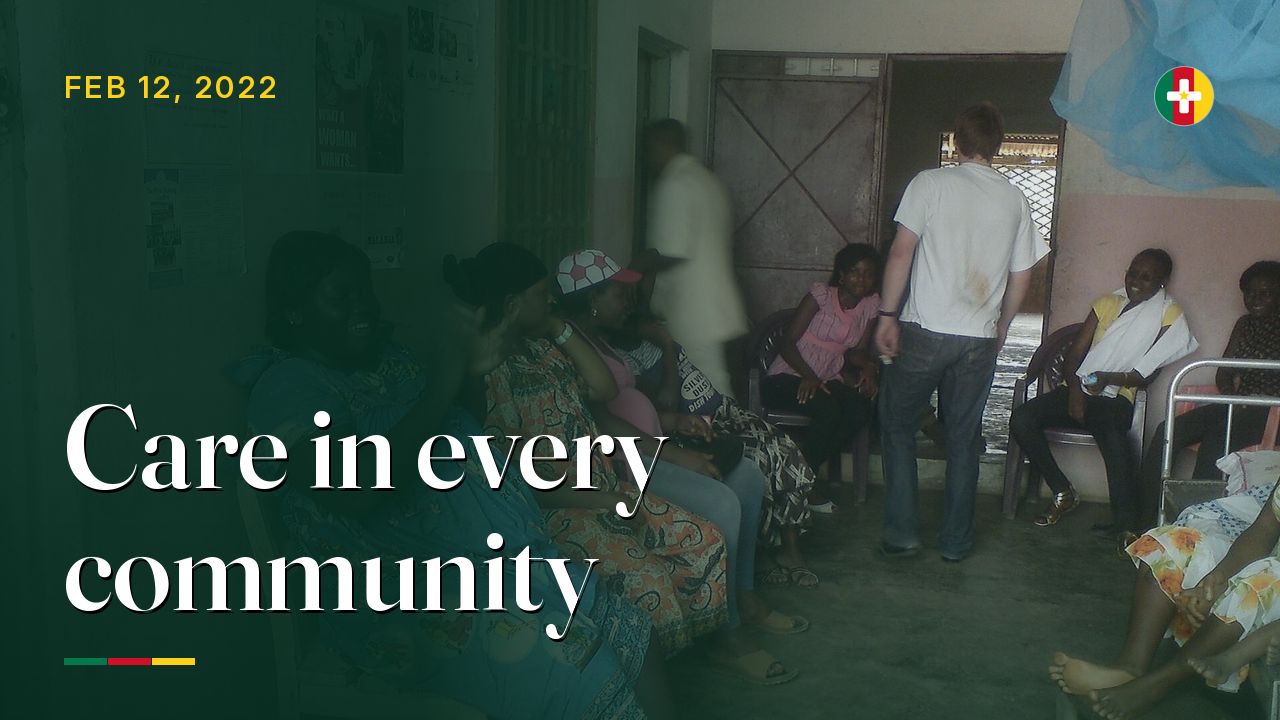
Reaching Cameroon's Last-Mile Communities with Community Oriented Primary Care
Overview
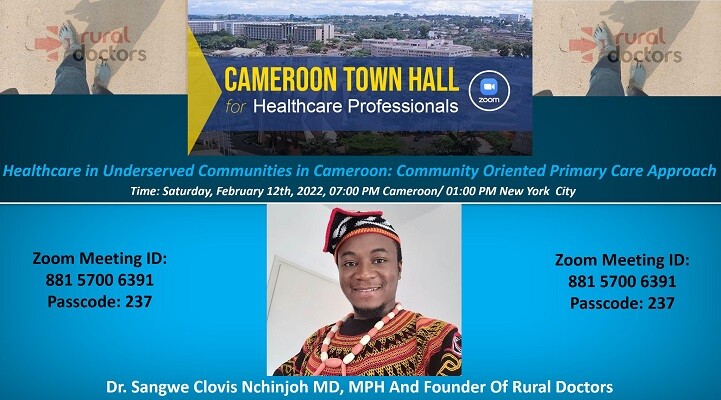
This policy briefing synthesises key insights from the Cameroon Town Hall for Healthcare Professionals meeting held on 12 February 2022, focusing on the theme "Healthcare Access in Underserved Communities: A Community Oriented Primary Care Approach," presented by Dr. Sangwe Clovis Nchinjoh, founder of Rural Doctors and CHAI Associate Routine Immunization Officer for missed communities.
Context
Some Cameroonian communities, such as the 47 islands of Manoka Health District near Douala, have no health centres, no electricity at the district hospital, one boat a day and very low immunisation coverage. Their number has never been measured. Vertical programmes struggle there, and outbreaks such as cholera spread easily.
Key issues
- Physical inaccessibility. Island and enclaved communities depend on rare, costly or unsafe transport, and night travel is often impossible, making emergency obstetric care and referral unreachable.
- Basic facility gaps. A district hospital without electricity, blood transfusion or general anaesthesia forced a caesarean section under local anaesthesia and torchlight.
- Programmes that ignore local priorities. Vaccination and hygiene campaigns fail when they arrive alone in communities facing hunger, cholera and maternal deaths, and when community structures are not involved.
- Workforce distribution. Doctors posted to rural areas often do not go, and experienced general practitioners leave rural posts to specialise. Community health workers in remote areas are unpaid.
- No data on underserved communities. Only quantitative coverage figures exist; no study maps these communities or explains why services fail.
Discussion highlights
- The community health framework already exists on paper; the gap is implementation of health area and district committees.
- Projects must link to district health services and DHIS2 and join regional NGO coordination to last.
- Debate on whether community health workers should be paid in remote areas or kept part-time with other livelihoods.
- Trusted, familiar health workers made cholera vaccination succeed in Manoka.
Recommendations
- Map underserved communities. MINSANTE and regional delegations should identify and list hard-to-reach communities (islands, enclaves, arid zones) and run qualitative studies on barriers to care. First step: a census of island communities in Douala VI and Bakassi with zero-dose children.
- Enforce the community health framework. District medical officers should ensure health area (COSA) and district (COSADI) committees meet and that community health worker data reach health centres and DHIS2.
- Pay and support remote community health workers. MINSANTE and partners should provide stipends and job aids to community health workers in communities with no health facility, linked to the nearest health centre.
- Create a remote and rural medicine pathway. MINSANTE and training schools should consider a remote and rural medicine specialty and better pay, housing and connectivity for remote postings.
- Use COPC to integrate programmes. Immunisation and other vertical programmes, with partners such as CHAI, should be delivered within a community oriented primary care plan built on needs the community ranks first.
- Mobilise diaspora support for training. Diaspora professionals should fund and mentor the Rural Doctors COPC training with field projects; the Chair offered to sponsor the first sessions.
Next steps
Follow-up session in two weeks (about 26 February 2022), with details to be confirmed. The Chair and the speaker were to discuss support for the training programme in the parking lot and in private.
Conclusion
Geography should not decide who gets care. Cameroon's last-mile communities need the community health system already designed on paper to work in practice, with paid community health workers, supported remote postings and programmes planned with the community.
Meeting minutes
Agenda
- Welcome and introduction of moderators by Elvis Ndansi
- Opening remarks and COVID-19 update by the Chair, Dr. Munoh Kenne Foma
- Introduction of the guest speaker by a co-moderator
- Presentation by Dr. Sangwe Clovis Nchinjoh on healthcare access in underserved communities and the community oriented primary care approach
- Discussion and Q&A, moderated by Dr. Bryan Tegomoh
- Moderators' reflections, summary by Elvis Ndansi and closing
- Parking lot discussions
Opening remarks
- Elvis Ndansi said the town hall had more than 1,200 subscribed members in over 34 countries and had met every two weeks without skipping a session for about a year and a half.
- The Chair reminded members that the platform is open to all health professionals and anyone who wants to change health in Cameroon, including engineers and lawyers.
- COVID-19 update by the Chair: he said the world could test and vaccinate its way out of the pandemic but not lock down, that boosters sharply reduced death and hospitalisation in all age groups, and that ICU patients in his New York hospital were unvaccinated. He congratulated Cameroon for hosting the Africa Cup of Nations during the Omicron wave, raised cold chain gaps for donated vaccines, and called for equitable access to Paxlovid and molnupiravir in Africa, noting Eli Lilly's pledge on baricitinib.
- Dr. Tegomoh added that the FDA had just authorised a new Omicron-specific monoclonal antibody from Eli Lilly. Dr. Obadia Mfuh Kenji reported that his Stanford laboratory had processed one million COVID-19 samples and that sample volume had fallen by more than half.
Presentation
1. What an underserved community looks like
Dr. Sangwe used Manoka Health District (Douala VI) as his example: about 47 islands served by one district hospital and no health centres, two hours 30 minutes by boat from Douala, with one commercial boat a day. Hiring a speed boat to tour the islands could cost close to one million FCFA, so staff often travel in risky fishing boats. He said no research has quantified how many such communities exist in Cameroon, whether islands, arid areas in the north or mountain enclaves.
2. Access shapes behaviour
He argued that what outsiders call tradition, such as home births or reliance on herbalists and roadside drug vendors, is often an adaptation to lack of access. A woman in labour at night on an island cannot cross the sea after 7 pm. Communities facing hunger and cholera will not prioritise vaccines, so services must start from the problems the community itself ranks first.
3. A caesarean section without electricity
In 2018 a full-term pregnant woman arrived at Manoka District Hospital bleeding heavily with fetal distress after waiting overnight for the boat. The hospital had no electricity, no blood transfusion, no general anaesthesia and the daily boat had left. After phoning colleagues in Douala and reading on local anaesthesia, the team performed a caesarean section with lidocaine and torchlight; mother and baby survived. This led him to do home-based antenatal care with a portable ultrasound across the islands.
4. Why these communities matter
Manoka had about 2 percent routine polio immunisation coverage. He said vertical programmes such as HPV or COVID-19 vaccination fail when they are not integrated with services people value, that mobile fishing communities can become reservoirs for outbreaks that spread to cities, and that universal health coverage must include every community. He described a cholera outbreak where hand washing campaigns failed and oral cholera vaccination was finally used.
5. System changes needed
Using the health system building blocks, he called for real community participation in governance, a specialty in remote and rural medicine (as in Australia) so experienced general practitioners are not lost to cities, paid community health workers in remote areas, contextualised primary care, and supply chains that keep anaesthetics and basic drugs available.
6. The COPC cycle
He presented the community oriented primary care model learned at Hebrew University: define one target population, identify its health needs through data and field observation, prioritise them with explicit scoring criteria, assess the chosen problem in detail, plan and implement interventions with the community, then evaluate and reprioritise. New programmes such as vaccination should be built into this cycle rather than run alone.
7. Rural Doctors and next steps
Rural Doctors always works through district health services, integrates community health workers and plans a national network of them. It was running a French Embassy funded project in selected Manoka islands, linking community health workers to nearby facilities, and an operational research study funded by the Pears Foundation through the Braun School alumni programme. Next steps were scaling up to new communities, a training course with two weeks of field work leading to funded student projects, and advocacy for underserved communities.
Discussion and Q&A
- A Cameroonian doctor working in England asked how to strengthen the community component so services continue when a doctor leaves. Dr. Sangwe said the government's community health framework already exists but is not implemented. If district medical officers ensured that health area committees (COSA) and district committees (COSADI) met as required, and community health workers were paid, a new doctor could step into a working system.
- The Chair recalled working on islands near Limbe and in a Bamenda hospital without water, and shared an evaluation in the Far North where women destroyed new wells because fetching water was their only time away from home. He asked how Rural Doctors would remain sustainable without its founder. Dr. Sangwe said Rural Doctors now has an office in Buea, staff including a human resources officer, journalists on the team, and young public health graduates trained in grant writing, so the vision does not depend on him. He sees Cameroon as a pilot for expansion in Africa.
- A public health specialist and Hebrew University alumnus asked how the work links to the Cameroon health system beyond the district, noted that community health workers are meant to be part-time with other livelihoods, and asked whether Rural Doctors joins NGO networks. He said community data flow through health centres to the district and into DHIS2, that national policy work is costly (about 10 million FCFA to review a draft) and is the role of other institutions, and that Rural Doctors began joining regional cluster meetings in the South West late in 2021 and planned to do so in the North West.
- A public health physician at the Littoral Regional Delegation, who supervised the speaker in Manoka, asked how to get posted doctors to actually work in rural areas. He admitted his first posting was hard: he was not yet on the government payroll and had no internet. He said pay and living conditions for remote postings must be reconsidered, which is a matter of administration and political will.
- A co-moderator relayed questions from people who wanted to support the work. He named two priorities: helping three new remote communities (in the South West and North West) build their own community health systems, and the training programme for health workers and project managers. Support could be ideas, volunteering in the field, funds, essential drugs or vehicles.
- Dr. Katte Jean-Claude stressed feeding data back to the district and asked how cholera vaccination was received in Manoka. Uptake was high because people had seen deaths during the outbreak and because the vaccinators were nurses and a doctor the islanders already knew and trusted.
- A nurse midwife working on sickle cell disease in a community described training health workers and community health workers for home and school visits. She proposed joining efforts and sharing contacts with Rural Doctors.
Calls to action and closing
- Louisa Viban, who had volunteered with Rural Doctors and was training in rural medicine in Canada, said the approach applies anywhere.
- Dr. Christelle Jouego Tagne urged diaspora members who cannot work on the ground to support local initiatives such as Rural Doctors.
- The Chair pledged to personally support the training programme, one training at a time, and to connect the speaker with others, adding that each community should define its own minimum package of activities.
- Elvis Ndansi summarised the session and thanked the speaker, the Chair and the moderators.
Next meeting
In two weeks (about 26 February 2022). Details to be confirmed.
Submitted by the Co-Moderators, Cameroon Town Hall for Healthcare Professionals.