Breast Cancer in Low-Resource Settings: Metastatic Disease and Special Situations
Overview
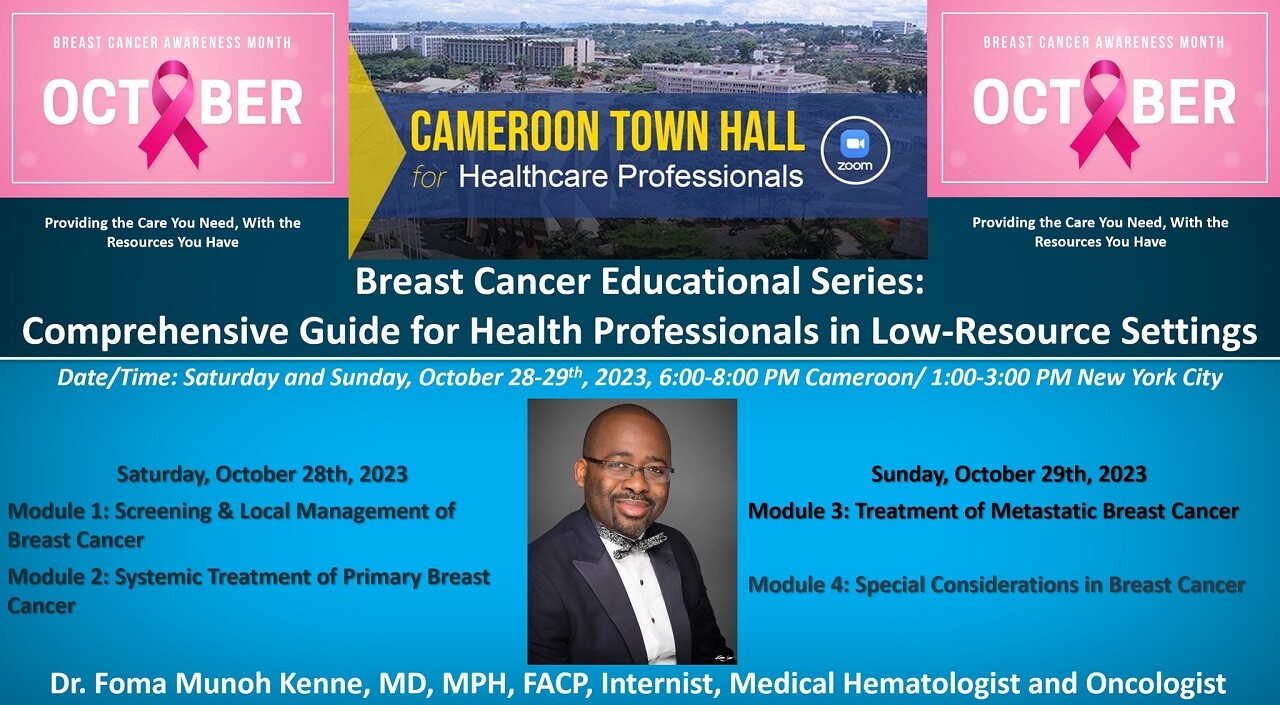
This policy briefing synthesizes key insights from day two of the Cameroon Townhall for Healthcare Professionals special Breast Cancer Educational Series, held on October 29, 2023, presented by Dr. Munoh Kenne Foma, hematologist and medical oncologist, on the treatment of metastatic breast cancer and special situations.
Context
Most breast cancers in Cameroon are diagnosed at the metastatic stage. There is no national screening programme, receptor testing is slow and centralised, there is one linear accelerator, and most modern targeted drugs are unavailable or unaffordable. About 80% of breast cancers are hormone positive and could be treated with cheaper endocrine therapy, but many patients receive chemotherapy without known receptor status.
Key issues
- Treatment without receptor status. Many patients get costly, toxic chemotherapy without ER, PR and HER2 testing, which can take up to two months.
- Missing medicines. CDK4/6 inhibitors, pertuzumab, trastuzumab deruxtecan, immunotherapy and PARP inhibitors are unavailable; trastuzumab is very expensive.
- Diagnostic gaps. Fine needle aspiration and excision biopsy are still common, image guided and stereotactic biopsy are lacking, and bone scintigraphy and PET are unavailable.
- Special situations poorly handled. Pregnancy, fertility, male breast cancer and inflammatory cancer are often managed on outdated assumptions.
- Workforce and teamwork. Few tumour boards, limited palliative care and no continuing medical education requirement.
Discussion highlights
- Start endocrine therapy while awaiting receptor results when there is no visceral crisis.
- Stage before surgery; surgery does not help metastatic disease.
- Radiologists should lead image guided biopsy; stereotactic biopsy is needed.
- GP practice varies widely; simple national guidance was requested.
- Fertility preservation is available in Cameroon for those who can afford it.
Recommendations
- Decentralise receptor testing. MINSANTE and Centre Pasteur du Cameroun should make ER, PR and HER2 immunohistochemistry available in every region with a target turnaround of under a month. First step: equip and train one laboratory per region, starting with the regional hospitals.
- Update the essential medicines list. MINSANTE should add at least one CDK4/6 inhibitor and pertuzumab, negotiate lower trastuzumab prices with partners such as CHAI, and ensure aromatase inhibitors, tamoxifen and fulvestrant are always in stock. First step: a costed request to the national essential medicines committee.
- Issue national breast cancer guidelines. MINSANTE, with oncologists, surgeons, gynaecologists and radiologists, should publish simple guidelines covering core biopsy, staging before surgery, receptor testing before treatment, endocrine first treatment for hormone positive disease, and management in pregnancy. First step: a one page referral and work up algorithm for GPs.
- Build tumour boards and imaging capacity. University and regional hospitals should run multidisciplinary tumour boards and train radiologists in image guided and stereotactic biopsy, with support from MedRad Africa and diaspora specialists. First step: a pilot tumour board linking Douala, Yaoundé and Buea online.
- Make continuing education mandatory. The National Medical Council should require CME for doctors treating cancer, and training schools should strengthen internal medicine and oncology teaching. First step: accredit the town hall's breast cancer series for CME.
- Expand screening and palliative care. MINSANTE should include mammography every two years from age 50 in universal health coverage and support palliative care training for nurses and other staff, building on Baptist and Catholic programmes.
Next steps
Lectures were to be posted on YouTube, slides sent to attendees, and future lectures offered with CME accreditation. Participants proposed a case discussion group linking diaspora and local doctors.
Conclusion
Most metastatic breast cancers in Cameroon are hormone positive and could be treated with available, affordable endocrine therapy if receptor status were known. The session argued that faster testing, simple national guidelines, teamwork and prevention would save more lives than access to the newest drugs.
Meeting minutes
Agenda
- Welcome and recap of day one (screening and local management of breast cancer) by Dr. Munoh Kenne Foma
- Module 3: treatment of metastatic breast cancer
- Module 4: special situations (pregnancy, fertility, male breast cancer, unusual histologies, inflammatory breast cancer, what is new)
- Discussion and Q&A
- Closing remarks
Opening remarks
- Dr. Foma said day one had drawn over 70 participants and that the aim of the series was to give health workers in Cameroon up to date, evidence based data on breast cancer, since most cases in Cameroon are diagnosed at the metastatic stage and screening is not national policy.
- He introduced himself: trained at the Faculty of Medicine and Biomedical Sciences in Yaoundé, first posted to the Bamenda Regional Hospital and later a hospital director there, then trained in clinical pathology and public health before internal medicine and hematology/oncology in New York. He said the views were his own and not those of his employer, and that he was not paid.
- He said cancer care is a team sport that needs tumour boards and centres of excellence, and recapped day one: preventive medication for high risk women (tamoxifen before menopause; tamoxifen, raloxifene, exemestane or anastrozole after), mammography every two years from age 50 as part of universal health coverage, full staging before surgery, no surgery for metastatic disease except for symptoms, mastectomy as equivalent to breast conserving surgery plus radiation, sentinel lymph node biopsy, and core biopsy instead of fine needle aspiration.
- He noted that Cameroon has only one functioning linear accelerator, in the private sector and not subsidised, that trastuzumab remains very expensive and should be on the essential medicines list, and that pertuzumab is not available.
Presentation
1. Know the receptor status before treating
Dr. Foma said metastatic breast cancer remains incurable and the goals are longer survival, symptom control and quality of life, with palliative care, which in Cameroon is led mainly by the Baptist and Catholic health services. No patient should be treated without known ER, PR and HER2 status, and metastatic lesions should be biopsied where possible ('no tissue, no issue'), which requires training in interventional radiology and breast imaging. He called for Centre Pasteur to decentralise receptor testing to every region and said chemotherapy for hormone positive disease without knowing the status is causing harm.
2. Hormone positive disease: endocrine therapy first
About 80% of breast cancers are ER or PR positive, and he said chemotherapy is harmful as first line in metastatic hormone positive disease except in visceral crisis or inflammatory cancer. The world standard is an aromatase inhibitor (anastrozole, letrozole or exemestane) with a CDK4/6 inhibitor (palbociclib, ribociclib or abemaciclib), which improved survival in the PALOMA, MONALEESA and MONARCH trials; these are not available in Cameroon but can be obtained from France by those who can afford them and should be added to the essential list. Where they cannot be afforded, an aromatase inhibitor, tamoxifen with ovarian suppression, or fulvestrant, all available in Cameroon, should be used. CDK4/6 inhibitors need monitoring by an oncologist for cytopenias and QT prolongation.
3. HER2 positive disease
HER2 positive cancer is hard to treat in Cameroon because the drugs are expensive or unavailable. First line is a taxane with trastuzumab and pertuzumab (CLEOPATRA trial), second line trastuzumab deruxtecan, which he said received a standing ovation at ASCO, and third line T-DM1 or tucatinib with trastuzumab and capecitabine, with attention to brain metastases. Trastuzumab is available but costly; pertuzumab and trastuzumab deruxtecan are not.
4. Triple negative disease
Triple negative cancer, about 20% of cases and more common in young women, needs chemotherapy, with single agent anthracycline or taxane regimens. PD-L1 testing guides immunotherapy with pembrolizumab, and sacituzumab govitecan, olaparib and talazoparib for BRCA carriers, and trastuzumab deruxtecan for HER2 low disease have changed care, but none is available in Cameroon. He concluded that the system is too fragile to treat metastatic disease, so prevention and early diagnosis must come first, and that bones must be protected with bisphosphonates or denosumab after dental clearance.
5. Breast cancer in pregnancy
He said termination does not improve survival. A breast lump lasting two weeks in a pregnant woman should be examined; ultrasound, mammography with shielding, core biopsy (telling the pathologist the patient is pregnant), x-rays and non contrast MRI are safe, while CT, bone scans and gadolinium should be avoided. Surgery is safe; radiation, methotrexate, trastuzumab, endocrine therapy and immunotherapy must not be given. Anthracyclines and taxanes are safe in the second and third trimesters, stopping around 35 weeks, and recent MD Anderson data show survival similar to non pregnant women.
6. Fertility after treatment
Every young patient should be counselled on fertility before chemotherapy. GnRH agonists during chemotherapy help preserve ovarian function, embryo and oocyte cryopreservation are options, and he advised waiting about two years after finishing treatment before pregnancy, with no evidence of worse outcomes for mother or child. He also covered survivorship issues: vaginal dryness, sexuality, body image, depression, bone loss and weight gain.
7. Male breast cancer and other special cases
Men can have breast cancer; risk factors include BRCA2 mutations, family history, Klinefelter syndrome, radiation and liver disease, and all men with breast cancer should have genetic counselling. Treatment mirrors women's, with tamoxifen as the cornerstone. Tubular and mucinous cancers have a good prognosis and are nearly all hormone positive; metaplastic cancers are aggressive; phyllodes tumours need wide excision. Inflammatory breast cancer is a clinical diagnosis requiring staging, preoperative systemic therapy, mastectomy with axillary dissection and radiation, never breast conserving surgery. He closed with circulating tumour DNA and next generation sequencing as the direction of oncology.
Discussion and Q&A
- A surgeon in Douala: in young pregnant women with dense breasts, should ultrasound or mammography come first? Dr. Foma said ultrasound is the standard under 40 and both should be combined in a pregnant woman with a lump; breast MRI with gadolinium is not allowed.
- Same surgeon: does tamoxifen affect male fertility, and should the two year wait start at diagnosis or after treatment? There is little data on male fertility. The two years count from the end of treatment.
- Same surgeon: in Cameroon it can take two months to get ER/PR results from Centre Pasteur, and up to five months to complete a work up. What should be prioritised? Dr. Foma said to stage first (a CT of the chest, abdomen and pelvis costs about 50,000 CFA francs), since surgery is useless in metastatic disease, then send 50,000 to 100,000 francs worth of receptor testing, and start endocrine therapy while awaiting results if there is no visceral crisis. He said every regional hospital in Ghana can do immunohistochemistry and asked why it is so complex in Cameroon. He added that Cameroon trains more cardiologists than internists and needs to reform internal medicine training.
- A participant: is there screening for male breast cancer? No general screening, since the number needed to screen would be too high; only men with BRCA, CHEK2 or strong family history are screened.
- A gynaecologist in Buea: comments on fertility preservation and pregnancy He said fertility preservation is possible in Cameroon, naming two centres, one of them in Douala, and that the talk corrected the belief that chemotherapy must wait until after delivery. He said the main problem is organisation, with specialists claiming a monopoly of knowledge.
- Dr. Joshua Tambe, radiologist: imaging comments He said metastatic work up relies on CT and MRI because bone scintigraphy has not worked for years and there is no PET; request forms often lack clinical information; many clinicians confuse screening and diagnostic mammograms; GPs order irrelevant studies; 14 gauge core biopsy gives the best samples; and no centre in Cameroon does stereotactic biopsy for microcalcifications. Dr. Foma said radiologists should lead image guided biopsy and suggested working with MedRad Africa.
- A surgical consultant: excision biopsy and triple assessment He argued excision biopsy remains useful because many doctors lack core biopsy needles, stressed triple assessment, said mammography has limits and young women should learn breast self examination, and said he starts tamoxifen while awaiting receptor results. Dr. Foma replied that radiation after axillary surgery depends on the number of positive nodes, that WHO recommends mammography every two years from 50 to 75, and that excision biopsy is advised against because it often means two operations and positive margins.
- A family physician in the UK: what should a GP in Cameroon do with a suspected breast cancer, and are there simple guidelines? The gynaecologist from Buea said GPs in towns refer to specialists but those in remote areas often manage alone for economic reasons. The surgeon from Douala said practice varies, some GPs over investigate and few can perform core biopsy. Dr. Foma said he used to refer to gynaecologists and now would favour breast surgeons, and repeated that every patient who can should get receptor status and an ultrasound guided core biopsy. He also explained how cancer cells develop resistance to chemotherapy, immunotherapy and targeted therapy, in answer to the gynaecologist.
- Suggestions from participants The gynaecologist from Buea proposed a permanent link between diaspora and local doctors; another participant suggested a non political town hall WhatsApp group for case discussion. Dr. Foma said future lectures would carry CME accreditation, that the lectures would be posted on YouTube, and that slides would go to those who attended.
Calls to action and closing
- Dr. Foma said the town hall is a forum of exchange where the diaspora must come with humility, offer solutions as well as criticism, and respect colleagues who stay in Cameroon despite poor pay and conditions.
- He said the regular town hall would resume the following Saturday and invited anyone in Cameroon doing notable work to propose a session.
Next meeting
The regular town hall the following Saturday (November 4, 2023, 86th edition).
Submitted by the Co-Moderators, Cameroon Town Hall for Healthcare Professionals.