Beyond the Clinic Walls: Whole Person Care for Sickle Cell Disease in Cameroon
Overview
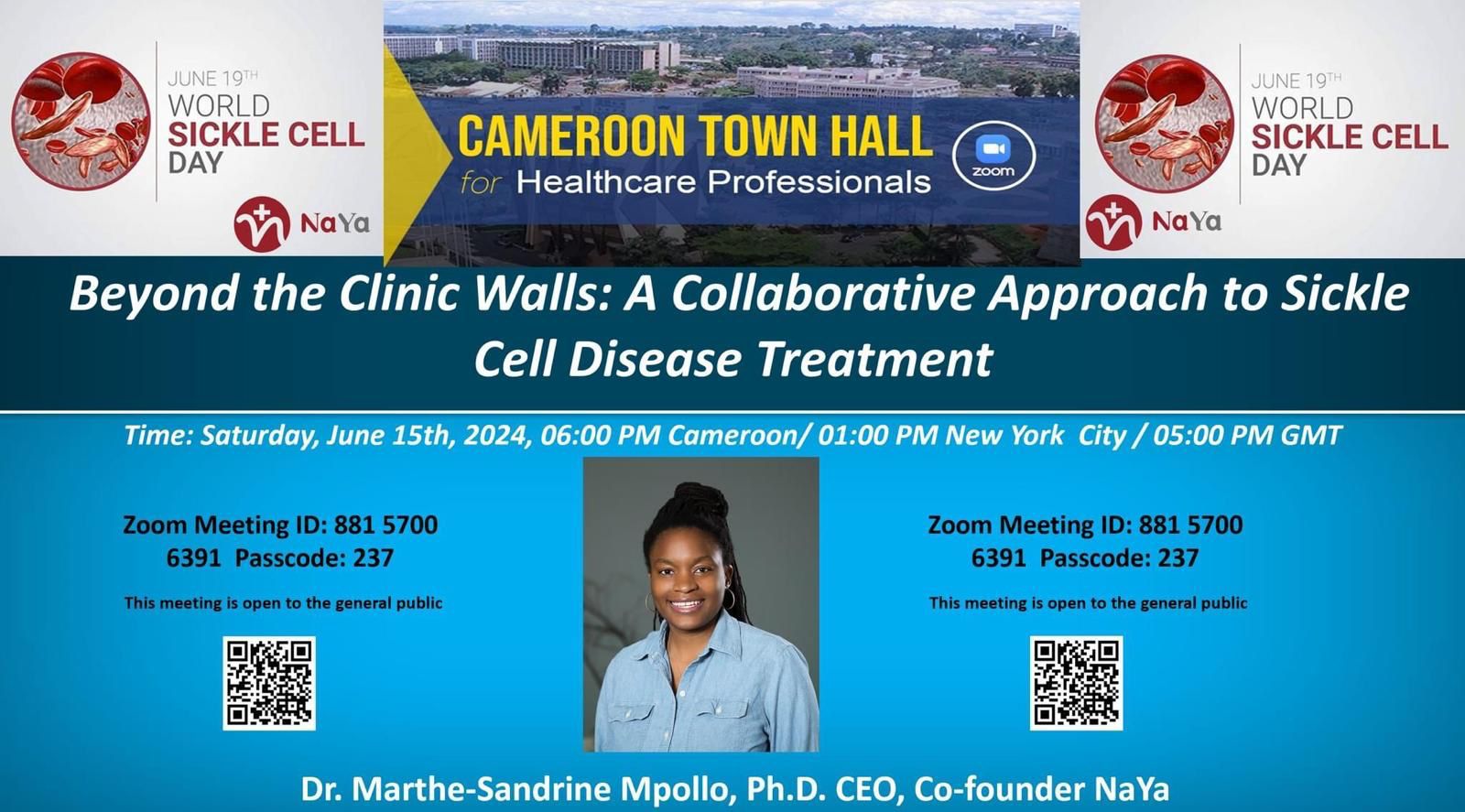
This policy briefing synthesizes key insights from the Cameroon Townhall for Healthcare Professionals meeting held on June 15, 2024 (103rd edition), focusing on the theme "Beyond the Clinic Walls: Sickle Cell Disease," presented by Dr. Marthe-Sandrine Mpollo.
Context
Cameroon has a high burden of sickle cell disease, with over 5,000 affected births a year cited and more than 500,000 carriers. New therapies are unaffordable, while evidence from Jamaica and the US shows that education, screening, early care and follow up cut mortality before modern drugs existed.
Key issues
- Affordability. Gene therapies and transplant are out of reach, and even hydroxyurea was cited at about 25 US dollars on average; penicillin stock outs occur.
- Gaps in early care. Newborn screening is not universal, penicillin prophylaxis is not routine, and catch up vaccines are not covered.
- Workforce knowledge. Few doctors prescribe hydroxyurea correctly and the move from paediatric to adult care is poorly managed.
- Social determinants. Poverty, low health literacy and provider attitudes drive emergency visits and deaths.
- Data. Little African evidence exists on social, psychological and economic burden.
Discussion highlights
- Faith leaders (the Council of Imams, churches) now encourage premarital screening.
- Community organisations such as the Yaoundé parents' association already provide peer support, savings funds and group purchase of drugs.
- Participants proposed starting awareness in schools rather than at marriage.
- Tanzania's compounded hydroxyurea showed a lower cost route.
- Students could take up modelling, psychological and economic research on sickle cell.
Recommendations
- Make newborn screening and early care standard. MINSANTE should extend newborn screening with point of care tests, enrol positive infants in care by about two to three months, give penicillin prophylaxis and the full vaccine schedule including catch up doses. First step: add newborn screening and prophylaxis to the republished national sickle cell guidelines and pilot in one region per year.
- Secure essential medicines. MINSANTE, the national procurement agency and partners should ensure continuous supply of penicillin, folic acid and hydroxyurea and assess local or pooled procurement, drawing on the Tanzanian compounding model. First step: a stock and price review of these products in regional hospitals.
- Train clinicians and plan transition. Training schools and hospitals should teach hydroxyurea prescribing and adult sickle cell care, and set up transition clinics from paediatrics. Diaspora haematologists can support case based teaching. First step: a short online course for district doctors.
- Fund and link community organisations. MINSANTE and regional delegations should recognise patient associations as partners in care navigation and education, with support for outcome reporting. First step: map existing associations and agree a simple reporting format.
- Start awareness early. MINSANTE and the education ministries should add sickle cell to school adolescent health programmes, building on HIV programme platforms, and work with faith leaders on non-stigmatising premarital counselling.
- Generate local evidence. Universities, with town hall support, should take up research on cost, psychological burden, siblings and future burden. First step: share a list of research questions with the University of Buea Faculty of Health Sciences.
Next steps
Moderators agreed to explore, with the Dean of the University of Buea Faculty of Health Sciences, student projects on sickle cell modelling and burden, and the town hall signalled readiness to support research. Participants were asked to complete the town hall survey and to mark World Sickle Cell Day on June 19.
Conclusion
The session showed that much of the gain in sickle cell survival comes from steps Cameroon can take now: education, screening, early prophylaxis, follow up and community support. Caring for the whole person, not only the cell, is within reach.
Meeting minutes
Agenda
- Welcome and opening remarks by the moderator, Elvis Ndansi, and the Chair, Dr. Munoh Kenne Foma
- Introduction of the guest speaker
- Presentation by Dr. Marthe-Sandrine Mpollo, "Beyond the Clinic Walls: Sickle Cell Disease"
- Comments by co-moderators and participants
- Discussion and Q&A
- Reminder on the participant survey, closing remarks and adjournment
Opening remarks
- The moderator welcomed participants and noted that sickle cell disease has now been the subject of three or four town hall sessions out of 103, a sign of its importance.
- The Chair said the American Society of Hematology made sickle cell a priority, which in the last ten years has brought new drugs (voxelotor, crizanlizumab), bone marrow transplant and gene editing, none of which are accessible in Africa. He asked for the discussion to move beyond clinical care to what communities are doing.
- Dr. Yauba Saidu of CHAI Cameroon, a previous speaker on eliminating sickle cell by 2060, reported that about two weeks earlier the national coordinator of the Council of Imams in Cameroon instructed all imams to require sickle cell status checks before celebrating marriages. He called this an important civil society step towards fewer affected births.
- The moderator introduced Dr. Mpollo: co-founder and executive director of NaYa Limited, a health financing and medical education start-up in West Africa that built a health financing app for low income patients and won a 2020 Orange social entrepreneur women's prize; Medical Science Liaison at Janssen in Canadian dermatology; holder of a PhD from the University of Cincinnati and an MSc from the Université de Montréal.
Presentation
1. Burden of disease
Dr. Mpollo said about 8 million people live with sickle cell disease worldwide (2021 data), a quarter of them in sub-Saharan Africa. She put prevalence in Cameroon at about 3%, with over 5,000 affected births a year, and said the disease ranks among the 12 leading causes of death in children under five. WHO recognised sickle cell awareness day (June 19) in 2008. She described the disease as systemic, driven by sickling, haemolysis, chronic inflammation and vaso-occlusion, so care must address the whole person rather than the red cell alone.
2. New therapies have not reduced the burden
She said treatment has advanced (hydroxyurea, voxelotor, crizanlizumab, and two cell based gene therapies approved in the US in November 2023, one using CRISPR to reactivate fetal haemoglobin and one adding a normal gene), yet global sickle cell births rose by close to 14% and adults in the US still live about 20 years less than average. Guidelines remain heavily clinical and target one part of the disease at a time. Gene therapies cost millions and bone marrow transplant about 100,000 dollars, while hydroxyurea at 1,000 mg a day was shown to cost on average about 25 US dollars in the countries studied, out of reach for many Cameroonian families.
3. Lessons from Jamaica and Dallas
She presented cohort data from Jamaica (1970s) and Dallas showing that survival improved before hydroxyurea was available. In Jamaica, counselling parents to recognise danger signs such as splenic sequestration cut mortality by about 71%, with further gains when vaccination came. In Dallas, newborn screening, a first visit at about 60 days, penicillin prophylaxis and active follow up of missed appointments (phone calls, rescheduling, social worker visits, letters) improved outcomes. Education, attention to social determinants and early care mattered as much as medicines.
4. Social determinants of health
She reviewed the WHO's five areas (economic stability, access to quality care, education, social cohesion and neighbourhood) and evidence that low income, low maternal education, younger maternal age and low health literacy are linked to more emergency visits, severe anaemia and higher child mortality, including in a five country African cohort. She called for more such research in Africa.
5. Whole person care: it takes a village
She proposed a whole person care model, supported by community linkages, that addresses the biological, behavioural, social and environmental needs of patients through the doctor, patient, family and community together.
6. Community models that work
She described a Yaoundé parents' association founded around 2005, with over 3,000 members and linked to the Chantal Biya Foundation Mother and Child Centre, which runs WhatsApp peer support groups, care navigation, a mutual savings fund for crises, provider partnerships that share health information, and group purchase of prophylaxis. Other examples: a Tanzanian pharmacy school that, with Ministry approval, compounded hydroxyurea about 11 times cheaper than commercial supply; diaspora health transfers linked to providers and outcome reporting, which support adherence; the American Society of Hematology's digital guidance for clinicians (about 80% of US family physicians said they were uncomfortable treating the disease); and a Quebec association using community nurses for blood drives, screening of newcomers, massage for children's pain, and annual education conferences.
7. Four pillars to scale whole person care in Africa
She proposed: convening to define the social determinants that matter in the African context; data integration to document interventions and outcomes; collaboration to share best practice and inform policy; and accountability, with community organisations trained to measure and report outcomes. These need IT infrastructure, funding for incentives, and trained care coordinators.
8. Call to action
She asked participants to find and support community organisations, volunteer IT or care coordination skills, share evidence on social media, champion whole person care in their practice, consider ventures such as local hydroxyurea formulation, and ask for accountability on outcomes when sending remittances for care.
Discussion and Q&A
- A physician now in Canada: what does this mean for Cameroon? He said no country can afford all of health care, so new therapies are 'nice to know' for sub-Saharan Africa, and the realistic route is holistic care using simple tools such as WhatsApp. He recalled caring for children with sickle cell in Cameroon and said the gains from simple measures gave him hope.
- Dr. Yauba Saidu (CHAI): how does this fit with elimination by 2060? He described two pathways: reducing affected births through premarital counselling with civil society and community health workers, and newborn screening (being expanded through the PEN-Plus initiative) with follow up. This needs regulation, working supply chains, funding and incentives for manufacturers, since hydroxyurea and blood products are hardly available, and robust data systems. He said political will is present.
- Dr. Katte Jean-Claude: what role do faith communities play? He said pastors in his Christian community now check whether couples have been screened, which has become good practice, though how couples handle discordant results remains unresolved. He called for open public discussion.
- Chair (Dr. Munoh Kenne Foma): what does the evidence mean for physicians? He said hygiene, sanitation, vaccination and antibiotics have done more for mortality than most hospital treatments. He noted that Cameroon has all the main sickle cell subtypes, including the Cameroon haplotype, and more than 500,000 carriers. He stressed the transition from paediatric to adult care, training family doctors and internists as the American Society of Hematology does, better transfusion medicine, and thanked Dr. Saidu for pushing the Ministry to revive its sickle cell unit and republish guidelines.
- Dr. Mathias Fobi: what was learned from early prevention work? He said he helped start the sickle cell centre at Children's Hospital in Cincinnati in 1972 with Dr. Marilyn Gaston and was a leader of the sickle cell awareness group there, whose main work was premarital screening and genetic counselling. He has the milder sickle cell variant he described as 'SD trait', had his family tested in Cameroon in 1973, and said family members with the disease reached adulthood through preventive care. He said in the 1970s patients spent about four months a year in hospital and lived to about 16 or 17 in the US, and that the pain of not marrying is less than that of raising a child with the disease.
- A participant (by chat): what prevention is possible at individual and community level? Dr. Mpollo said individuals should attend early visits, stay hydrated, watch weather and personal triggers and eat well; the Yaoundé association sends weather advisories. At community level, awareness should start in primary and secondary schools, as for HIV, because people close to marriage resist screening. She urged empathy for couples who carry on, who face stigma. Dr. Saidu added that school adolescent health programmes have missed the chance to include sickle cell, and suggested women's groups, households and social media materials.
- Dr. Yauba Saidu: should future burden be modelled? He noted projections that by 2045 to 2050 the world will reach about 10 billion people, two billion in sub-Saharan Africa, with more migration, and proposed scenario models for advocacy. The Chair said such modelling would be fascinating, since malaria elimination and better survival will change the gene pool, and that more than ten new drugs are in the pipeline. Dr. Tegomoh offered to connect University of Buea students with modellers.
- Dr. Katte Jean-Claude: when will gene therapies reach Cameroon? Dr. Mpollo said not for at least 15 years: US payment is still being worked out under a 2024 presidential executive order, the FDA requires 15 years of follow up, and Cameroon lacks basic transfusion services. Hydroxyurea and L-glutamine are available now. She asked who is best placed to counsel couples. The Chair, as 'devil's advocate', argued that a shared gene and cell therapy platform would serve many diseases and that Africans should keep investing in it.
- Dr. Yauba Saidu: what data are missing? He called for psychological and health economics research, such as household spending on care, and proposed that the town hall frame policy questions for MSc, MPH and doctoral students at the University of Buea, with support for design and data collection. The moderator said the town hall would be ready to offer scholarships for sickle cell research.
Calls to action and closing
- Dr. Katte Jean-Claude said he learned he carries the trait from a note in his father's Bible at about age 12, and that education in families, churches and associations is the cheapest prevention.
- Dr. Mpollo proposed using platforms built for HIV for premarital and newborn screening, an African rather than national response to stock outs of basic drugs such as penicillin, local production of penicillin, and attention to the siblings of affected children.
- The moderator reminded participants to complete the town hall survey shared by email and in the chat.
- The Chair described sickle cell in his own family, noted that fewer than 5% of doctors he assessed in Cameroon prescribe hydroxyurea correctly, and called for premarital screening, newborn screening, penicillin, extended and catch up vaccination, health education and better transition of care. The theme for the year is 'Hope through progress: advancing sickle cell disease care globally'.
- Participants were asked to post about sickle cell on World Sickle Cell Day (June 19).
Next meeting
In two weeks (late June 2024).
Submitted by the Co-Moderators, Cameroon Town Hall for Healthcare Professionals.