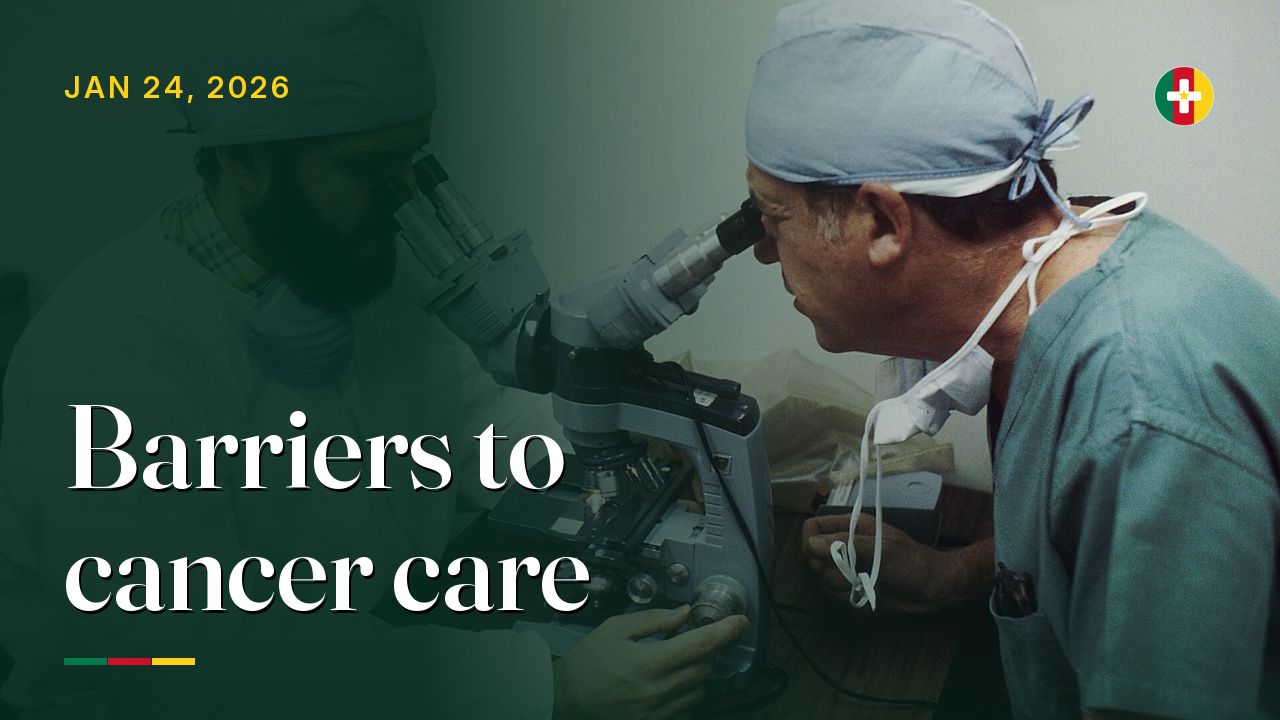
Removing the Barriers to Cancer Care in Cameroon: Diagnosis, Radiotherapy, Workforce and Financing
Overview
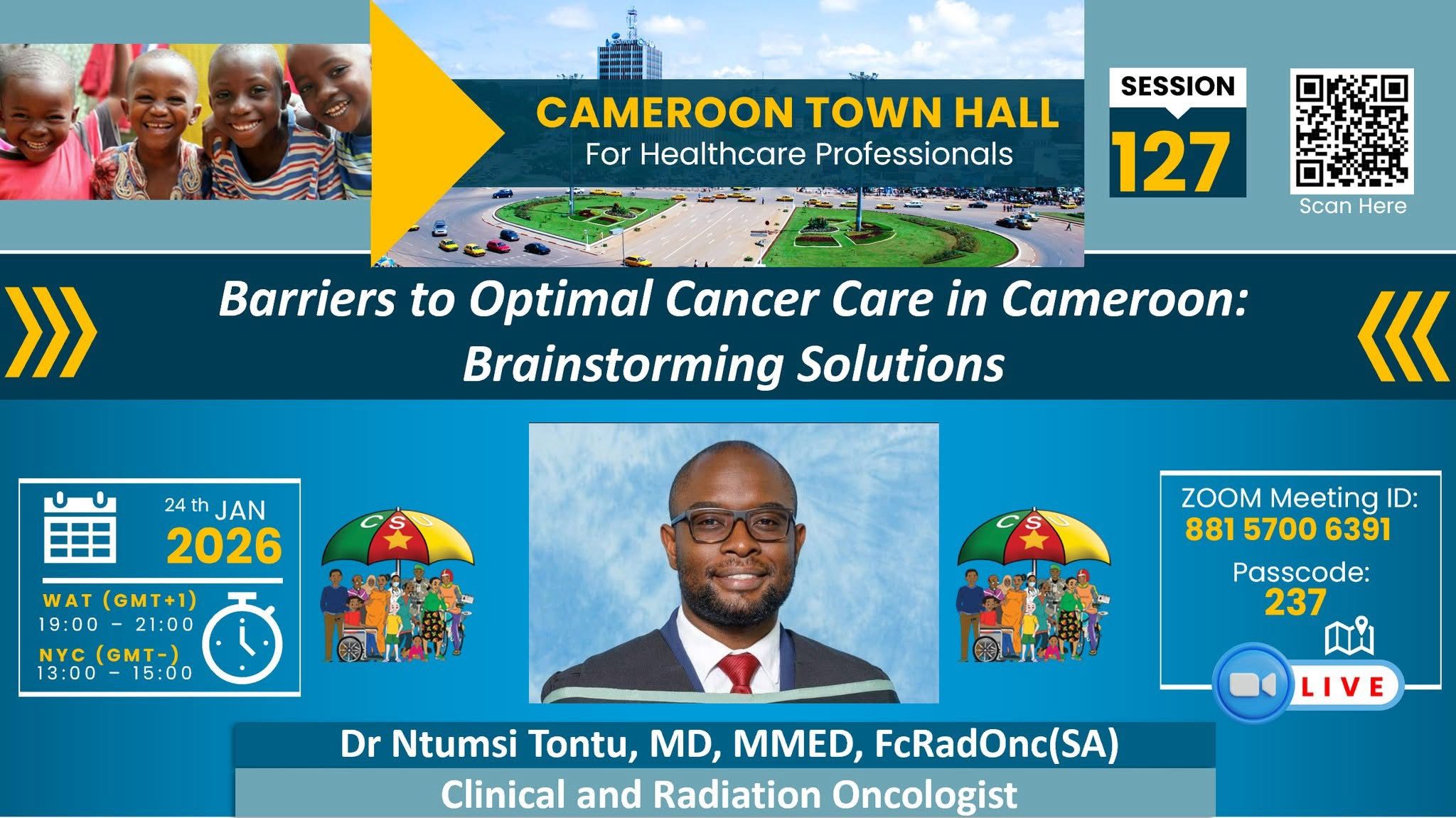
This brief draws on a session of the Cameroon Town Hall for Healthcare Professionals held on January 24, 2026. Dr. Ntumsi Tontu, clinical and radiation oncologist at Mbingo Baptist Hospital, set out the barriers to cancer care in Cameroon with four patient cases, and pathologists, oncologists and public health experts discussed solutions.
Context
Cameroon recorded more than 19,000 new cancer cases and over 12,000 deaths in 2022 (GLOBOCAN modeled estimates; there is no national registry). It has 26 medical oncologists, 11 radiation oncologists, 3 surgical oncologists and about 44 pathologists for about 30 million people (as reported by the speaker). Two teletherapy units serve the country, one barely functional, against a need of at least 44. Immunohistochemistry is scarce and slow, targeted drugs are paid out of pocket, there are no national screening guidelines, and the North West conflict disrupts care in a region served by one of the country's main cancer centres.
Key issues
- Treatment without diagnosis. Surgery and chemotherapy are started without receptor status or multidisciplinary review, and receptor results can take three months.
- Radiotherapy gap. More than 95% of patients who need radiotherapy cannot receive it (speaker's estimate).
- Catastrophic costs. A year of HER2-targeted treatment can cost 20 to 30 million FCFA; patients sell land or abandon curable treatment.
- Late and missed diagnosis. No organised screening, low suspicion of cancer in young patients, and reliance on traditional healers delay diagnosis.
- Medicine quality. Studies cited in the session found substandard anticancer medicines in Cameroon and neighbouring countries.
- Fragmented governance. National bodies and frontline services work apart, and there are no national cancer treatment guidelines.
Discussion highlights
- Dr. Tontu: cancer deserves the attention and investment HIV received.
- Dr. Foma: no tissue, no issue; pathology is the foundation of cancer care.
- Dr. Ivo: charity alone will not solve cancer care; diaspora investment must be tied to viable models.
- Dr. Samuel Akombeng Ojong: cancer is high burden but low political interest; oncologists must lead on governance and guidelines.
- Dr. Tontu: engage traditional healers to refer patients early.
Recommendations
- Declare radiotherapy access a national priority. MINSANTE should adopt a costed plan to expand radiotherapy using the IAEA Rays of Hope programme and public-private partnerships, and include faith-based and private centres such as Mbingo Baptist Hospital in the national cancer control plan. First step: request an IAEA needs assessment and list existing bunker projects for support.
- Make tissue diagnosis and receptor testing standard. MINSANTE, with partners and laboratories, should fund immunohistochemistry for every breast cancer and set turnaround targets, using telepathology to reach regional hospitals. First step: map current immunohistochemistry capacity and agree pricing with diagnostic suppliers.
- Train and retain the cancer workforce. Faculties of medicine and MINSANTE should add oncology to the undergraduate curriculum and create training posts in pathology, medical, radiation and surgical oncology. Diaspora groups can adopt specific posts, beginning with a second radiation oncologist and a surgical oncologist for Mbingo.
- Issue national cancer treatment guidelines. The National Cancer Control Committee, oncology societies and centres of excellence should draft resource-adapted guidelines, including de-escalated and cost-conscious regimens, and require multidisciplinary review before definitive treatment.
- Protect patients from catastrophic costs and poor-quality drugs. MINSANTE and the national regulator should test the quality of anticancer medicines, pursue pooled procurement with partners such as CHAI, and create a fund for highly curable cancers such as gestational trophoblastic neoplasia. First step: publish quality testing results and list the cancers to be covered first.
- Bring cancer into primary care and community networks. Regional delegations should train primary care staff to recognise cancer in young people, add cervical and breast screening to HIV services, and work with traditional healers on early referral.
Next steps
The town hall will invite the Minister of Public Health to a listening session on cancer care, connect Mbingo with ACPA's screening and training programme in the South West region, and explore support for training posts and the Mbingo radiotherapy project.
Conclusion
The four cases showed that many cancer deaths in Cameroon follow from gaps that can be closed: a missing biopsy, an untested receptor, a lost follow-up, an unaffordable vial. Diagnosis, radiotherapy, trained staff and protection from catastrophic costs would change outcomes for many patients.
Meeting minutes
Agenda
- Welcome by the moderator, Elvis Ndansi, and remarks by the Chair
- Remarks by co-moderator Dr. Bryan Tegomoh
- Presentation by Dr. Ntumsi Tontu on barriers to optimal cancer care in Cameroon
- Comments by the moderators, the Chair and participants
- Questions and answers moderated by Dr. Tegomoh
- Closing remarks and summary
Opening remarks
- Elvis Ndansi opened the first session of 2026 on barriers to optimal cancer care, citing about 20,000 new cancer cases and 15,000 deaths a year in Cameroon and late diagnosis in about 70% of patients. He asked for practical, scalable solutions rather than a list of known problems.
- The Chair, Dr. Foma, recalled that the town hall began five years earlier during COVID-19 and invited experts in any field, including artificial intelligence, to use the platform.
- Dr. Tegomoh noted the official withdrawal of the United States from the World Health Organization that week and called it a difficult time for global and public health. He introduced the speaker.
Presentation
1. Cancer is the new HIV
Dr. Tontu said cancer has become a public health problem deserving the attention and investment given to HIV. Citing Global Cancer Observatory 2022 figures, he reported over 19 million new cases and 10 million deaths worldwide, over 1.1 million new cases in Africa, and in Cameroon more than 19,000 new cases and over 12,000 deaths, figures that are estimates because Cameroon has no national cancer registry. Mortality to incidence ratios are much higher in low and middle income countries, for example 46.8% against 21.3% for breast cancer.
2. Mbingo Baptist Hospital's cancer service
Paediatric oncology at Mbingo began in 2003 with the World Child Cancer programme and adult oncology in 2010. The hospital sees about 1,000 new cancer patients a year with one medical oncologist, one clinical and radiation oncologist, one paediatric oncologist and two on-site pathologists, supported by eight remote pathologists through telepathology. It has patient hostels, a 350 kVA hydroelectric plant completed in 2021, a radiotherapy bunker under construction and a cancer centre building in design, for which it is fundraising.
3. No structured screening
There are no national screening guidelines or programmes, only opportunistic campaigns around awareness days, so most patients present late. He called for large epidemiological studies of patient profiles and environmental and genetic risks, including the possible role of chemicals used to preserve fresh produce, to design screening and prevention suited to Cameroon. CBC Health Services runs a women's health programme for breast and cervical cancer and is discussing a men's programme for prostate and colorectal cancer.
4. Workforce
Cameroon has 26 medical oncologists, 11 radiation oncologists and 3 surgical oncologists for about 30 million people, so most patients are managed by clinicians without oncology training and oncologists cannot subspecialise. He proposed more training slots, oncology in the medical curriculum, and structured engagement of the many Cameroonian oncology professionals in the diaspora.
5. Diagnostics and treatment
Diagnosis rests on histopathology and cytopathology, with about 44 pathologists nationally, long turnaround times, limited immunohistochemistry, no next-generation sequencing and no nuclear medicine imaging, so some cancers are understaged. Most systemic treatment is chemotherapy. He proposed government investment, public-private partnerships, telepathology and AI, clinical trial participation, de-escalation studies (for example low-dose abiraterone, 250 mg with food instead of 1 g fasting) and drug repurposing.
6. Radiotherapy crisis
Between 50% and 70% of patients need radiotherapy. Using WHO and IAEA benchmarks, Cameroon needs at least 44 machines and ideally 116, but has two teletherapy units, one barely functional, and no brachytherapy, so he estimated that more than 95% of patients who need radiotherapy cannot get it. He urged the government to declare a crisis, use the IAEA Rays of Hope programme, and recognise faith-based and private centres such as Mbingo in the national cancer control plan so they can benefit from external support.
7. Four cases
He presented a 27-year-old woman with stage IIIC breast cancer who had a mastectomy by a private gynaecologist without receptor testing and later developed bone metastases; a 55-year-old woman with HER2-positive disease who used traditional medicine, sold land to buy 10 vials of trastuzumab (about 250,000 FCFA a vial) and returned to traditional treatment; a 33-year-old man treated for three years for haemorrhoids, including three haemorrhoidectomies, before stage IV rectal cancer was found; and a 27-year-old teacher with gestational trophoblastic neoplasia after an unmonitored molar pregnancy, who responded to chemotherapy but stopped for lack of money. He said a full year of HER2-targeted treatment can cost 20 to 30 million FCFA, and he cited a study finding substandard anticancer medicines in four sub-Saharan countries including Cameroon.
8. The conflict in the North West
The armed conflict since 2017 brings lockdowns, gun battles, kidnappings and displacement. Patients present late, interrupt treatment and sometimes return after being kidnapped; home-based palliative care was stopped for staff safety; access to tramadol and morphine is restricted; staff are exhausted by doing five days of work in two after lockdowns; and partners hesitate to invest in the radiotherapy project. Mitigation includes continuing chemotherapy at satellite hospitals with telephone follow-up, patient hostels and training local specialists. He closed with Psalm 20:7.
Discussion and Q&A
- Reactions from the moderators and Chair. Dr. Tegomoh said the molar pregnancy case, being clearly avoidable, touched him most. Dr. Foma said Mbingo offers the most holistic cancer care he has seen in Cameroon, that pathology and immunohistochemistry are fundamental, that very few pathologists and no radiation oncologists are trained locally, and that the Minister should be invited back for a national dialogue on cancer care. He mentioned research with the Clinton Health Access Initiative that found some medicines in Cameroon with very low active ingredient content.
- Dr. Foma: if the diaspora could do one thing for Mbingo, what should it be? Dr. Tontu said the diaspora could adopt and fund training in surgical, medical and radiation oncology, since one radiation oncologist cannot run a radiotherapy department, alongside the radiotherapy and cancer centre projects. Mbingo has telepathology and teleradiology but struggles with internet supply. He introduced colleagues on the call, including the Chief Medical Officer, a visiting gynaecologic oncologist, a surgeon interested in surgical oncology and an internist interested in medical oncology.
- Dr. Henry Fomundam, first-time participant working in HIV, malaria and medicines regulation in Africa. He said European donors have also withdrawn, that substandard and falsified medicines are a problem in most of the 20 or more countries he has worked in, and suggested a fund at each session through which the diaspora could support cases chosen by the town hall.
- A public health researcher from Seattle: can HIV and TB programme lessons be used for cancer, can generics and bulk purchasing lower prices, and what of collaboration with the Cameroon Oncology Center? Dr. Tontu said traditional healers should be engaged rather than opposed, as the childhood cancer programme did by training healers in warning signs, which brought referrals. Pricing can be improved through public-private partnerships (for example analysers and reagents tied to discounted medicines), and generics depend on patent status. HIV testing platforms can integrate cervical and breast cancer screening. Mbingo refers patients for radiotherapy to the Cameroon Oncology Center and exchanges staff for training.
- Dr. Foma on drug access and the ACPA programme. He said the Clinton Health Access Initiative is working with the government on access to chemotherapy and targeted drugs such as trastuzumab and rituximab. ACPA would run a large cancer screening and training programme in the South West region in March with surgical oncologists, gynaecologists and pathologists, and invited the Mbingo team to meet them.
- Dr. Michael Awasum: was the 'high-grade carcinoma' diagnosis usual practice? Dr. Tontu said pathologists often report a carcinoma favouring a subtype when morphology alone is not definitive, and without on-site immunohistochemistry the team reviews the case with the pathologist. Dr. Awasum said such a diagnosis would not be acted on in the United States without an immunohistochemistry panel. Dr. Foma said fewer than 5% of breast cancer pathology reports in Cameroon before 2020 included ER and PR status, in a study he published. On building capacity, Dr. Awasum said it needs investors with a business plan, partners such as Roche Diagnostics, trained pathologists and staff; he described digital pathology for slide sharing and frozen sections and AI as an adjunct to the pathologist.
- Dr. Ivo on sustainable financing and adapted protocols. He said charity projects, including donor programmes he worked on with GIZ, were not sustainable, and that the African diaspora's investments in Africa far exceed the health financing gap; he cited diaspora health bonds in Uganda. His consortium, with Dr. Awasum, has partnered with Roche and hopes to offer validated immunohistochemistry in Cameroon by April 2026; Centre Pasteur can process about 600 of some 4,000 breast cancer samples a year and the rest are sent abroad at about 150,000 FCFA. He urged adapted, cost-conscious protocols, such as docetaxel and cyclophosphamide where added benefit is small, and low-dose regimens such as those studied in India, and suggested Mbingo publish its own guidelines.
- Dr. Samuel Akombeng Ojong: why does cancer get so little policy attention? He said a 30-year review of sexual and reproductive health and rights policy in Cameroon found reproductive cancers to be high burden but low political interest and under-researched, and that cancer care is divided between a national body producing policies with little communication and many separate frontline actors. Much breast and cervical cancer surgery is done by obstetrician-gynaecologists without multidisciplinary decisions. He asked oncologists to lead governance, compare Cameroon with other African countries, and draft Cameroon-specific guidelines with diaspora input. Dr. Tontu agreed, adding that a national registry and engagement of policymakers, including during elections, are needed.
Calls to action and closing
- Dr. Tegomoh mentioned a new Gates Foundation and OpenAI partnership on health AI in Rwanda and hoped similar support could reach Cameroon.
- Dr. Foma said cancer care shows the fragility of a health system and needs every specialty and support staff at the tumor board; he stressed prevention and screening, citing countries that are eliminating cervical cancer, and again asked for the Minister to be invited. He announced the ACPA screening and training programme in the South West region.
- Elvis Ndansi proposed that the Minister's next visit be in listening mode and summarised the session. Dr. Tontu thanked the town hall and collaborators who join Mbingo's multidisciplinary discussions.
Next meeting
February 2026 (date not announced in the session).
Submitted by the Co-Moderators, Cameroon Town Hall for Healthcare Professionals.