Leveraging the Diaspora to Improve Health Services in Cameroon
Overview
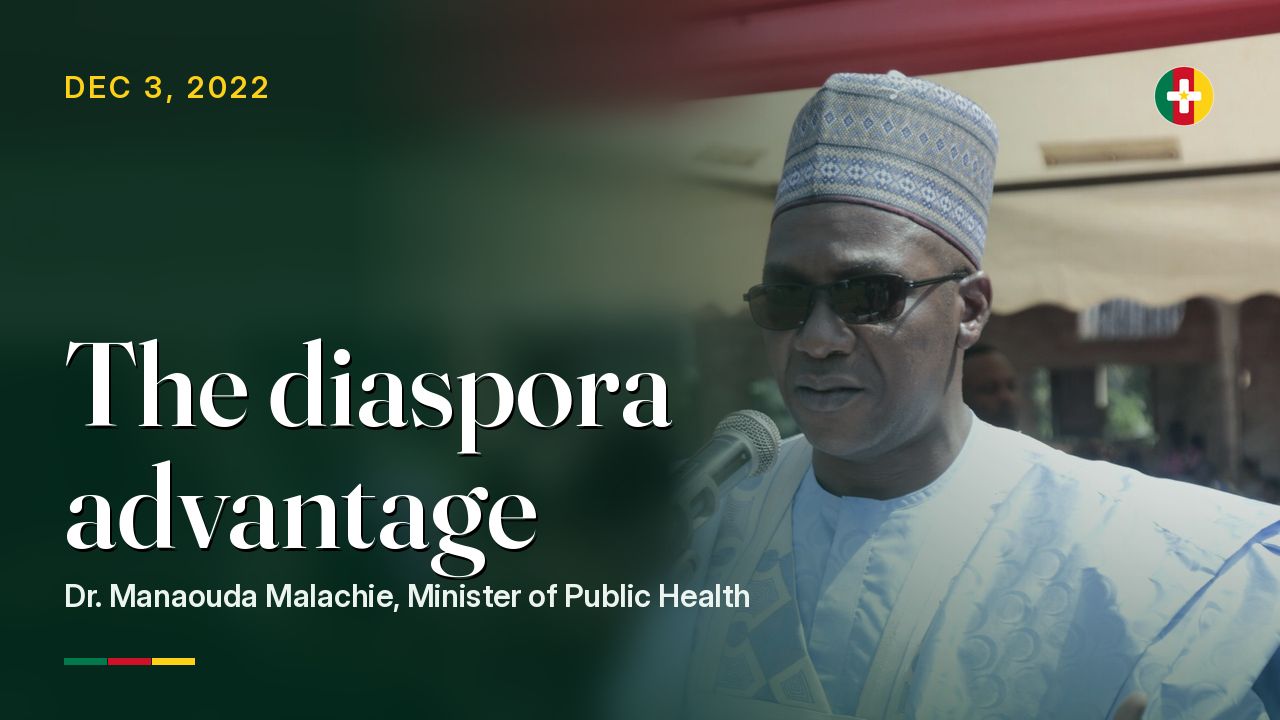
This policy briefing synthesizes key insights from the Cameroon Town Hall for Healthcare Professionals session of December 3, 2022, with His Excellency Dr. Manaouda Malachie, Minister of Public Health, on how Cameroon's health diaspora can help optimise and innovate health services, ahead of the National Medical Conference of December 13 to 16, 2022.
Context
Since 2019 the Health System Transformation Agenda has upgraded reference and regional hospitals, and the Minister reported that about 81% of requests for evacuation abroad in 2022 were redirected to national hospitals. Diaspora professionals want to teach, operate, donate equipment and invest, but face slow administrative files, poorly defined entry points, visa formalities and the lack of a permanent channel with the Ministry.
Key issues
- No single entry point. Diaspora offers reach the Ministry through the Division of Cooperation, the Directorate of Human Resources, embassies or personal contacts, without follow-up.
- Slow handling of files. Participants said files stall with officials; the Minister cited sanctions and a reporting number.
- Continuity beyond one Minister. Members asked how the effort would survive a change of Minister; the answer was a technical working group and a digital platform.
- Equipment donations. Shipping costs and outdated donated equipment limit the value of donations.
- Workforce gaps. Nurse anaesthetists are no longer trained, and staff pay remains a concern.
Discussion highlights
- The Minister committed to a working group after the National Medical Conference, with MINSANTE, MINREX, MINFI and diaspora focal points, acting as the diaspora office.
- He announced that his teams would start building a digital platform for the diaspora the very next day.
- Ministry missions would visit diaspora communities through Cameroon's embassies after the conference.
- He defined the diaspora as anyone who feels Cameroonian, whatever their nationality.
- He warned against intermediaries who claim to know the Minister and take money.
- Four continuing education and simulation centres were announced, the first planned for 2023.
Recommendations
- Constitute the diaspora working group with written terms. MINSANTE, with MINREX and MINFI, should create the working group by ministerial decision, with named members, a secretariat and a meeting calendar, so that it survives changes in leadership as the Minister intended. First step: publish the decision and the group's terms of reference after the National Medical Conference.
- Launch the digital platform with one procedure. MINSANTE should open the platform as the single door for missions, twinning, teaching, private practice and donations, with a tracking number for each file and a response deadline. First step: a registration form and a published list of focal points (Division of Cooperation, Directorate of Human Resources, Division of Studies and Projects).
- Name diaspora focal points. Diaspora associations and the town hall should each name a focal point per country, as the Minister asked, and channel offers through them. First step: the town hall compiles a list of associations and focal points and sends it to the working group.
- Publish a needs list for equipment. MINSANTE's Division of Studies and Projects should publish the equipment most needed by facility and the minimum standards for donations, and agree a shipping arrangement with partners. First step: a needs list on the conference or platform website.
- Pilot twinning and training missions. Reference hospitals (Garoua, Douala and Yaoundé General Hospitals) and diaspora departments should start a small number of twinning agreements and short missions, with visa support letters from the Ministry, and link them to the planned simulation centres. First step: one twinning pilot per reference hospital in 2023.
- Restore nurse anaesthetist training. MINSANTE and the Ministry of Public Service should create the nurse anaesthetist corps and a training route, with diaspora anaesthetists teaching. First step: diaspora anaesthetists submit the concrete proposal the Minister asked for.
Next steps
The National Medical Conference was held December 13 to 16, 2022, after which the Minister said the working group would be set up, ministry missions sent to diaspora countries and the digital platform developed. He asked to return to the town hall and offered documentation on COVID-19 gains and a later presentation of the seven pillars.
Conclusion
The Minister presented an upgraded hospital network and invited the diaspora to train, twin, practise and invest, and he committed to a permanent working group and digital platform as their entry point. Participants welcomed his openness and asked for procedures that work in practice and last beyond any one Minister.
Meeting minutes
Agenda
- Welcome by the moderators, led by Elvis Ndansi
- Introduction of the Minister by Dr. Christelle Jouego Tagne
- Presentation by His Excellency Dr. Manaouda Malachie, Minister of Public Health: health care supply in Cameroon and the National Medical Conference of December 13 to 16, 2022
- Audience poll results
- Questions and answers with members of the diaspora
- Closing remarks by the moderators and the Minister
Opening remarks
- Elvis Ndansi opened the session and handed over to Dr. Christelle Jouego Tagne, who presented the Minister's background: training at ENAM in Yaoundé and ENA in Paris, a programme at a Canadian centre for governance of public organisations, posts at the Presidency and as Secretary General of two ministries, and Minister of Public Health since January 2019.
- The Minister thanked the Chair and participants and said he was moved, because a platform like this one is not seen every day. He said he had so much to share that he was already asking to come back another time.
- He noted he was speaking the day after the Indomitable Lions beat Brazil at the World Cup, and said he was glad that progress in health would be made with the diaspora, with its help and with the expertise it has acquired abroad. The Ministry was receptive to the diaspora's proposals.
Presentation
1. The Health System Transformation Agenda
On taking office on January 4, 2019, the Minister drew up the Cameroon Health System Transformation Agenda, 'The Time to Act', which was validated by President Paul Biya and is being implemented. It rests on seven pillars, which he offered to present at another session. Its lines include the humanisation of care and services, better reception of patients, and qualitative and quantitative improvement of care through infrastructure, equipment and human resources. All of it aims at universal health coverage, with quality care accessible at lower cost.
2. Fewer medical evacuations abroad
The Minister said Cameroon now has first category hospitals meeting international standards . Over two to three years, evacuations abroad had been reduced by 80 to 85%: when a patient requests evacuation abroad, the Ministry first looks for a national hospital in Douala, Yaoundé or Garoua that can treat the patient. In 2022, about 81% of requests for evacuation abroad were redirected to hospitals inside the country.
3. Centres of excellence
Garoua General Hospital is oriented toward neurosciences, with about thirty neurosurgical procedures performed, and offers interventional cardiology including coronary angiography. Douala General Hospital is equipped for cancer care. Yaoundé General Hospital performs advanced surgery, including beating heart surgery, and seven or eight organ transplants had been performed there. The facilities were rehabilitated and equipped under a plan decided by the Head of State.
4. Regional hospitals, imaging and dialysis
Photographs showed operating rooms and emergency units of regional hospital centres (CHR), which he said would exist in eight regions, digital radiology, and 0.5 Tesla MRI units installed in Garoua and Bafoussam. He said kidney failure is becoming a real concern, so haemodialysis centres have been created in each region and in the reference hospitals (Douala General Hospital, Yaoundé General Hospital, the Yaoundé University Hospital Centre, Laquintinie Hospital in Douala). Kidney transplantation is done at Yaoundé General Hospital: the seven transplants so far were assisted by a Belgian team, and Cameroonian teams are now able to perform them. He showed these images so diaspora professionals know the working environment and equipment they would find.
5. The National Medical Conference
The National Medical Conference in Yaoundé, December 13 to 16, 2022, had the theme 'Optimising the quality of care and services and innovation in health in Cameroon'. It was to publicly measure progress, hold debates, round tables and scientific presentations, publicise the transformation of the health system, reward the best staff to create emulation, and host an exhibition. He said the diaspora, working every day in such structures abroad, was best placed to bring ideas, invited everyone to register on the conference website shown on screen, and said the conference would be the occasion to capture the contributions of the medical diaspora.
6. Four ways for the diaspora to contribute
He proposed four tracks. Training support: a diaspora specialist operates with a local team that learns by watching and assisting, which the Ministry prefers to evacuating the patient. Twinning between a facility or department abroad and its counterpart in Cameroon (emergency, neonatology, laboratory, or Garoua's neurosurgery with a large hospital abroad). Part-time practice in rotation, for example during campaigns or a month of leave, with a return a year or two later to check what was sustained. Private practice: a dialogue would be opened with the National Order of Physicians, and anyone wishing to open a clinic could approach the Ministry to work through the establishment agreement.
7. COVID-19 and its legacy
The Minister said all COVID-19 indicators were green, with about thirty to forty active cases, asymptomatic and not in hospital, and that the Ministry would propose to government an easing of measures. He said COVID-19 had been used to strengthen the system: about 14 or 15 CT scanners from partners, some fifty to sixty ambulances, MRI units, isolation centres now used for cholera and other diseases, and oxygen plants, with every region to have its own oxygen production plant. He offered to share documentation on these gains.
8. Universal health coverage
About twenty enrolment centres had been deployed across eight regions, with mobile units able to enrol people nationwide. The universal health coverage law had been drafted and submitted to government and was under review, so coverage could not yet be launched. A pilot phase was planned from the start of the year (2023), built around nutrition, pregnant women, children aged 0 to 5 and their consultations, and care for malaria, HIV, tuberculosis and kidney failure, as a basket of care.
Discussion and Q&A
- A co-moderator presented the audience poll: the majority of participants were aged 25 to 44, and the poll also asked about Cameroonian origin, passport and country of residence (details partly captured). Moderators noted the young profile of the audience, a bit like the Minister's.
- A participant joked that he might be sent to a remote post as punishment for asking the Minister a difficult question. The Minister said there is no bad or taboo question with him, and that he is open to all contributions and criticism, because if you are only told that you do everything well, you fall asleep and nothing moves forward.
- Who counts as diaspora, including those who have taken another nationality? The Minister said the diaspora is anyone who feels Cameroonian and wants to move things forward in Cameroon. Having left, or having taken another nationality, does not stop anyone being Cameroonian at heart.
- A participant asked how, concretely, the diaspora can reach the Ministry, and whether specialists can follow their patients between Cameroon and abroad. He repeated the four tracks. For now there are two entry points: the Division of Cooperation and the Directorate of Human Resources. After the National Medical Conference a working group would be set up with MINSANTE and the Ministry of External Relations (MINREX), with focal points from diaspora associations; each association and each country was asked to name one, using online meetings, WhatsApp and Twitter for a permanent dialogue. Follow-up of patients could go through the platform being set up.
- A participant in the United Kingdom asked how the diaspora abroad can make itself known. The Minister said diaspora members who come forward at Cameroon's diplomatic missions are relayed to the Ministry. After the conference, the Ministry would send missions to each country, with MINREX, to meet the medical diaspora at the diplomatic missions, collect proposals and formalise them in the working group. He said this had been planned before the conference but constraints had prevented it.
- An anaesthetist and intensive care physician in Avignon, France, asked whether donated equipment (ventilators, ultrasound machines) can be shipped free of charge, and who could receive it. The focal point is the head of the Division of Studies and Projects at MINSANTE, whose contact can be requested through the conference website. There is no free shipping channel, but the Ministry would work with donors to find a way, which might involve some cost. He asked that equipment be sorted first, since some donated equipment had been older than what the country already had, and said the Ministry would communicate what is most needed.
- A participant said procedures exist on paper, but files sit with officials who do not process them. What can the Ministry do? He linked this to the humanisation of services. With the Directorate of Human Resources, officials who hold or delay files are sanctioned, and he said many had been sanctioned. A telephone number exists to report an official who delays a file or answers badly. The future working group would be the entry point for diaspora files and would follow them up, and he said he acts quickly on each report so that good work is rewarded and bad work sanctioned.
- How can the diaspora invest in Cameroon? He said the environment is open and that the Ministry had received diaspora projects for private clinics. He warned against intermediaries who claim to know the Minister, since they will take money without results, and urged people to use the official entry points. He acknowledged that some health workers consider their pay below what they should earn, but said Cameroon is a country under construction, and that young doctors want experienced diaspora mentors.
- Dr. Ivo Che Ditah, professor of gastroenterology at the University of Minnesota, trained at the Faculty of Medicine and Biomedical Sciences in Yaoundé, asked how diaspora academics can give back. The moderator said many participants shared his view. The Minister said the working group to be set up after the conference would act for now as the diaspora office, dedicated to the bridge with the diaspora; a formal structure would be built with MINREX and the Ministry of Finance (MINFI). He offered to send students to such professors for continuing training or to bring them to Cameroon to teach. He announced four large continuing education and simulation centres, the first at the former COVID-19 treatment site, to open next year, where staff could train for two weeks to six months, and online coaching through telemedicine.
- A participant asked how the diaspora effort would continue if the Minister left office. The Minister said that while they were speaking he had decided that from the next day his teams would develop a digital platform to serve as the exchange platform for the working group. The working group would be technical, so that it would not change even if the Minister were no longer in office, and would include members of the Cameroonian diaspora, officials of MINREX and MINFI, and focal points of the medical diaspora.
- A physician raised the absence of a nurse anaesthetist cadre, and visa difficulties for diaspora members with foreign passports. He said this specialty is cruelly lacking: training had stopped and those trained were retiring, which COVID-19 exposed. Files had been opened with the Ministry of Public Service, and the Ministry was proposing professional corps for each specialty and its own vocational schools; he invited concrete proposals and offered to relay them. On visas, the Ministry writes to the consul or ambassador to facilitate a multiple-entry visa for a mission, and has sometimes arranged boarding without a visa and a visa on arrival.
- A follow-up on entry formalities for diaspora members with US passports. Speaking frankly, he said every country has its rules and a US passport holder needs a visa to enter Cameroon. He added that some diaspora members arrive believing they are above Cameroon's laws and should pass through like kings, and that this cannot be accepted.
Calls to action and closing
- A moderator thanked the Minister for his time and availability and hoped the questions raised would see results.
- The Minister said he was moved by the encouragement. He repeated that the Ministry was setting up the digital platform as the diaspora's entry point, would review the live chat comments, and asked to return to the platform for another session. He said no one can build the Cameroonian health system alone; he was open to criticism as well as encouragement and said he had hope that, with this platform, Cameroon could do better in public health.
- Elvis Ndansi thanked the Minister for his presence.
Next meeting
Next session two weeks later, December 17, 2022 (65th edition).
Submitted by the Co-Moderators, Cameroon Town Hall for Healthcare Professionals.