Getting Donated Medical Supplies and Equipment into Use in Cameroon
Overview
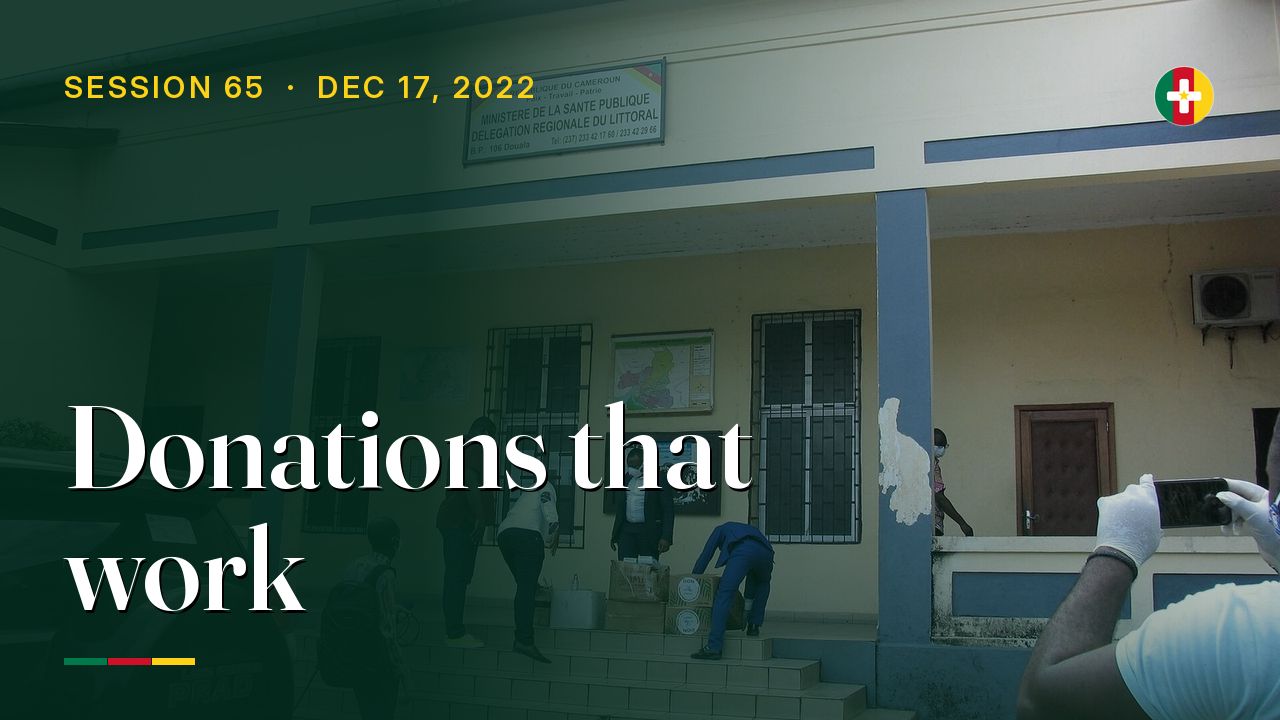
This policy briefing synthesises key insights from the Cameroon Town Hall for Healthcare Professionals meeting held on 17 December 2022 (65th edition), focusing on the theme "Donation of Medical Supplies and Equipment to Cameroon: How to Navigate the Process and Build Partnerships," presented by Roger Mforneh, International Programs Manager at MedShare International.
Context
The session followed the town hall's special session with the Minister of Public Health, where diaspora members repeatedly asked how to send donations home. Many donations are delayed at the port, incur charges, or arrive unsuited to local needs, voltage or skills.
Key issues
- Process is poorly understood. Donors often ship without regulatory pre-approval for medicines or an exoneration letter, leaving containers at the port.
- Single signatory and informal payments. Exoneration depends on one signature at the Ministry of Finance, and rushed donors sometimes pay to speed things up, which entrenches corruption.
- Mismatch with needs. Equipment is sent without a needs assessment and may be unused, unsuited to 220 volts, or beyond local skills.
- Maintenance gap. Few biomedical technicians are available, so donated equipment breaks down and Africa risks becoming a 'graveyard' for it.
- Unequal distribution. Donations follow diaspora home areas, while CHAI assessments found many hospitals without basic blood pressure machines or pulse oximeters.
Discussion highlights
- Government and faith-based hospitals can usually obtain full exoneration when shipments are consigned to them.
- Regional assemblies and councils can budget for supplies under decentralisation.
- Corporate social responsibility funding is available but needs ministry backing.
- A national needs-based assessment was proposed with CHAI and the ministry.
Recommendations
- Publish a single donation guide. MINSANTE, with the Ministry of Finance and the national regulatory authority, should publish a step-by-step guide to importing donated medicines, supplies and equipment, including required documents and timelines, and share it with diaspora associations through the town hall.
- Streamline exoneration. The Ministry of Finance should allow delegated signature or an online tracking system for exoneration requests for government and faith-based facilities, so that shipments are not held at the port when the signatory is absent.
- Run a national needs assessment. MINSANTE, with CHAI and partners, should map equipment and technician needs in district and regional hospitals across all ten regions in 2023 and share a priority list to steer donations toward underserved areas.
- Require needs-based, maintainable donations. Hospitals and regional delegations should accept equipment only against a stated need, at 220 volts, with installation, user training and a maintenance contact. Training schools should expand biomedical technician training.
- Coordinate diaspora and decentralised funding. Diaspora associations, alumni and village groups should pool funds with regional assemblies and councils for the same hospitals, and seek corporate social responsibility funding with a ministry letter of support.
Next steps
CHAI was to present on device financing at a future session, and MedShare's Ghana training centre plans were to be shared once approved. Participants were invited to contact the speaker directly.
Conclusion
The session showed that donations work when they follow the official process, respond to stated needs, and come with training and maintenance. Clear guidance from MINSANTE and the Ministry of Finance, and a national needs map, would help diaspora generosity reach the facilities that need it most.
Meeting minutes
Agenda
- Welcome and recap of the Minister of Public Health session
- Year in review by the Chair, Dr. Munoh Kenne Foma
- Introduction of the speaker
- Presentation by Roger Mforneh on donating medical supplies and equipment to Cameroon
- Discussion and Q&A
- Closing remarks
Opening remarks
- Elvis Ndansi opened the 65th edition and thanked participants for the previous week's session with the Minister of Public Health, when more than 350 people were on Zoom at one point and about 1,000 joined over the session.
- One of the co-moderators reported that the National Medical Council conference had announced an online platform, from January, where Cameroonian health professionals in the diaspora can register and receive an identification to ease their work in the country and with the ministry.
- Dr. Bryan Tegomoh noted that about 800 people followed the national medical forum online and that the US government was also seeking ways to engage diasporas. Elvis Ndansi mentioned the new presidential advisory council on African diaspora engagement in the United States.
- The Chair presented a review of the town hall's three years, from its start during COVID-19 to sessions in 2021 and 2022 on maternal and infant mortality, surgery, tuberculosis, malaria, sickle cell disease, cardiac surgery, radiology, medical oxygen, cancer, glaucoma, artificial intelligence, child rights, telemedicine, cholera, mpox, epilepsy, anaesthesia, family planning, stroke, radiation safety, WASH, and the Minister's session. He thanked moderators and speakers.
- Dr. Tegomoh added that participants from Gabon, Kenya and Ghana had joined and were looking to replicate the platform.
Presentation
1. Why donations get stuck
Mr. Mforneh said many diaspora donors lack knowledge of the regulatory requirements for humanitarian imports. Medications need prior approval from the national regulatory authority before shipping. The tax exoneration letter is signed by the Minister of Finance, so delays occur when the signatory is absent, and port storage charges accumulate while containers wait.
2. Shortcuts feed corruption
He said some diaspora donors, with only two or three weeks in Cameroon, try to compress a process of three to six months by paying people along the way, which then leaves later officials expecting the same. Following the process and working with people who know it avoids this.
3. The MedShare model
Recipients first complete an online application that works as a needs pre-assessment (patient volumes, departments, equipment and supplies needed). For a 25,000 US dollar sponsorship, a hospital receives a 40-foot container with 800 to 1,000 boxes of new supplies chosen from an online inventory and 30 to 40 pieces of equipment matched to its wish list, with shipping to Douala included. The recipient approves every item before loading. He put the market value at about 150,000 to 500,000 US dollars per container, and said the full cost to MedShare is about 42,000 to 43,000 dollars, with the balance raised by MedShare.
4. Documents and exoneration
Each shipment comes with a packing list, certificate of donation, non-commercial invoice and bill of lading. Government hospitals at any level and faith-based organisations can apply to the Ministry of Finance and usually obtain 100 percent exoneration, so only port charges remain. Non-profits registered in Cameroon for more than two years often obtain 20 to 50 percent. Shipments should be consigned to the institution, not an individual, and MedShare does not ship to private for-profit hospitals.
5. Voltage, installation and maintenance
Biomedical engineers convert equipment from 110 to 220 volts and add transformers where needed. For an additional 10,000 dollars, a Cameroonian biomedical engineer spends about two weeks at the recipient site installing equipment, training up to 40 doctors, nurses and technicians, and repairing or diagnosing broken equipment, with remote follow-up afterwards.
6. Track record in Cameroon
He said MedShare has shipped to 118 countries and more than 23 million dollars of supplies and equipment to Cameroon. With Coca-Cola Africa Foundation funding it shipped three containers a year for five years each to Central Hospital Yaounde and Douala General Hospital. Other partners included the Presbyterian Church in Cameroon, the Catholic dioceses of Bamenda and Buea, the North West and South West Regional Assemblies (the South West signed an MOU for six containers in 2023, one per division), and a Kumba association in Atlanta whose four containers helped upgrade a district hospital.
7. Funding sources
Individuals, associations, alumni groups, village associations, Rotary clubs (requests must come from members in Cameroon), faith-based groups, regional assemblies and councils under decentralisation, and multinational companies can all sponsor containers. He argued that companies operating in Cameroon, such as telecoms and banks, rarely fund health care because no one asks, and that requests backed by a ministry succeed far more often. Travellers can also take up to 50 pounds of supplies for a 100 dollar donation, with donation papers for customs.
Discussion and Q&A
- Elvis Ndansi asked whether manufacturers push back against donations that replace sales. Mr. Mforneh said there was no pushback: manufacturers such as Philips donate equipment and receive tax write-offs.
- An ophthalmologist based in Israel described a free newborn hearing and vision screening programme started this year at Laquintinie Hospital in Douala and asked how to obtain costly hearing screening instruments and how to approach companies. Mr. Mforneh suggested writing a short proposal with the programme's data directly to manufacturers, citing a donated machine obtained this way for a hospital in Nigeria, and approaching retiring doctors and hospitals abroad that replace equipment.
- Dr. Mathias Fobi, a member of a Cameroonian physicians' association in Atlanta, commented. He said he once bought equipment for General Hospital that could not be used because he did not understand local technical and staffing limits, and that the lesson was to ask facilities what they need first.
- A congenital heart disease specialist in Dallas with a mission hospital in Cameroon, asked how equipment is maintained after installation, noting machines failing after power outages and few functioning radiotherapy machines in Yaounde and Douala. Mr. Mforneh described the paid two-week biomedical training and repair visit and remote troubleshooting by video call, and stressed personal relationships with the engineer.
- A CHAI Cameroon staff member who clears donated devices for the Ministry of Public Health asked whether to keep using direct exoneration, citing a cancer device donation worth about 80 million francs CFA cleared for about one million francs. Mr. Mforneh said a working process should be kept; for a single item, consigning it to the ministry or hospital and obtaining exoneration is cheaper than a container sponsorship.
- Dr. Yauba Saidu, CHAI Cameroon Country Director, raised equity across regions. He said diaspora giving tends to favour a few home areas, and proposed a needs-based national assessment of equipment and technician needs with the Ministry of Public Health in 2023. He said CHAI assessments found that over 40 to 60 percent of hospitals lacked a simple blood pressure machine and 80 percent lacked a pulse oximeter. CHAI was to present on device financing at a future session.
- A public health expert with a PEPFAR project in Cameroon asked whether MedShare provides funding. Mr. Mforneh said MedShare is a non-profit that does not give grants; it uses cost sharing, with recipients paying 25,000 dollars toward a true cost of about 42,000 to 43,000 dollars.
- Dr. Henshaw Mandi asked when MedShare would open an office in Africa to cut shipping and training costs, offering local partnership. Mr. Mforneh said over 80 percent of MedShare shipments now go to Africa and that a feasibility study was under way for a biomedical equipment training and repair centre in Ghana.
- Dr. Bryan Tegomoh warned that Africa risks becoming a 'graveyard' for donated equipment without maintenance capacity, citing calls at the Second International Conference on Public Health in Africa in Rwanda for African biomedical technology hubs, and asked how donations benefit ordinary patients. Mr. Mforneh said recipient hospitals should use donated supplies and equipment for patients who cannot pay, or on a sliding scale, and that on visits he found most donated equipment in use.
Calls to action and closing
- Elvis Ndansi urged donors to think beyond their own villages so that areas without diaspora connections are not left out.
- A pulmonary and critical care physician in the US said she had funded a water tank for a hospital in her home area after asking what it needed.
- The Chair recalled that as a district hospital director he learned by chance that a friend at the Ministry of Finance could grant full exoneration for goods destined to government hospitals, and invited Mr. Mforneh back to brief other organisations.
- Mr. Mforneh also mentioned MAP International, which ships 20-foot containers of medicines, as another option.
Next meeting
The next session was held on 14 January 2023.
Submitted by the Co-Moderators, Cameroon Town Hall for Healthcare Professionals.