Companion Diagnostics: Building on Cameroon's Laboratory Base
Overview
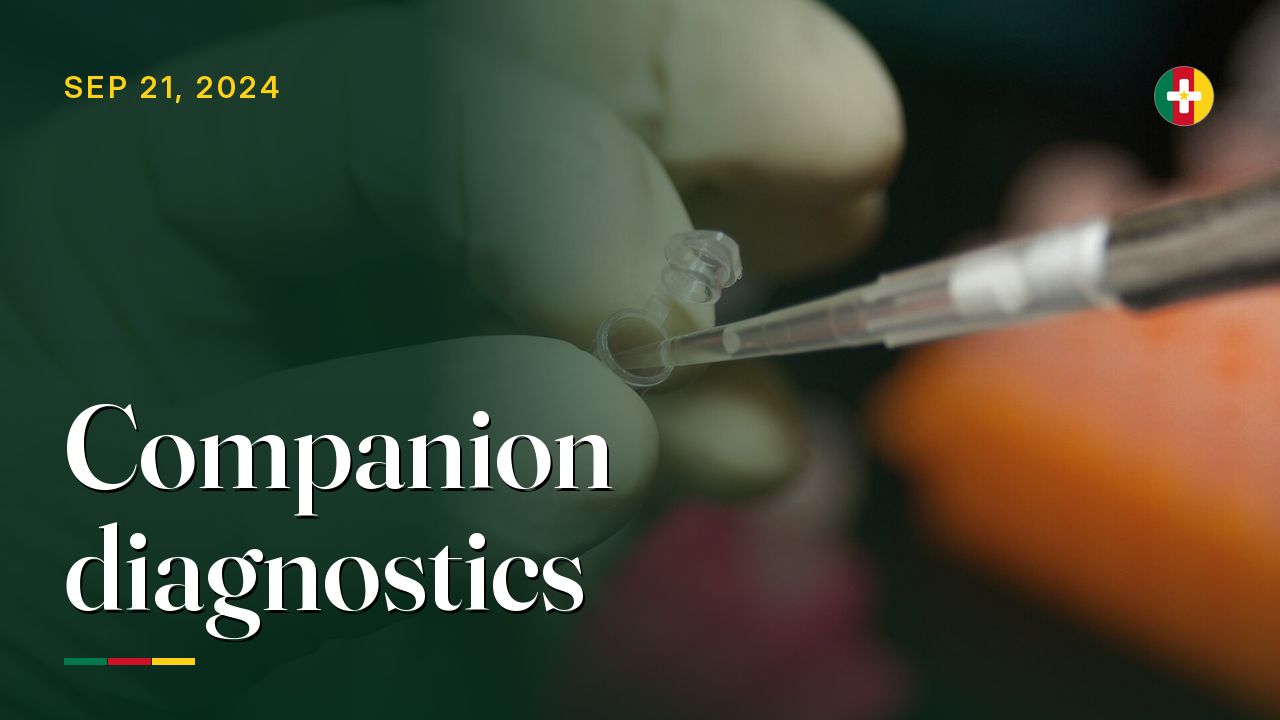
This policy briefing synthesizes key insights from the Cameroon Townhall for Healthcare Professionals meeting held on September 21, 2024, focusing on the theme "Companion Diagnostics: Advancing Personalized Medicine," presented by Dr. Obadia Mfuh Kenji of Stanford Health Care.
Context
Companion diagnostics link a test to a treatment so that patients receive drugs that will work for them. Cameroon already has PCR machines and some sequencers from the COVID-19 response, many of them underused, but lacks laboratory regulation, reliable reagent storage, and a central testing network.
Key issues
- Underused equipment. PCR and sequencing capacity built for COVID-19 is idle as COVID testing has fallen.
- No formal laboratory regulation. There is no national body inspecting laboratories or certifying staff, though some are ISO accredited.
- Working conditions. Power cuts spoil reagents, workloads are heavy, and laboratories and clinicians rarely communicate.
- Pathology bottleneck. Immunohistochemistry is cheap but needs skilled interpretation and quality antibodies.
- Data and representation. Genetic data need protection, and most tests and trials have been validated outside Africa.
Discussion highlights
- Participants agreed labs can start with validated PCR assays and build towards NGS.
- Advocacy made CD4 testing affordable and could do the same for molecular tests.
- Digital pathology and AI could extend scarce pathologists through remote reading.
- A tiered testing network with a central laboratory was proposed.
Recommendations
- Create a national laboratory regulator. MINSANTE should establish an independent body to license laboratories by level, inspect them against a checklist, and certify laboratory directors and staff, building on ISO and WHO accreditation. First step: publish minimum standards for each level of facility.
- Repurpose COVID-era molecular equipment. MINSANTE, the national public health laboratory and reference hospitals should map existing PCR and sequencing machines and validate assays for priority markers (for example EGFR, HIV drug resistance, TB resistance). First step: an inventory of machines and their use.
- Build a tiered testing network. MINSANTE should define which tests each level performs and set up sample transport to central laboratories with results in one to two days, avoiding sending samples abroad.
- Protect reagents and data. Hospitals should secure power and cold storage for reagents, and MINSANTE should adopt data protection rules and data sharing agreements for genetic testing.
- Pilot digital pathology. University hospitals, with diaspora pathologists, should pilot slide scanning and remote reading with peer review. First step: one scanner in a reference hospital linked to volunteer pathologists.
- Strengthen lab and clinician dialogue. Training schools and professional societies should include joint sessions between laboratory staff and clinicians on test selection and interpretation.
Next steps
Dr. Kenji offered the town hall's laboratory experts to help any laboratory implementing PCR or NGS. The next session was planned for two weeks later.
Conclusion
Participants agreed that Cameroon does not need to start from scratch: skilled laboratory staff and equipment from the COVID-19 response give a base for companion diagnostics. Regulation, quality, communication and advocacy are the steps that would turn this base into better treatment choices.
Meeting minutes
Agenda
- Welcome by Elvis Ndansi and Dr. Marthe-Sandrine Mpollo (in English and French)
- Introduction of the speaker by the Chair
- Presentation by Dr. Obadia Mfuh Kenji on companion diagnostics
- Comments by the Chair
- Discussion and Q&A
- Closing remarks and parking lot
Opening remarks
- Elvis Ndansi welcomed participants and introduced Dr. Marthe-Sandrine Mpollo as co-moderator in French. He said participants now come from about 36 countries.
- The Chair said the session continued the town hall's discussion of precision medicine, and expressed the hope that West and Central Africa can catch up with the US within a few years.
- The Chair introduced Dr. Kenji as manager of infectious disease and esoteric testing at Stanford Health Care, a WHO consultant, a researcher on malaria and other infections in Cameroon, and one of the founders of the town hall.
Presentation
1. Personalized medicine
Dr. Kenji, speaking in a personal capacity, opened with President Obama's question of whether matching cancer treatment to a person's genetic code could become as routine as matching blood types. He cited definitions from the US President's Council of Advisors on Science and Technology (classifying patients into subpopulations, not making unique drugs) and the National Cancer Institute (using genes, proteins and environment). He contrasted one dose for all with dosing by metabolizer type (ultra-rapid, extensive, intermediate and poor), and defined genomics, pharmacogenomics and single nucleotide polymorphisms.
2. What companion diagnostics are
He defined a companion diagnostic as an in vitro test or imaging device that provides information essential for the safe and effective use of a specific therapy. It identifies patients expected to respond, predicts risk of adverse reactions and guides dosing. He showed the FDA list of cleared companion diagnostics and the Roche cobas EGFR Mutation Test v2 as an example: a PCR test for 42 EGFR mutations in non-small cell lung cancer, run on tissue or plasma, that guides tyrosine kinase inhibitor treatment and detects resistance such as T790M within four to eight hours.
3. Laboratory techniques
He compared PCR (familiar, sensitive and specific, but only finds what it targets), droplet digital PCR (for low frequency variants), FISH (for gene rearrangements such as HER2 and ALK, but labour intensive), immunohistochemistry (simple and widely used, but semi-quantitative and subjective), microarrays, and next generation sequencing, which can find unexpected changes across hundreds of genes but is costly for one or two targets.
4. Sequencing has become affordable
He said the first human genome took about 13 years and about 300 million dollars, while a genome can now be sequenced in a day for under 1,000 dollars. He outlined the NGS workflow (sample processing, library preparation, sequencing, bioinformatics) and platforms, noting that Oxford Nanopore devices the size of a tablet or phone can be used in the field.
5. Case study: comprehensive genomic profiling
He described TruSight Oncology, which he helped validate at Illumina: one DNA and RNA test of about 500 cancer genes (517 biomarkers) plus tumour mutation burden and microsatellite instability, covering most cancer types. For non-small cell lung cancer, it uses about five slides and five days, against about 29 slides and 42 days for the traditional sequence of single tests. A liquid biopsy version uses circulating tumour DNA from blood. He walked through a sample report listing fusions, matched therapies and supporting literature, and said clinical validation alone took about nine to fifteen months.
6. Infectious diseases
He said companion diagnostics also guide infection care, citing GeneXpert MTB/RIF, which detects tuberculosis and rifampicin resistance, and HIV genotypic resistance testing of reverse transcriptase, protease and integrase genes, recommended at diagnosis, treatment failure or when switching therapy.
7. Benefits and limits
Benefits include better outcomes, fewer adverse effects, optimal dosing, lower cost from avoiding trial and error, and faster drug development through targeted trial recruitment. Limits include tests tied to a single drug and biomarker, high development cost, complex joint regulatory approval, ethical issues, limited access in low resource settings, and false positive or negative results. He said existing PCR machines in Africa could run validated assays for markers relevant to local populations.
Discussion and Q&A
- Chair (Dr. Munoh Kenne Foma): how does this work in practice? He described a 36-year-old non-smoker with lung cancer whose initial PCR panel was negative and who received chemotherapy; NGS later found an EGFR kinase domain duplication and he did well on osimertinib for three years. At progression, a second NGS showed a MET exon 14 skipping mutation, and a MET inhibitor was added. He said companion diagnostics start with basics such as blood typing and HER2.
- A medical laboratory scientist: how can Africa benefit while protecting genetic data, and do epigenetic changes limit these tests? Dr. Kenji said data protection is a global problem, handled through memoranda of understanding, data sharing agreements and cybersecurity, planned before implementation. He said diagnosis matters even before treatment is affordable, that COVID-era PCR machines and sequencers sit underused, and that labs can start with PCR assays. Mutations mainly affect PCR, because primers may stop binding, so primers should be checked regularly; sequencing avoids this. Asked about cost, he cited the CD4 count, which became widely available through advocacy, and a project in Zimbabwe that produced freeze-dried reagents. COVID sequencing cost about 150 dollars per sample; he could not give a figure for oncology in Africa.
- A physician in Canada: what regulatory framework ensures reliable laboratory results in Cameroon? Dr. Kenji said he knows of no formal body in Cameroon that inspects laboratories against a checklist, unlike CLIA, CAP and the Joint Commission in the US, but several laboratories in Yaoundé and Douala are ISO accredited and WHO has an accreditation programme that the Bamenda regional hospital went through. He called for an independent regulator with requirements for laboratory directors and certification of staff. The medical laboratory scientist added that reagents are spoiled by power cuts in health centres, that doctors and laboratories rarely communicate, and that he once worked with five staff for 200 patients a day. The Chair said internal and external quality control was practised in Yaoundé laboratories, and that Cameroon needs a licensing body, tiered testing by level of facility, and a central laboratory system able to return results in one or two days.
- A laboratory professional: please explain microsatellite instability and drug metabolism. Dr. Kenji explained that when mismatch repair fails, mutations accumulate and create neoantigens that attract T cells, so MSI-high tumours respond better to immunotherapy, while tumours use PD-L1 to evade attack. Metabolism differs with polymorphisms in drug metabolising enzymes, enzyme inhibition and drug interactions. The Chair gave the example of testing for poor metabolisers of 5-fluorouracil and capecitabine, which recently spared one of his patients a dangerous first dose.
- Dr. Marthe-Sandrine Mpollo: how do we avoid race-based prescribing, and how should clinicians read results validated in other populations? Dr. Kenji said sequencing reads the individual's own genome; some variants are more common in certain populations, but treatment follows the individual result. Reports carry literature citations and disclaimers, and the clinician must interpret them in light of the patient. He explained positive predictive value with the example of PCR for E. coli in urine. The Chair said trials validated in Asia were repeated in Western populations, that Africa has the greatest genetic diversity and should validate key trials, and recalled that early EGFR trials failed until patients were selected by mutation.
- Dr. Marthe-Sandrine Mpollo: can AI extend scarce pathology skills? Dr. Kenji said Stanford uses digital pathology and is developing AI for slides, and that laboratory staff in Cameroon could stain and scan slides for remote reading and peer review, as ASCP does in Kenya, provided internet is reliable. The Chair said papers at ASCO and ESMO 2024 showed AI could match trained pathologists in reading HER2 immunohistochemistry.
Calls to action and closing
- Dr. Mpollo summarised in French and English: companion diagnostics are individualised medicine, COVID-era equipment and skilled laboratory staff give Cameroon a base, and clinicians and laboratories must work hand in hand.
- Dr. Kenji said the town hall is a place to network and partner, offered expert help to laboratories implementing PCR or NGS, and said Cameroon could make its own primers and probes.
- A parking lot session of about 15 minutes followed.
Next meeting
In two weeks (early October 2024).
Submitted by the Co-Moderators, Cameroon Town Hall for Healthcare Professionals.