Global Health Funding Cuts: How Cameroon is Responding
Overview
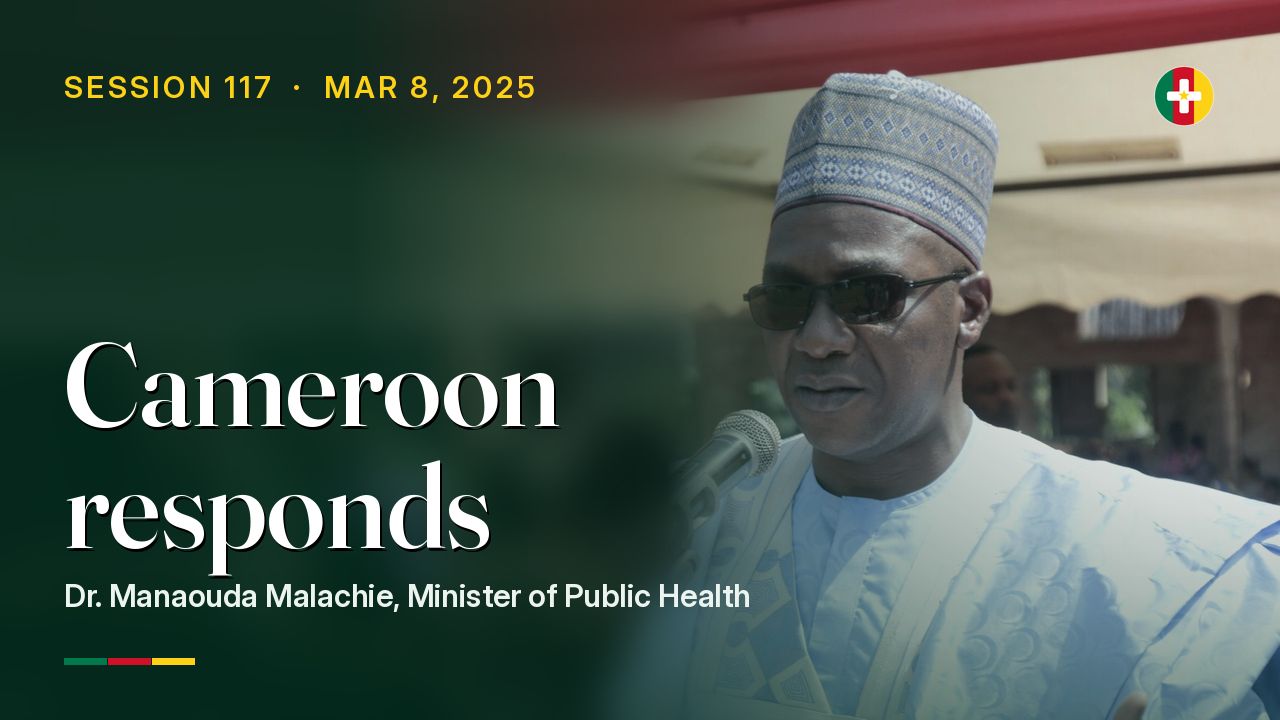
This policy briefing synthesizes key insights from the 117th session of the Cameroon Town Hall for Healthcare Professionals, held on March 8, 2025, with His Excellency Dr. Manaouda Malachie, Minister of Public Health, on how Cameroon is responding to the suspension of US global health funding.
Context
The suspension of US funding in early 2025 left Cameroon with an estimated 51 billion FCFA gap for HIV and further gaps for maternal and child health, immunization, malaria, TB and onchocerciasis. Households pay 62% of health costs directly, and health receives 3 to 5% of the national budget.
Key issues
- Continuity of HIV and other services. Staff paid by USAID and PEPFAR were suspended; the State moved its own staff in and asked community health workers to keep working.
- Domestic financing. The universal health coverage law, health taxes and the innovative financing strategy are not yet in force; no new external partner has been secured.
- Cost of local production. Local medicines cost two to three times more than imports, which limits a local-first purchasing policy.
- Workforce retention. Staff leave rural postings and the country; housing and pay measures are under way.
- Barriers for the diaspora. Bank financing, bureaucracy across ministries, and a restrictive National Medical Council document discourage investment, teaching and missions.
Discussion highlights
- The Minister described the suspension as an opportunity to regain autonomy and set 2028 for taking over these funds.
- The 6,000 FCFA maternal health voucher covers antenatal care, delivery and caesarean section.
- The Minister invited diaspora surgeons to assist operations by telemedicine from abroad.
- He said the National Medical Council's document on diaspora practice has no government endorsement.
- He told partners that funding restricted to workshops is not wanted.
Recommendations
- Pass and fund the universal health coverage law. Government and parliament should adopt the universal health coverage bill and earmark health taxes, such as tobacco levies, to it. First step: publish the health financing strategy with innovative sources and a timeline for the 2028 takeover of donor-funded programmes.
- Publish the transition and incident data. MINSANTE should share regular updates from the incident management system on stocks, staff redeployed and service continuity for HIV, TB, malaria and immunization, so regional delegations, partners and the diaspora can target support. First step: a monthly public dashboard.
- Make local production affordable. MINSANTE, the Ministry of Finance and the Ministry of Industry should agree the tax incentives discussed with manufacturers, link local purchase to CEMAC pooled procurement for a larger market, and fast track the Cameroonian Medicines Agency. First step: a costed incentive package for the products local firms already make.
- Deliver the retention measures. MINSANTE should complete the 10 billion FCFA on-call housing programme and the staff retention plan, starting with the hardest-to-staff districts. First step: publish the list of districts and the construction schedule.
- Open a clear door for diaspora professionals. MINSANTE, the Ministry of Higher Education and the diaspora working group should launch the diaspora platform with one procedure for missions, teaching and investment, and publish the list of telemedicine-equipped operating rooms. Diaspora professionals and the town hall should channel offers through it. First step: a pilot of telemedicine-assisted surgery and a recurring surgical mission through the platform.
- Align partner funding with national plans. MINSANTE should require partners to fund national priorities under one plan, one budget and one monitoring framework, as raised in the Lusaka Agenda discussion, rather than workshops. First step: a review of partner budgets for workshop and training lines.
Next steps
The town hall committed to prepare a policy document from the session and asked the Minister for digital copies of the documents he presented (Health System Transformation Agenda, centres of excellence list). The diaspora working group's technical committee was due to meet soon.
Conclusion
The Minister set out a response that relies on State staff, universal health coverage and domestic financing to replace US funds, and placed the diaspora at the centre of investment, skills and advocacy. Participants welcomed his openness and asked that the measures be published and the barriers to diaspora engagement removed.
Meeting minutes
Agenda
- Welcome by the moderators, Elvis Ndansi, Dr. Bryan Tegomoh and Dr. Marthe-Sandrine Mpollo
- Welcome to the Minister by the Chair, Dr. Munoh Kenne Foma
- Opening greeting by His Excellency Dr. Manaouda Malachie, Minister of Public Health
- Questions sent in advance by members: impact of the US aid suspension, domestic financing, priorities for 2025, technology, local production, workforce retention, infrastructure, private sector, global health diplomacy
- Open questions from members
- Closing summaries by the moderators, closing remarks by the Chair and the Minister
Opening remarks
- Elvis Ndansi welcomed participants and said about 2,450 people from 36 countries had attended at least one session, and that the town hall meets monthly from 2025. The Minister was attending for the third time.
- Dr. Tegomoh said global health aid had been a lifeline for low and middle income countries and recalled that the previous session discussed the disruption of PEPFAR, HIV and malaria programmes. Dr. Mpollo, moderating from Canada, named HIV and maternal health programmes once supported by USAID.
- The Chair thanked the Minister for creating the diaspora committee, which was moving toward an interactive website where diaspora members could submit projects, and said the Minister had facilitated more than 20 diaspora projects, some worth millions of dollars, including CLEAR Radiology, and helped diaspora members reach the Ministry of Higher Education to teach.
- The Minister said the town hall was his home too, thanked members for their work for Cameroon, and said the diaspora has an essential role, which the Ministry would keep facilitating.
Presentation
1. Size of the funding gap
The Minister thanked the United States for its long support and said the suspension created a deficit estimated at 51 billion FCFA for HIV, about 800 million FCFA for maternal and child health, and a hit to the Expanded Programme on Immunization, which US aid financed at about 12%. He also cited gaps of about 900 million FCFA for onchocerciasis, a gap for tuberculosis, and 23 billion FCFA mentioned for malaria. He said the Ministry had issued a communiqué against people selling HIV, TB and malaria treatment that the State still provides free.
2. Immediate mitigation
After a rapid impact study, the Ministry redeployed State-paid staff to replace workers paid by USAID and PEPFAR, mobilised public resources to keep services running, and kept the supply chain going through CENAME and the 10 regional health promotion funds. Regional delegates, technical groups, community organisations and community health workers were told to keep working and that the State would pay where funding stopped. An incident management system was activated to follow the situation on the ground. He said work on a sustainable financing plan had begun around October to November 2023, with Cameroon expected to take over these funds by 2028.
3. Universal health coverage and domestic financing
At least 80% of people living with HIV are covered by universal health coverage, and the bill giving it a legal framework was under government review. Domestic resources would come from member contributions under that law, health taxes such as levies on tobacco and other harmful products, and a validated health financing strategy with innovative sources shared with the Ministry of Finance. He cited Africa CDC's financing pillar, Africa CDC and African Union emergency support, CEMAC pooled purchasing of medicines and vaccines, and concessional loans from Afreximbank and the African Development Bank, which Cameroon had applied for. Talks with Africa CDC, WHO, the World Bank and the Gates Foundation had not yet produced new partners.
4. Priorities for 2025
His priorities were: reducing maternal and infant mortality, through antenatal care, safe delivery, more midwives and the health voucher, under which 6,000 FCFA covers antenatal visits, ultrasound and delivery, including a caesarean section if needed, with performance bonuses for staff; communicable diseases (malaria, TB, HIV); non-communicable diseases such as diabetes, hypertension and cancer, through awareness in markets and community gatherings and specialised hospital units; extending universal health coverage, since 62% of health spending is paid directly by households according to the national health accounts; and infrastructure, including nearly ten high-end facilities recently inaugurated.
5. Telemedicine and digital records
Regional hospital operating rooms (six built, two under construction) and first category hospitals have remote assistance telemedicine, and the Minister appealed to diaspora surgeons in London, the United States or Canada to help operate on patients in Cameroon from abroad. An international tender had been launched to digitise and interconnect the health system so that a patient travelling from Douala to Maroua is identified with one card. Remote reading of X-rays by specialists in Yaoundé or Douala was being used for remote areas.
6. Local production of medicines and vaccines
After meeting manufacturers in Douala and Yaoundé, the Ministry proposed tax breaks and subsidies for the local pharmaceutical industry, partnerships for technology transfer including traditional medicine (now regulated by law), and support for research on medicinal plants. Public buyers are asked to source locally where a local maker exists and to limit imports to the balance. The difficulty is that local production costs two to three times more than imports. He said a vaccine production plan begun during COVID-19 had led the national vaccine supplier to work toward producing cholera vaccine for reactive campaigns.
7. Keeping health workers
He said no one can stop a person determined to leave, but the Ministry works on living and working conditions in rural postings: regular review of collective agreements, a minimum wage in the private sector, performance bonuses and allowances that he checks on field visits, and on-call housing in every health district, authorised by the Head of State after his December 31, 2024 address, for a total of 10 billion FCFA, with plans sent to government for validation. A staff retention plan and automated career file tracking with SMS alerts were in place.
8. Facilities, supply chain and regulation
Integrated health centres are being added and upgraded to district medical centres, more district hospitals created, and about twenty category 2 and 3 hospitals are operational, including Garoua General Hospital; the aim is that no one walks more than an hour to a facility. A decree reorganised CENAME with territorial branches for last mile delivery, a text would bring all supply into the national system to fight counterfeit and street drugs, and the law creating a Cameroonian Medicines Agency was at validation. The Health System Transformation Agenda, with seven pillars, was given to the private sector to choose where to invest, with tax and land support.
Discussion and Q&A
- Elvis Ndansi: how will the withdrawal of US funding affect HIV, maternal health and vaccination, and what contingency plans exist? The Minister set out the deficits and the immediate measures above, and said the suspension was an opportunity for Cameroon to regain control of its autonomy.
- Elvis Ndansi: how will the government mobilise domestic resources, and with which regional partners? Through the universal health coverage law, health taxes, the innovative financing strategy, diaspora investment, blended finance, Africa CDC and AU emergency funds, CEMAC pooled procurement and African development banks.
- Dr. Tegomoh: what are the top priorities for 2025 and beyond, and how is Cameroon using telemedicine and AI? Maternal and infant mortality, communicable and non-communicable diseases, universal health coverage and infrastructure; telemedicine in operating rooms, an electronic patient record tender and remote reading of images.
- The Chair, from the chat: is there a plan to manufacture HIV and malaria drugs locally for Central Africa? The Minister described the Prime Minister's committee on pharmaceutical industrialisation, his meetings with local manufacturers, incentives under discussion, the cost gap with imports and local cholera vaccine production.
- Elvis Ndansi: how will Cameroon retain health workers, improve district and regional infrastructure, and support the private sector? Better conditions, on-call housing worth 10 billion FCFA, a retention plan, more and better facilities, supply chain reform and the seven pillar Transformation Agenda for private investors.
- Elvis Ndansi: what role should African nations play in global health diplomacy, and how can the diaspora help? He said Cameroon supports the new public health order for Africa, a stronger Africa CDC, greater negotiating power and pooled production. Cameroon is third Vice-President of the WHO Executive Board and at its 150th session asked that the US withdrawal not reduce resources for Africa. The diaspora can invest in infrastructure and production, set up training programmes, transfer skills, advocate for fairer funding and lead specific projects.
- Dr. Samuel Ndinjiakat (comment) As rapporteur of the diaspora working group, he said progress had been slow but the technical committee would meet soon, and that a permanent task force was needed because teaching in Cameroon involves the ministries of public health, higher education, finance and human resources. He said his Grace Gardens hospital had received support from the district and the Ministry.
- Prof. Theodore Ngatchu: why is it so hard for diaspora professionals to invest and practise in Cameroon? He said the 6,000 FCFA delivery package shows large government subsidies that are not communicated, and that international standard facilities cannot be built on charity and are hard to finance from abroad. The Minister said bank lending is difficult because of banks' habits after loan defaults, that the Ministry was working with the Ministry of Finance, that a revised hospital reform law would change billing, and that diaspora projects should add value rather than duplicate existing services.
- Dr. Samuel Akombeng Ojong: how does Cameroon see the Lusaka Agenda, pooled African markets, the 15% Abuja target and internal efficiency (one plan, one budget, one monitoring framework)? The Minister said partners often fund only workshops and training, and that he had told some that if the money is only for workshops, Cameroon does not want it. He supports the Africa CDC led agenda and production for the sub-region, stressed prevention, and said he was not sure Cameroon could reach 15% in the current context, with health at 3 to 5% of the budget, but that he argues to government and parliament that health drives the country's emergence goal for 2035.
- An oncological surgeon: what is the strategy for cancer care and research? He said the rise in cancer partly reflects more diagnosis. Two national cancer institutes are planned, in Yaoundé (with Korean and Italian partners) and at Garoua General Hospital; meanwhile Yaoundé and Garoua General Hospitals treat cancer with State subsidies, and Douala General Hospital is building a bunker for a PET scan and is at the linear accelerator stage with the IAEA. He called research the poor relation of the system.
- Dr. Ivo Che Ditah, Minnesota: what is the Ministry's relationship with the National Medical Council after its restrictive document on diaspora missions, and how can diaspora teachers and surgeons (such as his brother, a cardiothoracic surgeon) work in Cameroon? The Minister said the Council's document had no government endorsement and should not be considered, since the Council advises and government regulates. He acknowledged bureaucracy, citing two years spent chasing diploma certificates for a midwifery programme, and offered to connect any diaspora professional with a facility of their choice, noting cardiac surgery missions from Italy at Yaoundé General Hospital and missions from Belgium and Switzerland. He agreed communication must improve and showed new documents listing centres of excellence and their equipment.
Calls to action and closing
- Prof. Fobi urged members to use the Minister's openness for patients.
- Dr. Mpollo summarised the step by step response and the Minister's invitation to the diaspora to join missions, local production and hospital construction, and recommended reading the Health System Transformation Agenda.
- Dr. Tegomoh said the town hall would prepare a policy document from the session and asked the Minister for a digital copy of the documents shown.
- The Chair said communication is the language of leadership and credited the diaspora committee for his recent presentation at his former Faculty of Medicine.
- The Minister concluded that Cameroon has a mitigation plan to keep essential services running, will accelerate universal health coverage and domestic financing, put more weight on prevention, and support Africa CDC. He encouraged even small diaspora initiatives and said his door remains open.
Next meeting
Next monthly session.
Submitted by the Co-Moderators, Cameroon Town Hall for Healthcare Professionals.