After the 2025 Funding Shock: Priorities for Cameroon's Health System in 2026
Overview
This brief draws on the year-end session of the Cameroon Town Hall for Healthcare Professionals held on December 20, 2025. Co-moderator Dr. Bryan Tegomoh reviewed the year, and clinicians, researchers and diaspora leaders discussed priorities for 2026, with a focus on health financing, public health basics, health data and artificial intelligence.
Context
In 2025 most USAID funding to Cameroon was cut, affecting HIV, malaria, tuberculosis and maternal and child health programmes. Speakers reported that Cameroon avoided stock-outs of antiretroviral drugs and malaria and tuberculosis supplies, signed a new memorandum of understanding with the United States, and recorded about a 20% fall in malaria incidence in the National Malaria Control Programme's 2025 report (as reported in the session). A cholera outbreak affected the Far North region. Most health facilities still keep paper records without a unique patient identifier, and the medical curriculum does not cover artificial intelligence.
Key issues
- Dependence on a few funders. The cuts showed how exposed priority programmes are when one external donor withdraws.
- Paper records and no patient identifier. Patients returning to a facility often leave no trace of earlier visits, which blocks follow-up, data use and any digital tools.
- AI used without training. Students and clinicians already use large language models, but there is no formal training on how to use them, check their outputs or handle responsibility for errors.
- Data that do not reflect Cameroon. Models are trained mostly on non-African data, and Cameroon has little curated clinical data of its own.
- Public health basics under pressure. Speakers warned that hygiene, sanitation and vaccination, which account for most gains in survival, are being undermined by misinformation.
Discussion highlights
- Dr. Foma: hygiene and sanitation, vaccination and antibiotics did more for survival than most later medical advances.
- Prof. Joshua Tambe: start digital records by giving every patient a unique medical record number.
- Dr. Obadia Mfuh Kenji: AI, like laboratory automation, makes staff more efficient rather than replacing them.
- Dr. Marthe-Sandrine Mpollo: AI is a tool; teach people to frame questions and review outputs.
- Prof. Tambe: responsibility stays with the clinician; AI works best with a human reader.
Recommendations
- Diversify and protect financing for priority programmes. MINSANTE and the Ministry of Finance should keep a standing contingency line for HIV, malaria, tuberculosis and immunisation commodities and publish a plan to increase domestic funding. First step: report how the 2025 contingency plan was used and what it would cost to maintain.
- Introduce a unique patient identifier. MINSANTE, with regional delegations and hospital directors, should require a medical record number for every patient in public referral hospitals, as a first step towards electronic records. First step: pilot the identifier and a standard intake form in one regional hospital and one district, drawing on private facilities that already use them.
- Add AI and health data to training. Faculties of medicine and health sciences, with MINSANTE and the Ministry of Higher Education, should add a module on the responsible use of AI, critical appraisal of outputs and data protection to the harmonised curriculum. Town hall experts can deliver an initial CME series in 2026.
- Set rules for clinical use of AI. MINSANTE should issue guidance that AI tools are decision support only, that the clinician remains responsible, and that patient data shared with AI services are protected. First step: convene clinicians, radiologists, pathologists and lawyers to draft the guidance.
- Keep public health basics funded and visible. MINSANTE and regional delegations should protect funding for water, sanitation and hygiene, immunisation and community health workers, and counter vaccine misinformation with clear public messages.
Next steps
The moderators will survey participants on the 2026 format, plan sessions and a possible CME series on artificial intelligence in health, and continue work with the Ministry's diaspora working group.
Conclusion
Cameroon came through the 2025 funding shock without major stock-outs, but the year exposed how fragile priority programmes are. In 2026 the town hall's participants want steady financing, digital patient records and responsible use of AI, built on the public health basics that have saved the most lives.
Meeting minutes
Agenda
- Welcome by the moderator, Elvis Ndansi
- Opening reflection by the Chair, Dr. Munoh Kenne Foma
- Review of 2025 by Dr. Bryan Tegomoh
- Remarks by the moderator and the Chair
- Round table on 2025 and priorities for 2026
- Closing remarks by the Chair
Opening remarks
- Elvis Ndansi welcomed participants to the last session of 2025, a review of the year and a discussion of priorities for 2026, with particular attention to shifting health financing. He noted that 2025 was the first year the town hall met monthly instead of twice a month.
- The Chair, Dr. Foma, reminded participants that for most of human history life expectancy was 30 to 40 years and that the largest gains came in the last two centuries from hygiene and sanitation, vaccination and antibiotics. He asked that public health and its achievements stay at the centre of the town hall's work.
Presentation
1. A year of funding shocks
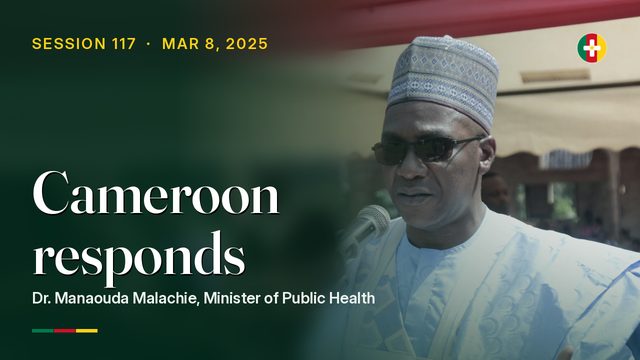
Dr. Tegomoh recalled that early in 2025 the new United States administration cut most USAID funding, which supported PEPFAR, the President's Malaria Initiative, tuberculosis and maternal and child health programmes in Cameroon and across Africa. In March the Minister of Public Health came to the town hall for over two hours to explain how Cameroon was adjusting its priorities, and a communiqué the following week called on diaspora health professionals to help build capacity.
2. The year's sessions
He reviewed the year's topics: careers and residency opportunities in the diaspora (January), the funding cuts (February), the Minister's session (March), malaria and the RTS,S and R21 vaccines with a study on vaccine misinformation (April), artificial intelligence (May), sickle cell disease (June), stroke with Dr. Alain Lekoubou of Penn State (July), the Lusaka Agenda with Dr. Samuel Akombeng Ojong (August), the diaspora health committee with Dr. Samuel Ndinjiakat (September), breast cancer (October) and the Heartbeat e.V. cardiac surgery team (November).
3. Giving back in person
He described lectures given in Cameroon by the Chair, including on liver cancer at the Faculty of Medicine and Biomedical Sciences in Yaoundé and on cancer at the Faculty of Health Sciences in Buea with Prof. Joshua Tambe, and a meeting with the Vice Chancellor of the University of Buea. He also noted a scholarship launched by the Chair to help clinical biology residents attend a clinical biology conference in Cameroon, and Dr. Katte's invited talk at UCSF on type 1 diabetes in sub-Saharan Africa.
4. Progress worth recognising
Cameroon was among the first African countries to roll out the RTS,S malaria vaccine. Dr. Tegomoh said the National Malaria Control Programme's 2025 report showed about a 20% fall in malaria incidence compared with the previous year. He also cited polio vaccination through the Expanded Programme on Immunisation, wider use of digital tools for antenatal care such as replicas of the Gifted Mom initiative, and more community health workers volunteering in rural areas.
5. Outbreaks and preparedness
A cholera outbreak in the Far North region strained the response, and the national public health authorities issued technical guidance. Africa CDC supported Cameroon on genomic and wastewater surveillance. In December the Ministry of Public Health and the United States Embassy set out a global health security strategy, which he hoped would bring new collaboration in 2026.
6. Looking to 2026
He said 2026 would bring more discussion of artificial intelligence in medicine, public health and biosecurity, and expressed hope for more investment in digital health and for an operational emergency response capacity.
Discussion and Q&A
- Elvis Ndansi on the government's response to the funding cuts. He said the memorandum of understanding signed between Cameroon and the United States was worth about 350 to 400 million US dollars for malaria, tuberculosis and HIV. Cameroon had no stock-out of antiretroviral drugs, diagnostics, malaria or tuberculosis supplies during the year, which he credited to a contingency plan funded through the Prime Minister's office. He thanked the Chair and co-moderators and asked participants how the monthly format had worked.
- The Chair on contributions made through the town hall. Dr. Foma highlighted what he described as one of the largest chronic kidney disease screening campaigns done in Africa, carried out in Cameroon with Elvis Ndansi's help, and said results are awaited. He thanked Dr. Samuel Ndinjiakat for keeping the diaspora committee moving and Prof. Joshua Tambe for his support in Cameroon, and said ACPA (the Association of Cameroonian Physicians in the Americas) plans further collaboration and memoranda of understanding in Cameroon.
- Prof. Joshua Tambe: format and priorities for 2026. He suggested keeping the monthly rhythm with periods of continuing medical education (CME) that would appeal to students, alongside practical policy sessions. He proposed health data management and artificial intelligence as priorities, noting that the harmonised medical curriculum has nothing on AI although students already use large language models. He described using AI in radiology research (radiomics and radiogenomics to predict genotype, response and survival) and proposed that every facility start by giving each patient a unique medical record number, as the first step to digital records.
- Dr. Samuel Ndinjiakat on the diaspora working group. He said the working group with the Ministry had moved to another level despite delays, and that a formal diaspora working group was expected now that the elections were over. He supported CME on AI, called for the town hall to document and share the work of diaspora groups, and said the moderators need more volunteers in 2026.
- Dr. Marthe-Sandrine Mpollo on AI and the basics. She said AI and automation are tools that should build on basics such as hand hygiene and patient education on stroke. Students must be trained to frame questions, review outputs and understand the limits and biases of models. She suggested the town hall analyse its own session recordings to find the most frequent questions and use them to set the 2026 agenda, and argued that Africa may not need its own large model so much as models built on how its clinicians reason and document care.
- Dr. Obadia Mfuh Kenji on lessons from 2025 and AI in the laboratory. He said 2025 showed the danger of depending on one funder and the need to diversify funding. He compared AI to laboratory automation, which made labs more efficient rather than replacing staff, and described a microbiology automation system being installed at Stanford that reads culture plates with AI after six months of training, and fully digital pathology. He cited a publication in which pathologists using an AI model were 30% more accurate. Dr. Foma congratulated him on his new role as director of advanced diagnostics at Stanford.
- Dr. Jean Claude Njabou Katte on the town hall's format. He favoured keeping the monthly calendar and adding CME sessions (for example one evening of about three hours) given by town hall experts on topics such as cancer, pathogen genomics and starting a health organisation.
- Dr. Foma asked Dr. Tegomoh how AI can be used in Africa and taught in schools. Dr. Tegomoh said progress depends on quality training data, which is running short, and that heavy reliance on AI-generated data risks model collapse. Africa needs context-specific solutions; with no frontier labs on the continent, collaboration with large labs is possible but raises the question of fair return on African data. He expected a move towards agentic AI in 2026 and raised concerns about safety and interpretability. He said students should not be barred from AI, but critical thinking and research methods remain essential, and he cited concern about cognitive deskilling.
- Dr. Foma on prompting and clinical use. He said users need mastery of the subject to detect errors and hallucinations, and described asking models to answer only from ASCO, ESMO and NCCN guidelines and high-level studies. AI is good at facts but not at the human side of care such as palliative care conversations. He described AI scribes in his oncology practice and the value of AI in radiology and pathology, and suggested a CME course on AI for students in 2026.
- Prof. Tambe on CLEAR Radiology and liability. He said CLEAR Radiology introduced a medical record number for every patient, standardised intake forms, cloud-hosted images and teleradiology. On liability, he said the clinician who uses AI remains responsible, so AI should not be deployed alone; he cited a Netherlands Cancer Institute study in Radiology finding that AI combined with a human reader performed best for mammography.
Calls to action and closing
- Dr. Foma said AI is here to stay and should be learned, taught and integrated responsibly in Cameroon, and promised more AI discussion in 2026 and said the moderators would work on a CME course.
- He closed by returning to public health: hygiene and sanitation, vaccination and antibiotics did more for human survival than most later medical advances, and these gains must be defended.
- The moderators said a survey would be sent to participants on the town hall's format for 2026.
Next meeting
January 2026 (date not announced in the session).
Submitted by the Co-Moderators, Cameroon Town Hall for Healthcare Professionals.