Sustainable Specialist Care in Cameroon: Lessons from Diaspora Cardiac Surgery at Douala General Hospital
Overview
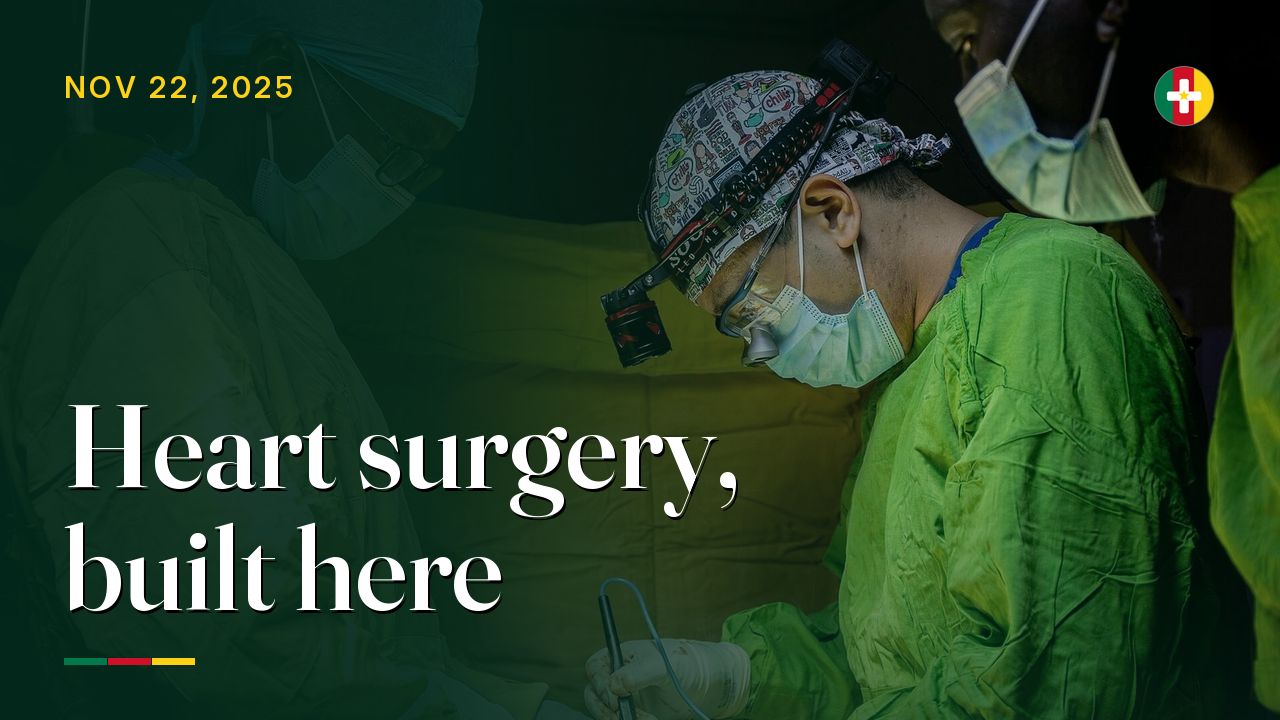
This brief draws on a session of the Cameroon Town Hall for Healthcare Professionals held on November 22, 2025. Prof. Clarence Pingpoh and Dr. Thierry Siemeni of Heartbeat e.V. described two 2025 cardiac surgery missions at Douala General Hospital built around training a fixed local team. Diaspora participants discussed how the Ministry of Public Health, hospitals and the diaspora can make such programmes easier to start and keep going.
Context
Rheumatic heart valve disease is common in Cameroon and specialist cardiac surgery is available at very few centres. Heartbeat e.V., a team of specialists working in Germany, carried out missions at Douala General Hospital in February and September 2025, with a fixed local surgeon, anaesthesiologist and cardiologist. The team took years to gain access to a public hospital. Supplies are carried by hand, equipment maintenance is irregular, and allied professions such as perfusion and biomedical engineering are scarce.
Key issues
- Slow access to public hospitals. Diaspora teams with proven expertise spent years trying to reach a decision maker. A RAD-AID memorandum of understanding in Douala was still unsigned at the time of the session.
- Customs and logistics. Equipment and consumables are carried in many bags because shipping requires plans that often change at short notice. Exoneration depends on knowing the right regional and national channels.
- Missing allied professions. There is no regular training for perfusionists, and too few biomedical engineers and cardiac anaesthesia staff, so equipment fails and surgery depends on visiting teams.
- Incentives for trained staff. Staff who learn new procedures are paid on fixed scales, so the extra work is not rewarded and the skill may not be used or may move to private practice.
- Fragmented diaspora effort. Several diaspora groups run separate programmes. Speakers called for coordination through the town hall, the new Cameroonian association of cardiothoracic surgeons and ACPA.
Discussion highlights
- Prof. Pingpoh: the aim is knowledge transfer to a fixed local team, not coming and going.
- Dr. Siemeni: local anaesthesiologists and perfusionists worked hands-on from the first case.
- Dr. Samuel Ndinjiakat: a Ministry access card, customs facilitation and a Ministry representative are being prepared for approved diaspora teams.
- Sidney Tazeh: be prepared to do the heavy lifting; strict written procedures and daily supervision keep equipment running.
- Elvis Ndansi: a letter from the regional health commissioner can support exoneration of donated containers.
Recommendations
- Finalise a single entry route for diaspora clinical teams. MINSANTE should complete the diaspora commission's access card and facilitation procedure, covering customs exoneration, temporary practice authorisation and a named Ministry focal person. First step: publish the procedure and the documents required, and process the files already submitted.
- Name a partnership focal point in each referral hospital. Directors of general and regional hospitals should designate one person to receive and answer diaspora partnership proposals within a set time, and sign or decline memoranda of understanding promptly. The town hall can share a directory of these contacts.
- Train the allied professions that keep specialist care running. MINSANTE, training schools and university partners should create or expand training for biomedical engineers, perfusionists and cardiac anaesthesia nurses, starting with hospitals that already host cardiac surgery. Diaspora teams can contribute curricula and supervised practice during each visit.
- Make maintenance and incentives part of every partnership. Hospitals and visiting teams should agree in writing on equipment maintenance (a named technician, a maintenance schedule and spare parts) and on how staff who take on new procedures will be rewarded. First step: add these clauses to the Douala General Hospital partnership.
- Coordinate diaspora cardiac programmes. The Cameroonian association of cardiothoracic surgeons, Heartbeat e.V., ACPA and other groups should share patient lists, schedules and stock through one coordination channel, with the town hall as a meeting point, so that efforts are concentrated in centres that have the technical platform.
Next steps
The town hall will follow up the diaspora access card file with the Ministry of Public Health, facilitate introductions for teams seeking hospital partners in Yaoundé and Douala, and explore an ACPA and Heartbeat e.V. joint outreach planned for 2027.
Conclusion
The Heartbeat e.V. experience shows that diaspora specialists can build specialist care in a public hospital when they train a fixed local team. Faster access, simpler logistics, trained allied staff and fair incentives would let such programmes grow beyond a single hospital.
Meeting minutes
Agenda
- Opening remarks on the theme by the moderator, Elvis Ndansi
- Introductory remarks by the Chair, Dr. Munoh Kenne Foma
- Comments from regular participants on the theme
- Presentation by Prof. Clarence Pingpoh on the Heartbeat e.V. cardiac surgery programme at Douala General Hospital
- Remarks by Dr. Samuel Ndinjiakat on Ministry of Public Health support for diaspora missions
- Questions, answers and contributions (Dr. Thierry Siemeni, Pierre Christian Takam, Sidney Tazeh)
- Unite for Health Foundation video on maternal and child health
- Closing remarks
Opening remarks
- Elvis Ndansi opened the session on the theme "Building Sustainable Health Solutions for Cameroon: Capacity, Infrastructure and Innovation." He noted that maternal mortality remains high, preventable disease is still common and rural and conflict-affected communities lack basic care, while non-communicable diseases are rising. He framed the discussion around three needs: training and retaining health workers (including through the diaspora), reliable equipment and supply chains, and locally adapted innovation such as telemedicine and portable diagnostics.
- The Chair, Dr. Foma, asked diaspora professionals to ask what they can do for the country, and to do it in a way that builds local capacity and infrastructure rather than parachuting in. He introduced Heartbeat e.V. as a team whose work in Cameroon he had followed for two years.
- Dr. Samuel Ndinjiakat, Gladys Larissa Happi, Sidney Tazeh and Dr. Obadia Mfuh Kenji briefly welcomed the topic. Sidney Tazeh said: "I refuse to give up on Cameroon."
Presentation
1. Why cardiac surgery, and why now
Prof. Pingpoh cited WHO figures that about 40 million people live with rheumatic heart valve disease and that 80% of those who die of it live in low and middle income countries. With a young population and a shift towards cardiovascular risk profiles, he said valve disease and other cardiac conditions are a growing need in Cameroon and across Central and West Africa.
2. A small team of key experts
Heartbeat e.V. is a group of Cameroonian and other specialists working in Germany who give their own time, money and holidays. The core team is two cardiothoracic surgeons (Prof. Pingpoh and Dr. Thierry Siemeni of Jena), a chief perfusionist from Würzburg (Alexis Kana Kenfack), a cardiologist (Titus Sabi), a cardiac anaesthesiologist and, from the second mission, a medical engineer (Pierre Christian Takam). They limited the team to the experts the local service could not yet supply.
3. Two missions in 2025
The team worked at Douala General Hospital in February 2025 and again at the end of September 2025, and described both as successful. Access came through Prof. Félicité Kamdem, head of cardiology, and the support of the hospital's management. A symposium on the challenges of sustainable cardiac surgery in Cameroon was held during the first mission and in-hospital training during the second.
4. Preparation is most of the work
Each one-week mission needs months of planning. Material is collected from the members' clinics, from the Edwards foundation and from friends in Germany and Switzerland, often at reduced cost, then carried in many bags. The team holds near-weekly Zoom meetings with the Douala team to screen patients, check equipment and complete administrative documents, and arrives the weekend before to review every patient and set the operating plan.
5. Knowledge transfer, not heroics
Prof. Pingpoh said the aim is knowledge transfer to a fixed local team (an anaesthesiologist, a cardiologist and a surgeon), with the local surgeon starting procedures under supervision. Dr. Siemeni added that local anaesthesiologists placed the central and arterial lines from the first case, and that extra perfusionists were brought so local staff could run the heart-lung machine themselves.
6. Biomedical engineering as part of the service
Mr. Takam checked defibrillators, heart-lung machines and other equipment before surgery, which Prof. Pingpoh said is not yet standard in Cameroon. Mr. Takam said the problem was not the equipment itself but the lack of continuous maintenance and follow-up, and noted a problem with the generator.
7. Adapting care to local conditions
Practices from Europe or America cannot be transferred one to one. The team extubates patients in theatre before transfer to intensive care, and is careful to select patients whose long-term outcome can be supported by the care available locally. The team operates on adults only; patients are referred through the hospital's cardiologists.
8. Students, universities and a referral app
The team invites Cameroonian students to accompany them, has published with one student, and is in contact with university deans about partnerships with German universities. To improve patient selection and link patients and diaspora specialists with hospitals, it is developing an app, Abela Connect, and invited town hall members to register.
Discussion and Q&A
- Dr. Samuel Ndinjiakat on what the Ministry of Public Health can do for missions. Drawing on medical missions since 2011, he recommended shipping supplies in advance rather than carrying them, and said the town hall is working with the Ministry on a platform that would give approved diaspora teams an access card, customs facilitation and a Ministry representative on the ground. The documents were with the Minister and the process had paused during the election period. He stressed post-operative recovery and follow-up as the hardest part, from his experience with the separation of conjoined twins.
- Elvis Ndansi on customs exoneration for donations. He said regional health commissioners in the regional councils are influential: a supporting letter from the commissioner of the receiving region, sent to the Ministers of Health and Finance, can secure exoneration for a container of equipment or medicines. He added that the Ministry has discussed an access card with priority entry for diaspora professionals who hold another nationality, pending dual nationality.
- Prof. Pingpoh's reply on shipping and planning. He said the main obstacle to shipping ahead is that plans in Cameroon change at short notice. The team now leaves some stock on site between missions and completes it each time.
- Dr. Erika, a paediatrician in Yaoundé: is the work limited to Douala, and how are patients prioritised between adults and children? Prof. Pingpoh said cardiac surgery needs a suitable technical platform and cannot be offered in every region; the team works where a partner is willing, currently Douala General Hospital, and would work in Yaoundé or elsewhere on the same terms. The team does adult cardiac surgery only. Patients are referred by the hospital's cardiologists and selected for long-term benefit, with some debate in the team about taking on high-risk cases who have no other option.
- A radiology resident at Emory University, Atlanta: how did the team find a gatekeeper, given that a RAD-AID memorandum of understanding in Douala was still unsigned? Dr. Siemeni said it took years of messages, visits and missed appointments before a department head answered; the team then prepared a project plan and he presented it to the hospital board in September 2024. Elvis Ndansi said the town hall has allies at Yaoundé General Hospital, Laquintinie Hospital and Douala General Hospital and can arrange such introductions by phone or Zoom.
- Gladys Larissa Happi: were there problems with power? Mr. Takam (in French) said the challenge was not the equipment but continuous maintenance and follow-up, and that there was a problem with the generator. Dr. Foma, who worked at Douala General Hospital, described it as one of the best managed hospitals in Cameroon and said hospital heads he met recently, including at his alma mater's faculty of medicine, were open to diaspora collaboration once the person is verified. He mentioned a new palliative care unit at the faculty of medicine that is seeking diaspora help.
- A participant (by chat): can diaspora cardiac surgeons coordinate their missions, for example with Prof. Charles Mve Mvondo? Prof. Pingpoh said they are in close contact with him; he is president of the first Cameroonian association of cardiothoracic surgeons, created in 2025, of which the team are members. The team avoids the word mission, because its aim is that the Douala team can operate without them, and it believes concentrating efforts will have more impact than many small programmes.
- Dr. Foma on biomedical engineering and allied training. He said that when he worked in clinical pathology in Cameroon about 90% of laboratory machines were not working, and that MRI machines at major hospitals had stopped working. Cameroon trains doctors but not enough of the engineers, perfusionists and anaesthesia staff who keep them working.
- Sidney Tazeh on sustainability and public institutions. He said his private centre, CLEAR Radiology, moves much faster than work through public institutions, but public hospitals have the greatest reach, so he proposed public-private partnerships. Diaspora groups must do the heavy lifting themselves: he once flew to France for a CT scanner part, and his scanners run at about 98% uptime because he supervises daily, keeps strict written procedures and works with a Ghanaian teleradiology partner. He advised against being too disruptive and adapting to local expectations.
- Elvis Ndansi on incentives for trained staff. He said staff trained in new procedures are paid on fixed public salary scales; unless hospital management rewards the extra work, they will not use the skill or will take it to private practice. Programmes like Heartbeat's should agree incentives with the hospital as part of the training.
Calls to action and closing
- Elvis Ndansi showed a short Unite for Health Foundation video on a community maternal and child health programme in the North West region that links economic activity, schooling and antenatal care.
- Dr. Foma said the Association of Cameroonian Physicians in the Americas (ACPA) hopes to partner with Heartbeat e.V. on an outreach in 2027.
- Prof. Pingpoh thanked the town hall and said the team is willing to work with any hospital that has the technical platform, including Yaoundé General Hospital and Laquintinie. His closing message was that primary care, early prevention and diagnosis, including of rheumatic heart disease, matter as much as high-end surgery. Dr. Siemeni and Mr. Takam thanked the town hall for the connections it offers.
- Elvis Ndansi closed by saying Cameroon does not lack skilled people but connection and coordination, which the town hall exists to provide.
Next meeting
Next month (date not announced in the session).
Submitted by the Co-Moderators, Cameroon Town Hall for Healthcare Professionals.