Access to Novel Targeted Therapy in Cameroon
Overview
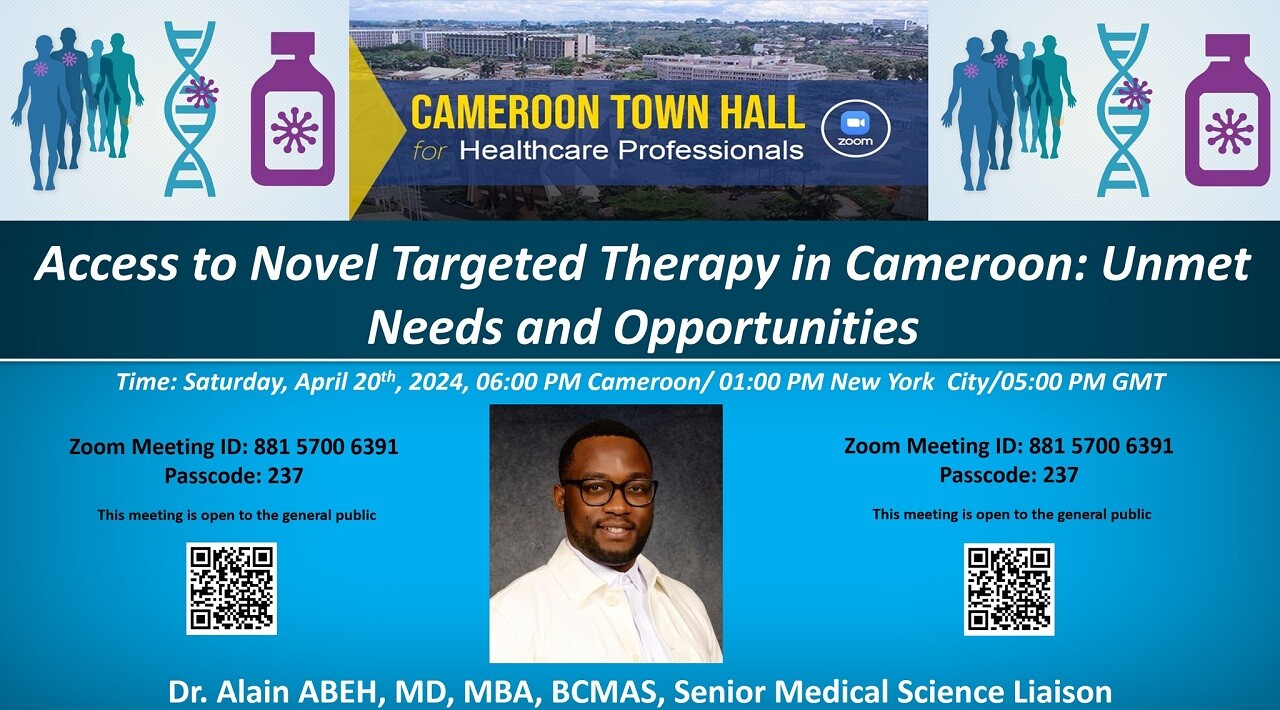
This policy briefing synthesizes key insights from the Cameroon Townhall for Healthcare Professionals meeting held on April 20, 2024 (99th edition), focusing on the theme "Access to Novel Targeted Therapy in Cameroon: Unmet Needs and Opportunities," presented by Dr. Alain Abeh, Senior Medical Science Liaison.
Context
Targeted therapies now form the backbone of treatment in cancer, rheumatology, gastroenterology and dermatology. Cameroon lags behind several African countries in access because of missing diagnostics, an unreliable procurement system, low quality imports, and gaps in training.
Key issues
- No test, no targeted treatment. Basic immunohistochemistry (hormone receptors, HER2) is rarely done, so patients cannot be matched to therapy.
- Procurement and trust. CENAME supplies only a minority of chemotherapy, owes suppliers, and attracts few bidders; prices can rise after 'subsidy'.
- Outdated choices. Older molecules have been ordered even when better ones were offered at the same price.
- Quality and regulation. Marketing authorisations go to low quality manufacturers, while serious companies stay away.
- Training and data. Clinicians are not exposed to modern diagnosis, and there are no disease registries to show need.
Discussion highlights
- Participants compared Cameroon unfavourably with Rwanda, Uganda, South Africa, Côte d'Ivoire and Burkina Faso.
- Payer led models in Nigeria (mPharma with Roche; an insurer with Johnson & Johnson) and a digital revolving fund supply chain were presented as options.
- Patient advocacy and informed patients were seen as drivers of change.
- Private laboratories and the Baptist health services were cited as examples of what works now.
Recommendations
- Build diagnostic capacity first. MINSANTE and reference hospitals (for example in Douala and Yaoundé) should set up immunohistochemistry and basic molecular testing, and make hormone receptor and HER2 testing standard for breast cancer. First step: fund one immunohistochemistry service in a public reference hospital in each of Douala and Yaoundé.
- Restore trust in procurement. MINSANTE and the Ministry of Finance should clear CENAME arrears, publish payment terms, and adopt digital stock management with a revolving fund. First step: review the memorandum of understanding offered by the digital supply chain company and pilot it for cancer medicines.
- Tie market authorisation to quality and diagnostics. The national regulator should apply stricter quality checks before authorisation and, like South Africa, negotiate bulk deals that include diagnostics, training and follow up. First step: a list of priority off-patent biologics and biosimilars (such as rituximab, trastuzumab and injectable methotrexate) for negotiated procurement.
- Update the essential medicines list. MINSANTE should involve specialist societies when choosing molecules, so that newer options offered at equal cost (such as tenofovir alafenamide or pangenotypic hepatitis C regimens) are adopted.
- Create registries and real world evidence. Universities, hospitals and diaspora researchers should start registries for cancer and immune diseases and run phase four observational studies. First step: a registry for inflammatory and rheumatic diseases in one teaching hospital.
- Support patient advocacy. Partners and the town hall should help patient groups organise and engage the Ministry, and clinicians should practise shared decision making and refer patients rather than tell them nothing more can be done.
Next steps
The moderators planned a follow up meeting with the speaker and Dr. Mpollo, and a meeting with the head of the Nigerian supply chain company, to see how the town hall could support these proposals. The next session was the 100th edition.
Conclusion
Participants agreed that Cameroon's gap in targeted therapy starts with diagnosis, procurement and trust rather than with the drugs themselves. Many molecules are already off patent; acting on testing, payment discipline and quality control would open access.
Meeting minutes
Agenda
- Welcome and recap of the previous session on colon cancer screening
- Remarks by Dr. Bryan Tegomoh on next generation sequencing and introduction of the speaker
- Presentation by Dr. Alain Abeh on access to novel targeted therapy in Cameroon
- Comments by the Chair
- Discussion and Q&A
- Closing remarks and adjournment
Opening remarks
- Elvis Ndansi welcomed participants to the 99th session and announced that the 100th would follow. He said about 2,400 people from about 36 countries had attended at least one session.
- Dr. Tegomoh recapped the previous session on colorectal cancer screening, where stool based tests (FIT and FOBT) were discussed because sigmoidoscopy and colonoscopy are scarce in Cameroon, and where the screening age for people of African descent remained 45. Participants proposed a graduate study comparing FIT and FOBT.
- Dr. Tegomoh noted close to 5,000 new mpox cases in the DRC linked to clade I, characterised through next generation sequencing. He said sequencing cost has fallen from about 1,000 bases per US dollar in the early 2000s to about 100 million bases today, and that Africa should use sequencing in clinical medicine and precision therapy, not only in outbreaks.
- Dr. Tegomoh introduced Dr. Alain Abeh, a Cameroonian trained physician and Medical Science Liaison who began with Mylan, worked on access to sofosbuvir based hepatitis C treatment in Africa, and now works with Nordic Pharma on immunology and rheumatology products.
Presentation
1. What targeted therapies are
Dr. Abeh, who declared no financial interests and said he used no AI to prepare his slides, described targeted therapies as drugs that act on the biochemical pathways of mutant proteins. Since trastuzumab was approved in the late 1990s, small molecules and monoclonal antibodies have become the backbone of precision medicine, first in cancer and now across specialties, with fewer side effects than older chemotherapy. He outlined checkpoint inhibitors, CAR-T and other T cell therapies, and monoclonal antibodies, and stressed that each requires a test for its target protein to know which patients qualify.
2. Global trends
He said almost 90% of start-ups in the US and Europe invest in targeted therapy and North America holds more than half the market, while Europe, Africa and parts of South America are still growing markets that often wait 15 to 20 years for patents to expire. Cancer in sub-Saharan Africa is projected to double by 2050. East African countries such as Rwanda and Uganda have national policies and registries, and South Africa and North African countries negotiate bulk deals tied to diagnostic infrastructure.
3. Use across specialties in Cameroon
In oncology, he cited trastuzumab for HER2 positive breast cancer, bevacizumab in cervical cancer, and rituximab in B cell lymphomas; despite biosimilars, 500 mg of rituximab still costs about 500,000 to 600,000 and bortezomib about 300,000, and therapies for chronic lymphocytic leukaemia are unavailable. In rheumatology, TNF and JAK inhibitors barely reach the market, methotrexate faces stock outs and is prioritised for oncology though doses for arthritis are about 50 times lower, and lupus (about 1.5% in young black women, as stated) is treated mainly with steroids. He also cited inflammatory bowel disease, which is under-reported and confused with infection, GI cancers, and dermatology, where steroids remain the only option.
4. Old molecules ordered despite better options
He gave two examples from his work. For hepatitis B, the government kept ordering tenofovir disoproxil fumarate 300 mg even when companies offered the more effective tenofovir alafenamide 25 mg at the same cost. In a hepatitis C pilot in Burkina Faso, Cameroon, Côte d'Ivoire and Tanzania, test kits were supplied for mass screening, but Cameroon ordered an older regimen requiring genotyping rather than the pangenotypic sofosbuvir combinations that would have saved patients money; Cameroon was the only country where the project failed.
5. A fragmented supply
He cited a 2023 inventory of chemotherapy in Cameroon in which about 43% came directly from pharmaceutical companies, about 20% from the national procurement agency (CENAME) and about 14% through private pharmacies or relatives abroad, with no central body taking the lead.
6. Unmet needs
He listed training (doctors trained where these diseases are not tested for, so they believe they do not see them, and rheumatologists from East Africa and Nigeria whom he met at the American College of Rheumatology meeting practising as of 30 years ago); diagnosis (clinical biologists not taught recent techniques); patient perception (telling a patient 'we have done everything' pushes them towards witchcraft explanations); and policy (national committees that focus on supplying drugs while neglecting testing and follow up). He said it is unethical to screen patients without offering a next step.
7. Doing more with less
He proposed prevention (HPV and hepatitis B vaccines, early diagnosis), disease registries to show need to policy makers and investors, and greater use of off-patent drugs and biosimilars, such as injectable methotrexate, which in Canada is still first line for rheumatoid arthritis at 20 to 25 mg by prefilled syringe. He warned that marketing authorisations are granted to low quality manufacturers who use Africa as a dumping ground, and that serious companies stay away when diagnostic infrastructure is missing.
8. Opportunities
He called for patient advocacy groups to press for access, shared decision making (patients who understand why are about ten times more inclined to take a test), stronger quality control before marketing authorisation, and young scientists generating real world evidence through phase four observational studies, since randomised trials are hard to run in Cameroon.
Discussion and Q&A
- Chair (Dr. Munoh Kenne Foma): why do the basics still fail? He said oestrogen and progesterone receptor testing has been known since the late 1970s and HER2 since the 1980s, yet most breast cancer patients in Cameroon are treated without knowing their hormone status, and fewer than 10% were tested according to published papers. Without immunohistochemistry there can be no targeted therapy, and lung adenocarcinoma alone has more than 20 approved targets. He said there is no system of continuing assessment for teachers, pathologists or students, that CENAME is a problem, and that CHAI is working to bring oncology drugs to Cameroon.
- Dr. Tegomoh: what role does CENAME play? Dr. Abeh said CENAME has one of the largest cold chains in the country but has lost the trust of suppliers over unpaid debts. He said his former company was for a long time the only HIV drug supplier and was owed millions of dollars, and that trastuzumab supplied in 2019 to 2020 sold out within a month to patients paying cash, but the supplier waited about four years for payment and stopped supplying. He added that the Cameroon Baptist Convention holds more cancer drug inventory than CENAME, and that patient groups should organise to press for change.
- Franklin Maloba: is there a platform to study how these drugs work in Cameroon's diverse population, and what is truly new? Dr. Abeh said progress is driven by private laboratories that send immunohistochemistry samples abroad, taking one to two weeks, and that local immunohistochemistry would pay for itself across specialties. The Chair said African participation in clinical trials and phase four surveillance is the way to capture genetic variation, and asked why large hospitals such as Laquintinie and the General Hospital in Douala do not run their own immunohistochemistry instead of sending samples to Centre Pasteur or abroad. He praised Mbingo and the Baptist mission as a success story and recalled the Uganda HIV marches that shocked the world into subsidising treatment.
- A participant (by chat): why is there no investment in biosimilar production in Cameroon? Dr. Abeh said the issue now is availability, not where drugs are made; companies build plants where demand and cost justify it, and policy barriers and the lack of trained staff deter investors.
- Dr. Marthe-Sandrine Mpollo: are there African models Cameroon can copy? She described a HER2 breast cancer access programme at a hospital in Abuja in which mPharma (a Ghanaian company) arranged payment plans and sourced the drug directly from Roche, and a Johnson & Johnson partnership with an insurer and a main hospital that brought a biologic for rheumatology patients to Nigeria in 2023. In both, the payer rather than the government made the deal work. Dr. Abeh said trastuzumab supplied at a notional 100 dollars was resold under a 'subsidised' price of 125 dollars, and that a failed hepatitis project in Cameroon lost about 300,000 dollars of drugs to expiry.
- Elvis Ndansi: beyond finance, why do some companies say Africa is not their market? He described a Nigerian digital supply chain company that manages cancer drugs for some states through a revolving fund and has sent a memorandum of understanding to MINSANTE, and said CENAME tenders now attract no bidders. Dr. Abeh said the economic model is the main reason: companies answer to shareholders and need returns within a few years. Dr. Mpollo added reputational and epidemiological risk, as drugs are not tested in African populations.
- Dr. Samuel Ndinjiakat: what would make access sustainable? He said improving the supply chain and connecting willing private investors with the government, through the town hall and the ministerial working group, would solve much of the problem. He noted about 200 sickle cell patients in his area who need medication they cannot obtain.
- A pharmacovigilance officer in the Netherlands: can private companies help? He suggested that Cameroonian private importers who know the market could buy from international companies and manage local procedures, and said he was interested in investing.
- Franklin Maloba: what should a cancer patient in Cameroon do now? The Chair said patients should be empowered: learn their diagnosis and subtype, seek support groups and the best hospitals, and ask doctors whether immunohistochemistry or staging scans were done. He said informed patients get better care whatever their means, and that one patient starting a movement could change how CENAME and the Ministry act.
Calls to action and closing
- The Chair listed priorities: invest in infrastructure, education and training, research and development, regulation, public private partnership, access to diagnosis, affordability, health insurance, advocacy and international collaboration.
- Dr. Samuel Ndinjiakat urged practitioners to refer and seek colleagues' help rather than tell patients nothing more can be done.
- Dr. Mpollo said lessons from countries such as Burkina Faso give hope.
- A working group member said Cameroon's policies already exist on paper and the challenge is executing them.
- Dr. Abeh said he was meeting his company's business development team about products in rheumatology, dermatology and ophthalmology for West African countries including Cameroon.
- Elvis Ndansi offered a follow up meeting with Dr. Abeh and Dr. Mpollo on how the town hall could take their ideas to decision makers.
Next meeting
In two weeks: the 100th session (May 4, 2024 per the town hall's records).
Submitted by the Co-Moderators, Cameroon Town Hall for Healthcare Professionals.